








The Green Lantern Problem: How South Dakota is Building Biomanufacturing Capability Inside Its People
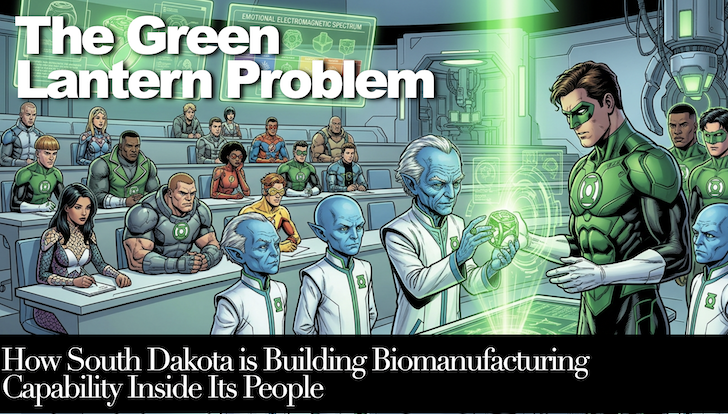
The Green Lantern is fundamentally different from those other superheroes.
Superman’s power is locked in his alien biology; Tony Stark’s genius is welded into his iron suit. Their powers, talents, and machinery belong essentially to them. But Green Lantern is not a person—it is a platform. There was a Green Lantern before Hal Jordan, and there will be Green Lanterns long after him. The Corps does not merely require heroes; it requires a repeatable, industrial mechanism to forge them.
A ring can be handed over in a matter of seconds, but capability cannot. Someone still has to teach the recruit what the ring can do, where its limits lie, how to operate under pressure, when to follow procedure, and when judgment must take over. The technology transfers instantly. The skill does not. Having the universe’s most powerful device is entirely useless if you lack a trained Corps capable of wielding it under real-world pressure.
Industrial biotechnology already knows how brutal technology transfer can be. Moving a process from the laboratory to the pilot plant and then to commercial scale has consumed entire fortunes and broken countless promising companies. Yet there is a transfer problem harder still: How do you move operating capability from one human being into another, and then do it again, and again, reliably across generations?
Even Green Lantern does not receive the ring and immediately get sent out to save Sector 2814. New recruits go to Oa, headquarters of the Green Lantern Corps, where veteran trainers such as Kilowog put them through the intergalactic equivalent of industrial operator qualification. Kilowog is not there to explain that the ring is green or point out where the on-off switch ought to be. He is there to teach judgment under pressure, drill response until it becomes instinct, and discover—in a relatively controlled environment—which recruits are about to do something catastrophically stupid. In other words, even the Guardians of the Universe concluded that issuing advanced technology without structured training was a poor deployment strategy.
Turning from the structural problems potentially facing the Justice League of America, a real-world prototype has been constructed on the ground in Brookings, South Dakota. There, at Dakota BioWorx’s pilot-scale facility, a hands-on, 10-week work-based pilot course is testing a new model for human capability transfer—anchoring the high-flying Green Lantern concept in the grit, steel, and process fluid of a working plant.
For centuries, industry relied on the quiet, proximity-based architecture of traditional apprenticeship. Put the newcomer beside the veteran. Watch. Try. Get corrected. Learn which gauge matters, which sound portends trouble, which valve sticks, and what the written procedure somehow forgot to mention. Sometimes your mentor was Yoda; sometimes the training program amounted to little more than a gruff, “Don’t touch that valve, kid.” That informal arrangement may suffice when an industry needs a single operator. It becomes a dangerous bottleneck when a nascent sector needs thousands.
The 3 Types of Transfer
There are really three different transfer problems hiding inside industrial deployment.
**Technology transfer** asks whether the process itself can move—from laboratory to pilot plant to commercial scale.
**Knowledge transfer** asks whether what has been learned about that process can move with it: the specifications, assumptions, operating windows, failure modes, and lessons accumulated along the way.
But **capability transfer** asks something harder still: can another person actually do what the experienced operator can do, independently, under real operating conditions? Knowing what the master knows is not the same as being able to do what the master does when the pressure starts drifting at two in the morning.
The Corps Problem
The American bioeconomy has become remarkably adept at fashioning rings. We invest heavily in biotechnology innovation—in novel organisms, metabolic pathways, process engineering, and high-tech steel refineries. As BioMADE CEO Douglas Friedman has repeatedly emphasized, sustained investment in biotechnology innovation and commercialization is essential if the United States is to remain competitive in the emerging global bioindustrial economy. Federal partners, including the U.S. Department of Defense and the National Science Foundation, have increasingly focused on domestic supply chains, national security, and the physical infrastructure required to move biotechnology into true commercial manufacturing.
Yet commercial deployment requires something that cannot be installed by an EPC contractor or delivered on a flatbed truck: people have to know how to run the plant.
That is why the experiment taking shape at Dakota BioWorx in Brookings deserves attention far beyond the upper Midwest. Dakota BioWorx and South Dakota Biotech have joined forces under a BioMADE education and workforce grant to develop a next-generation biomanufacturing talent pipeline. The coalition is one of six BioMADE-funded workforce teams nationwide — and the only one outside the coastal innovation hubs.
That geography is far from incidental. While much of American biotechnology innovation emerges from coastal research centers, commercial-scale biomanufacturing demands agricultural feedstocks, heavy industrial infrastructure, operating talent, and room to build. South Dakota and the broader Midwest bring direct access to corn, soybeans, sugar beets, and abundant biomass, alongside generations of deep expertise in food processing, industrial fermentation, and biofuels.
Dr. Kara McCormick, director of science and operations for South Dakota Biotech and co-principal investigator on the grant, sees that agricultural base as a natural platform for high-value bioproduct development—creating new markets for regional crops while building resilient industrial employment. If biotechnology’s deployment era is going to spread across agricultural America, however, another resource must scale right alongside the physical steel: human capability.
Putting the Solution Inside Someone Else’s Head
Usually, when industry encounters an operational bottleneck, we engineer a solution. But when the problem itself is a shortage of capable people, finding the solution is only the preliminary step. The real challenge is putting that solution inside somebody else’s head.
That is vastly harder than it sounds. A process has specifications, a fermenter has blueprints, software can be duplicated, and standard operating procedures can be emailed across the globe. But an experienced plant operator contains thousands of subtle, unwritten judgments: what a normal process profile looks like, how rapidly a temperature gradient should move, which minor deviation signals disaster, what can safely wait, when to intervene, and when intervention will only make things worse. Some of that knowledge is explicit; much of it is deeply tacit.
The traditional apprenticeship system was civilization’s original answer to this challenge, moving knowledge through sheer physical proximity as instruction, imitation, correction, and repetition gradually produced another capable hand. At its best, apprenticeship is magnificent. Its fatal weakness, however, is its lack of standardized repeatability. The quality of the final result depends entirely upon the talent of the master, the random problems the apprentice happens to encounter, and whether the habits being transmitted are genuine best practices or merely old, unquestioned habits.
That is a fragile architecture for an industry attempting rapid, nationwide deployment. The answer is not to abolish apprenticeship, but to industrialize the foundation beneath it—standardizing the baseline so the master is reserved exclusively for the nuances that only a master can teach.
Big Toys in a Big Sandbox
That structural shift is what makes the 10-week Brookings pilot so compelling. Participants work directly with process controls, scale-up operations, and safety protocols that mirror the exact operating environments they will encounter in commercial biomanufacturing.
Dr. Neal Connors, chief scientific officer for Dakota BioWorx and principal investigator for the program, captures the distinction perfectly: traditional biotechnology education spends considerable time at the laboratory benchtop, but industrial manufacturing requires something entirely different. “You’ve got to play with the big toys in the big sandbox.”
A commercial biorefinery is an extraordinarily expensive classroom. An operator should never encounter an abnormal process condition for the first time while responsible for millions of dollars of commercial product. Commercial aviation learned this decades ago; pilots train in flight simulators, practice emergency procedures, and master abnormal conditions before an aircraft full of passengers becomes the classroom.
The same philosophy applies here. The objective is not merely to train button-pushers and valve-turners, but to give operators a deep, intuitive comprehension of what is happening inside the reaction vessel so their actions carry context: Why this valve? Why this sequence? Why is this pressure reading drifting, and what happens three steps downstream if I adjust it now? That comprehension marks the precise boundary between passive procedural compliance and true operating capability.
From Training Program to Replication System
The Brookings curriculum is not being developed in an academic silo. Organizers are leveraging deep regional academic partnerships—collaborating with South Dakota State University (SDSU) to incorporate established bioprocessing certifications and specialized biotechnology coursework. The pilot cohort also integrates specialists from national networks like InnovATEBIO and NIIMBL to address regulatory compliance, quality control, and workplace safety.
Furthermore, because South Dakota does not possess an unlimited labor pool, the model widens the recruitment aperture. Participants include early-career students, mid-career workers seeking to upskill, and individuals without advanced scientific degrees, alongside targeted outreach to rural communities and military personnel transitioning to civilian life. The superhero model searches in vain for another rare, fully formed Superman; the Green Lantern model builds an engine that constructs the Corps.
Consequently, the 10-week Brookings pilot is best understood as a prototype for a broader replication system. The next step is formalizing the coursework into a pre-apprenticeship program that transitions directly into a fully registered state apprenticeship program via Start Today SD, an initiative under the South Dakota Department of Labor and Regulation.
Notice how the architecture shifts: apprenticeship hasn’t been discarded, but moved downstream. Instead of asking a veteran operator to design an entire educational curriculum from scratch on the shop floor, standardized preparation establishes the baseline knowledge first. Apprenticeship can then do what it does best: transfer judgment, nuance, and real-world operational wisdom.
Future iterations will incorporate an online lecture component so foundational concepts can travel digitally while participants come to pilot facilities for the hands-on mastery that cannot be digitized. Coupled with a comprehensive regional workforce analysis—including an industry “voice of the customer” survey and a five-state job-impact study looking several years ahead—the coalition keeps its feedback loop tied tightly to industry demand. A training platform that fails to continuously ask industry what capabilities it requires eventually becomes just another classroom teaching yesterday’s requirements.
The Transfer Problem After the Transfer Problem
Industrial biotechnology has spent decades obsessing over technology transfer, and rightly so. Can the organism that performed in a shake flask perform in a pilot reactor? Can the process survive commercial-scale fluid dynamics? Can yields hold up? Can downstream processing keep pace with the fermenter?
These questions defined the scale-up era. But suppose the answer to every one of those engineering questions is yes. There still remains the ultimate transfer problem: Can the operating knowledge move from the minds of the engineers who designed the process to the operators who must run it on the night shift? Can it transfer without losing the unwritten details nobody remembered to log? Can it move predictably from plant to plant, and from the first generation of operators to the second?
That is the Green Lantern problem. The bioeconomy has spent billions crafting exquisite rings—engineered organisms, metabolic pathways, catalysts, control systems, and steel refineries. But the deployment era demands something less flashy and far more essential: a repeatable, scalable system for forging the Corps that knows how to use them.
What is unfolding in Brookings is more than a regional workforce grant; it is a live experiment in whether an industry can institutionalize its own competence. If it succeeds, the model taking shape on the South Dakota prairie may well become the template for how agricultural America claims its place at the center of the bioindustrial age. The technology may always emerge from the lab, but the future of biomanufacturing will ultimately belong to the places that figure out how to build the Corps.
Category: Top Stories

