









The Corner Belongs to Choice. Is Choice Around the Corner?
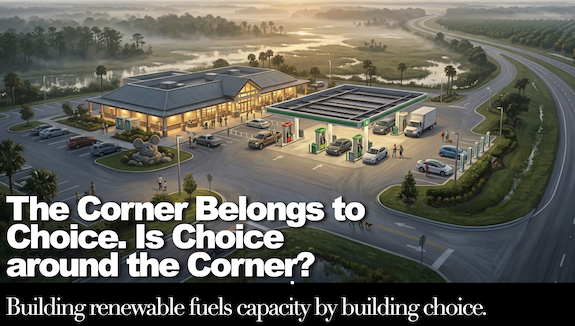
Fort Drum Service Plaza sits an hour southeast of Disney World along the Florida Turnpike, marked by a statue of Mickey Mouse that has signaled to a generation of children that the Magic Kingdom is near. At seven-fifteen in the morning, it plays host to what must surely be the longest line for Dunkin’ coffee on earth, as weary parents search for sustenance before tackling the final stretch of the family journey.
Fort Drum is a complex of human activity, and it is complex in its nature: inside, families stream toward the restrooms, someone hungers for a doughnut, drivers grab twenty minutes of sleep, and others sift through brochures promising the highlights and lowlights of Orlando, while outside on the asphalt, a dog takes its morning walk and the family car demands energy.
Here the plaza becomes truly instructive, for the motorist outside may choose gasoline, or diesel, or E85, or draw electrons into an electric vehicle, reflecting the simple reality that just as no family inside is compelled to eat identical meals, no vehicle outside is forced to consume identical energy. Nobody finds this array of choices remarkable, which is perhaps the most remarkable aspect of the entire scene. In a world increasingly reluctant to embrace the alternative, Fort Drum stands as a quiet monument to differing human needs and to way markets emerge even the blackwater hardwood swamps, floodplain marshes, pine flatwoods, palm hammocks and orange groves of the Kissimmee River Valley The wonder of Fort Drum is not merely that all these choices exist; it is that they coexist within the very same footprint of earth.
The Value of Here
Anyone can open a hamburger stand in the next county, erect a service station in an adjoining town, or build a coffee shop along a parallel highway, but one cannot simply duplicate Fort Drum wherever it suits the imagination. The Turnpike created the traffic, and the traffic generated the value of stopping at this precise coordinate, transforming access to the traveler into a scarce and precious commodity. Were Burger King to offer the State of Florida a vast sum for exclusive control of Fort Drum—banishing all competing coffee shops, restaurants and retail options in favor of forty thousand square feet dedicated solely to Whoppers and fries—the corporation might rationally value the location more highly than any individual concessionaire operating there today.
Yet nearly every traveler would instantly grasp that something fundamental had been destroyed. The plaza would still dispense food, but it would cease to operate as a true marketplace. That illustrates the profound difference between competition for a location and competition at a location: the former settles who pays the highest rent in a single transaction, whereas the latter allows diverse businesses to discover every day what travelers actually desire. The first competition happens once; the second happens every day.
Gasoline Is Welcome
The Florida Turnpike wages no campaign against petroleum. Gasoline is extraordinarily convenient for every passing motorist, yet petroleum does not receive exclusive rights over the highway interface. Diesel is present, E85 is available, and electric chargers stand ready, though nobody is required to purchase any of them.
This distinction is vital because conventional energy-transition policy has overwhelmingly focused on production and consumption through mandates that specify volumes, tax credits that favor particular technologies, and subsidies that attempt to offset the economic disadvantages of whatever technology society currently favors, leaving everyone to quarrel endlessly over definitions. The Turnpike adopts a far simpler philosophy by presenting choices at the exact place and moment where the consumer’s decision is made. An alternative fuel twenty miles off the highway is not economically equivalent to one standing beside the gasoline pump, nor is a distant charger equivalent to one located where the family has already paused for Mickey, coffee and restrooms. The alternative may exist in abundance, but distance can convert abundance into scarcity.
Sixteenth-Century Pepper
This dynamic explains why alternative energy so frequently resembles what might be termed sixteenth-century pepper. Pepper was certainly available in Renaissance Europe, but it required vast and precarious networks of merchants, ships, intermediaries and immense physical distances to arrive, remaining exotic precisely because its underlying complexity remained perpetually visible to the buyer. Modern pepper, by contrast, sits quietly beside the salt.
Petroleum has achieved much the same transformation. Consider the labyrinthine machinery required to deliver ten gallons of gasoline to a motorist at Fort Drum—a chain encompassing exploration, deepwater drilling, gathering systems, pipelines, supertankers, refineries, commodity exchanges, maritime insurance, regional terminals, tank trucks, strategic reserves, international sea lanes and occasionally the United States Navy. There is almost nothing simple about gasoline, yet the motorist experiences only the seamless gesture of inserting a card, lifting the nozzle and squeezing the handle as that complexity disappears into infrastructure. Alternatives suffer from the inverse condition, arriving like St. Bernards carrying small wooden casks across an Alpine pass through dedicated apps, specialized contracts, peculiar regulations and isolated destinations, leaving the incumbent to reign at the public fountain while the alternative arrives in the pack of Marco Polo. The energy transition may suffer less from a supply problem than from a profound failure of convenience.
The $7 Gasoline Test
Disruption in the American energy market rarely arrives as an absolute absence of supply; gasoline seldom vanishes entirely, but becomes suddenly and acutely expensive. Should conflict in the Strait of Hormuz drive gasoline to seven dollars a gallon, price performs its proper market function by signaling scarcity, prompting drivers to consolidate trips, join carpools, work from home, or evaluate alternative modes of transport.
Yet price can induce real substitution only when accessible alternatives are present to receive the shifting demand. If the alternative lies twenty miles down a back road, the consumer experiences price mainly as financial pain. If the alternative stands directly beside the pump, price transforms into actionable information as the price board announces that world conditions have shifted and the marketplace offers the available choices. Without depth, price transmits pain; with depth, price transmits choice, achieving resilience without rationing.
Monopolizing the Interface
Physical proximity alone, however, does not guarantee a functioning market. When E85 sells in Florida at a twenty-nine percent discount to standard E10 fuel while wholesale ethanol trades at a thirty-four percent discount to unblended gasoline, the motorist observes a retail price that reasonably reflects the underlying commodity advantage. That healthy transmission does not always occur. A gasoline pump and an E85 pump standing six feet apart may look like diversity, but if one commercial entity controls the pricing of both, the consumer may still be facing a single decision-maker.
Call this monopolizing the interface. When an incumbent controls both the dominant product and its purported substitute on the same forecourt, the alternative can become a corporate price hedge rather than a true competitor, with some of its cost advantage absorbed as margin rather than transmitted as competitive pressure. True market depth therefore demands more than an extra nozzle: there is product depth through the existence of the alternative, access depth when the alternative is conveniently near, and market depth when independent commercial pathways are capable of transmitting relative price advantages. If petroleum prices spike while ethanol remains stable, an independent E85 operator possesses every incentive to capture market share by passing enough savings to the consumer to increase volume, whereas a unified operator can absorb that advantage. A real marketplace requires room for distinct decisions, not merely different labels on adjacent pumps.
My Great-Grandfather Bought Corners
My perspective on this spatial problem stems in part from family history, for my great-grandfather bought corner locations for Standard Oil of California during the dawn of the automotive age. The early oil companies recognized that the scarce asset was not merely the petroleum buried beneath the earth; it was the corner. Purchasing a key intersection in 1940 set in motion an eighty-year compounding of value as roads widened, suburbs expanded, traffic multiplied, utilities arrived and surrounding acreage developed, transforming a modest piece of dirt into an indispensable gateway to the motoring public.
Those early investments represented brilliant foresight and earned their commercial rewards, but they created an enduring structural obstacle for energy technologies that arrived later, because the competitive outcome at the location could be effectively settled decades before ethanol, electric vehicles, advanced batteries or hydrogen fuel cells even existed. Tomorrow’s alternative energy does not merely compete against the economics of gasoline; it competes against an inherited geography of convenience secured generations ago and exceedingly difficult to reproduce.
Location Has Capacity
This requires us to reexamine our understanding of real estate, moving beyond the familiar adage that location dictates price to recognize that location also has capacity. A single urban parcel might host a single-family home or an apartment building housing fifty families; a prime commercial corner might host a single retailer or a marketplace containing twenty; a strategic energy location might serve one pathway or several. That does not mean maximum density is always the right answer, but it means exclusivity at an exceptional location carries an opportunity cost.
The vital question is not merely what a corner is worth to its private owner, but how much locational capacity disappears when one use takes all of it. Much of the value of a prime corner originates beyond its property line: the road creates the traffic, the interchange concentrates it, and the corner captures it. Private foresight creates value too, and deserves its reward, but the extraordinary convenience of the corner remains the product of a larger system.
The Commons
There is an old name for an exceptionally valuable spatial asset whose usefulness depends upon preventing any single user from taking all of it: a commons. A true commons was never an unregulated free-for-all where every villager could graze unlimited cattle until the pasture degenerated into mud and manure, nor was it a space one wealthy farmer could take for his exclusive use,. And a distant pasture twenty miles away offered little practical benefit to the villager whose cow needed feed today.
A functioning commons depends upon governed access. Modern radio spectrum operates on much the same principle, structuring frequencies so that multiple broadcasters can operate without destroying the usefulness of the medium, just as airport gates organize access to scarce terminal infrastructure. The underlying principle is not that every user receives equal space, but that one legitimate use should not unnecessarily extinguish other legitimate uses of a scarce access point. The land at our strategic corner can remain private, the businesses can remain private, and the transactions can remain private; what public policy has an interest in preserving is not ownership of the corner, but the possibility of competition at the corner.
Dasani Doesn’t Get the Tap
We accept this principle without hesitation in the market for drinking water. Dasani is free to advertise, discount, innovate and persuade millions of consumers to buy its bottled water, yet no reasonable observer would argue that Dasani’s commercial success entitles it to exclusive possession of the kitchen tap. We naturally distinguish between the commodity itself and the interface through which commodities reach the public.
Petroleum may win eighty or ninety percent of the consumers at a given intersection through market preference, and that is entirely fine. But commercial dominance in the commodity should not automatically confer exclusive control over the convenient interface through which the remaining ten percent can reach an alternative. Dasani is welcome; it just doesn’t get the tap.
The Remedy: Energy Marketplace Zoning
The appropriate policy remedy is far simpler than trying to pick winning technologies or enact elaborate market mandates, requiring neither the prohibition of single-fuel stations nor forced retrofits of existing private properties. Instead, municipalities and highway authorities could use ordinary land-use authority across a narrowly defined class of exceptional transportation nodes—major highway interchanges, strategic intersections and public service plazas—designating them as Energy Marketplaces rather than exclusive single-path outlets.
The regulatory object is not the molecule; it is the privilege of exclusivity at an unusually valuable location. A gasoline-only station, a charging-only facility, or a hydrogen-only site remain entirely lawful down the road. At the exceptional corner, the objective is to preserve the possibility of multiple energy propositions and, wherever practical, commercially independent providers. Plurality gets proximity; exclusivity gets distance. The consumer remains free to buy whatever he wishes and the supplier remains free to compete as vigorously as it wishes, but no one automatically receives the right to convert an unusually valuable access point into a permanently exclusive interface.
The Farmers’ Market
The logic is already universally understood through the farmers’ market. A farmer who sells seventy percent of the produce on Saturday morning earns his profit without acquiring the right to lease the entire town square and banish his competitors to the outskirts; the square is preserved as a place where the market can happen. Likewise, a shopping center may have a dominant anchor tenant without surrendering the entire property to that tenant.
The purpose of the architecture is not to guarantee equal outcomes, but to preserve the place in which competition occurs. Applied to energy, a common site providing shared parking, restrooms, food and retail amenities could host independent, commercially unbundled energy providers that evolve alongside changing technology. The gasoline refiner need not become an electric charging company, nor the charging company a refiner; nobody requires Marriott to put Hilton rooms inside the Marriott when you can put the Hilton next door. The important thing is that the customer can conveniently reach both.
The Turnpike Already Knows This
This approach is far from theoretical. The Florida Turnpike already manages its service plazas as enduring platforms for commerce rather than merely turning each one over to whichever single merchant might value exclusive control most highly. Restaurants change, coffee vendors change, retail offerings change, and energy technologies change, yet the architecture of plurality remains.
The state does not need to predict whether Dunkin’ will defeat Starbucks, preserving instead the place where the traveler can buy coffee; nor does it need to predict whether E85, electricity or some technology yet to emerge will defeat gasoline. Under deep technological uncertainty, preserving the marketplace and letting the market find out is a remarkably durable form of policy. Don’t predict what will occupy every stall in 2050—preserve the stalls.
The Green
There remains one problem: regulations can be fragile too. Governments change, priorities change, and people grow tired of being told that a restriction imposed decades earlier remains necessary because experts say some future crisis might justify it. Walls require constant defense, but space can acquire defenders of its own.
This became strikingly clear several thousand miles from Fort Drum, on Lytham Green along England’s Lancashire coast, a sweeping expanse between the town and the Ribble estuary whose history is bound up with keeping development back from the water and giving the coast room. But that is not how most people experience the Green today. They walk dogs, children play, visitors admire the estuary, families gather, and once a year enormous crowds arrive for the Lytham Festival. Over breakfast, a local friend mentioned the festival, and when someone asked who had played this summer, the names came immediately: Alanis Morissette, Michael Bublé.
Ask about flood resilience and you might begin a historical discussion, but ask about the festival and people know exactly what happens on the Green. Something important has occurred: the Green has acquired constituencies having almost nothing to do with the reason space beside the water needed preserving in the first place. People defend the Green because they like the Green. The strongest resilience infrastructure acquires defenders who have forgotten the problem addressed in construction. That is not forgetting the infrastructure. That is the infrastructure succeeding.
From Flood Control to Festivals
This may be the ultimate benchmark for durable energy infrastructure: can an energy marketplace become so useful that its preservation no longer depends upon energy-transition rhetoric? A well-designed plaza may begin by providing energy depth, but people arrive with other needs—coffee, dining, restrooms, parcel pickup, car washes, vehicle servicing, shopping, and places to sit, along with services nobody drafting the original ordinance imagined.
Traffic becomes the feedstock for a commercial ecosystem. Eventually the original policy debate fades into the background, and people defend the place not because of modeled oil-supply risks but because the plaza has become an ordinary and useful part of life. Nobody says, “Please preserve the Energy Marketplace Zoning Ordinance because of our modeled exposure to petroleum supply disruptions”; they say, “Why would you get rid of the plaza? Everybody stops there.” The infrastructure has escaped its justification; it has become modern pepper.
Mickey Remains
Back at Fort Drum, no motorist needs to ponder spatial economics, regulatory philosophy or land-use theory, and that seamless invisibility is precisely why the plaza succeeds. The family seeks breakfast, the child looks for Mickey, the dog requires grass, and the weary driver needs a restroom while outside, the vehicle takes whatever energy it requires.
Coffee vendors will change, charging hardware will change, and fuels will change, as some alternatives disappear and others we have not yet imagined arrive. Mickey, for all we know, may someday move. But the vendors are temporary, whereas the marketplace is the durable asset. That may be a wiser ambition for the energy transition than endlessly attempting to crown a technological victor: don’t pick tomorrow’s winner, but don’t grant yesterday’s winner permanent possession of the strategic corner either. Preserve the open stage where tomorrow’s choices can arrive.
The corner does not belong to petroleum, nor to ethanol, hydrogen or electricity. The corner belongs to choice.
Category: Top Stories

