








Jefferson’s Farmer, Adams’s Market: How the USDA Learned to Reward Stewardship (Part 2 of “Action by the US Government”)
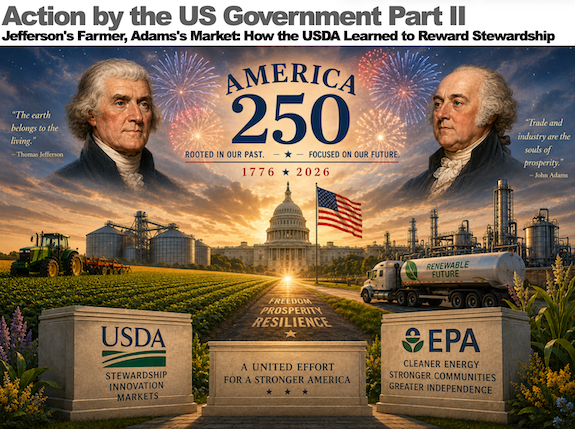
When Thomas Jefferson imagined the future of the American republic, he pictured millions of independent farmers making their own decisions on their own land. Freedom, in Jefferson’s view, depended on dispersing power as widely as possible. Citizens who controlled their own farms could not easily be controlled by anyone else.
John Adams, by contrast, understood something equally important: independence alone does not produce prosperity. Nations become wealthy and durable when they build institutions capable of organizing the efforts of millions of independent people toward common purposes.
For most of American history, these two ideas existed in uneasy tension. How do you persuade free people to act collectively without diminishing their freedom? How do you preserve independence while creating prosperity? And perhaps most importantly for agriculture, how do you encourage stewardship without replacing the judgment of farmers with the judgment of bureaucrats? As the United States approaches its 250th anniversary, the United States Department of Agriculture appears to have arrived at a distinctly American answer.
The USDA’s recent evolution from the Regenerative Pilot Program of 2025 to the finalized Regenerative Feedstock Rule of 2026 represents more than a change in agricultural policy. It represents a profound shift in how the federal government understands its role in building agricultural resilience, environmental stewardship, and economic competitiveness. The old model relied primarily on subsidies and regulation. The emerging model relies on markets.
The story begins in December 2025, when the USDA launched its $700 million Regenerative Pilot Program as part of the broader Make America Healthy Again initiative. Announced by Secretary of Agriculture Brooke Rollins alongside Health and Human Services Secretary Robert F. Kennedy Jr. and CMS Administrator Dr. Mehmet Oz, the program rested on a simple but increasingly compelling premise: the health of a nation ultimately depends on the health of its soil.
The challenge was not a lack of farmer interest. American producers had spent decades experimenting with cover crops, reduced tillage, crop rotation, and other regenerative practices. The problem was that the federal conservation system itself had become increasingly difficult to navigate. Programs designed to encourage stewardship often required producers to overcome layers of paperwork, fragmented applications, and uncertain economic outcomes. The pilot program sought to remove those barriers.
By deploying $400 million through the Environmental Quality Incentives Program and another $300 million through the Conservation Stewardship Program, the USDA attempted something remarkably practical: reducing the cost and risk of experimentation. Farmers were allowed to bundle multiple regenerative practices into streamlined applications, making it easier to adopt whole-farm approaches to soil management.
The results were substantial. By mid-2026, the program had generated more than 67,000 whole-farm conservation plans covering approximately 49 million acres and established more than 1,500 direct conservation contracts worth over $200 million. Yet the most important lesson of the pilot program may have been philosophical rather than agricultural. Subsidies can help farmers adopt new practices. But subsidies alone rarely create permanent systems.
On June 25, 2026, acting pursuant to President Trump’s Executive Order on American Energy Dominance, Secretary Rollins announced the final Regenerative Feedstock Rule. If the pilot program had focused on helping farmers transition toward regenerative practices, the final rule focused on ensuring those practices could support themselves economically. The shift was subtle but profound.
Rather than paying farmers to adopt specific practices, the USDA created a framework allowing farmers to prove the value of what they had already accomplished. The final rule established standards for measuring and verifying reductions in carbon intensity for major American crops, including corn, soybeans, sorghum, and spring canola. Through mass-balance accounting systems, auditing protocols, and standardized measurement methodologies, producers could now document the environmental attributes of their crops and market those attributes directly to private buyers. Jefferson would have recognized the farmer. Adams would have recognized the market.
To support this transition, the USDA introduced its updated Feedstock Carbon Intensity Calculator, allowing producers to quantify the impacts of practices such as reduced tillage, cover cropping, nutrient optimization, and no-till farming. Armed with verified data, farmers could participate directly in emerging markets for sustainable aviation fuel, renewable diesel, and other low-carbon products. The significance of this transition extends well beyond carbon accounting. The traditional conservation model asked taxpayers to reward stewardship through public expenditure. The new model asks markets to reward stewardship through private demand.
The timing of this transition is particularly noteworthy. USDA estimates suggest that approximately 68 percent of corn producers and 70 percent of soybean producers already employ at least some regenerative practices. Rather than attempting to compel additional adoption through regulation, the USDA has chosen to create mechanisms allowing producers to capture the economic value of practices they have already embraced.
It is something distinctly American: creating the conditions under which millions of independent decisions can produce a collective outcome. Jefferson believed that free citizens, operating independently, could build a prosperous republic. Adams believed that institutions and markets could channel individual ambition toward national strength. Two hundred years after their deaths, the USDA appears to have concluded that America’s agricultural future depends on combining both insights.
The farmer remains free, the market provides direction. And somewhere between Jefferson’s field and Adams’s ledger, a new model of American agriculture is beginning to emerge.
Category: Top Stories

