








Jefferson’s Independence, Adams’s Strength: The EPA, the Bioeconomy, and America’s Next 250 Years (Part 3 of “Action by the US Government”)
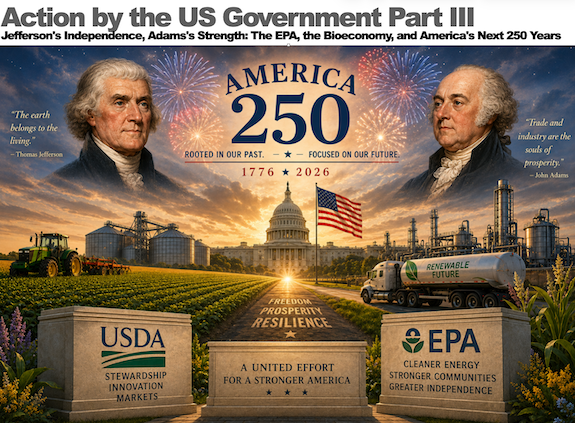
On July 4, 1826, fifty years after the Declaration of Independence, Thomas Jefferson and John Adams died within hours of one another. It was an ending so improbable that generations of Americans have treated it almost as mythology. The two men had spent decades disagreeing about nearly every important question facing the young republic. Jefferson believed that freedom depended on self-sufficiency, local resilience, and the productive power of ordinary citizens. Adams believed that freedom depended on institutions, commerce, manufacturing, and the capacity of nations to project strength in an uncertain world.
Yet beneath their disagreements lay a shared conviction. A republic, if it wished to remain free, could never allow itself to become dependent. Two hundred years after their deaths, and on the eve of America’s 250th birthday, that argument remains surprisingly alive.
Over the past week, we have explored two profound developments in American policy. Congress, through the emerging 2026 Farm Bill, has sought to strengthen both the productive capacity of American agriculture and the markets that transform agricultural abundance into economic power. The United States Department of Agriculture, through its regenerative agriculture initiatives, has sought to create a system in which stewardship and profitability reinforce one another. Now comes the third pillar: demand.
Because no matter how productive a nation becomes, and no matter how effectively it organizes its markets, prosperity ultimately depends on one fundamental question: Who will buy what you produce?
For much of the past half century, American agriculture has relied heavily on export markets to answer that question. This strategy generated enormous prosperity. But it also exposed American producers to geopolitical forces beyond their control. Over the past several years, retaliatory tariffs, strategic competition, and shifting global alliances have demonstrated the risks of relying excessively on foreign markets to absorb domestic abundance. The Environmental Protection Agency’s Renewable Fuel Standard proposals for 2026 and 2027 represent an extraordinarily ambitious answer to this challenge. Rather than seeking to guarantee prosperity through subsidies or trade negotiations alone, the federal government has chosen to expand domestic demand itself. The scale of this shift is remarkable.
Biomass-based diesel requirements are set to rise from 1.1 billion gallons in 2025 to 1.78 billion gallons in both 2026 and 2027. Renewable diesel volumes are projected to increase from 2.6 billion gallons in 2025 to nearly 4.7 billion gallons by 2027. Demand for soybean oil, canola oil, distillers corn oil, and other agricultural feedstocks is expected to rise dramatically. Domestic soybean crush is projected to reach record levels, while investments in oilseed processing, fuel production, and rural infrastructure continue to accelerate.
The immediate beneficiaries, of course, are American farmers, processors, and rural communities. But the deeper significance lies elsewhere. The Renewable Fuel Standard is often described as an environmental policy. It is also an industrial policy. It is a rural development policy. Increasingly, it is becoming a resilience policy. Jefferson would have understood the goal immediately. A nation capable of feeding itself, fueling itself, and supplying its own necessities possesses a form of freedom that cannot easily be taken away. Adams would have recognized something equally important.
That freedom requires institutions, investment, infrastructure, and markets sufficiently robust to survive external shocks. The EPA’s recent actions suggest that the United States government has arrived at a conclusion that both men might appreciate: the strongest form of international engagement is not dependence, but capability. This does not mean retreating from the world. Quite the opposite.
The United States remains one of the world’s largest agricultural exporters, energy producers, and industrial economies. But recent policy developments suggest a growing recognition that international strength ultimately rests on domestic capacity. Nations that can feed themselves, fuel themselves, and finance themselves possess strategic options unavailable to those that cannot. In this sense, the recent actions of Congress, the USDA, and the EPA are best understood not as separate policies, but as components of a broader national project.
Congress is attempting to preserve and expand the productive capacity of American land. The USDA is attempting to align environmental stewardship with economic incentives. The EPA is attempting to ensure that the resulting abundance finds reliable domestic markets. Together, these efforts represent something larger than agricultural policy. They represent an effort to renew one of the oldest promises of the American experiment: that a free people, governing themselves, can build sufficient prosperity, resilience, and confidence to determine their own future.
Tomorrow, Americans will celebrate the 250th anniversary of the Declaration of Independence. Fireworks are an odd tradition. Yet every generation continues to light them because they symbolize something essential about the republic itself: the belief that free people, acting together voluntarily, can create moments of extraordinary power and beauty that none could achieve alone.
Thomas Jefferson believed that America’s strength would grow from its fields. John Adams believed that America’s strength would grow from its institutions. Two hundred years after their deaths, and 250 years after the founding of the republic they helped create, the United States appears to have reached a remarkable conclusion. America’s greatest strength has always been its ability to combine both.
And if the recent actions of Congress, the USDA, and the EPA are any indication, the American experiment is not settling into old age.
Category: Top Stories

