








Jefferson’s Fields, Adams’s Markets: The Farm Bill Debate at America 250 (Part 1 of “Action by the US Government”)
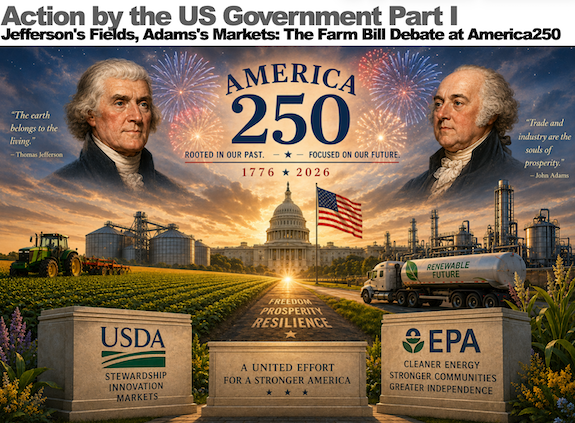
On July 4, 1826, as Americans celebrated the fiftieth anniversary of the Declaration of Independence, two of the republic’s greatest architects lay dying. Thomas Jefferson passed away at Monticello in Virginia. A few hours later, John Adams died in Massachusetts, reportedly unaware that his old friend and longtime rival had preceded him.
For more than half a century, Jefferson and Adams had argued about what would make America prosperous, secure, and enduring.
Jefferson believed that the nation’s strength would arise from its land, its farmers, its capacity for self-sufficiency, and the vast possibilities of continental expansion. Adams believed that strength emerged from commerce, industry, institutions, finance, and the ability to engage confidently with the wider world. They disagreed about almost everything except one thing: America would succeed only if it found a way to convert its extraordinary natural abundance into lasting national strength.
Two hundred years after their deaths, and 250 years after the Declaration of Independence, Congress is engaged in an argument they would immediately recognize.
The legislative landscape shaping the future of American agriculture, energy production, and conservation is currently defined by two major proposals: the House’s Farm, Food, and National Security Act of 2026 and the Senate’s Agricultural Act of 2026. Both seek to guide American agriculture through fiscal year 2031. Yet beneath their thousands of pages of legislative language lies a remarkably familiar debate: should America strengthen itself primarily by protecting the productive capacity of its land, or by building the markets, institutions, and industries that transform that productivity into economic power? The answer emerging from Capitol Hill appears to be that, as with Jefferson and Adams themselves, the nation requires both. The contrast is most apparent in Title IX, governing energy and the emerging bioeconomy.
The Senate’s approach is unmistakably Adamsian in spirit. It seeks to build markets, establish standards, and create the institutional architecture necessary for the next generation of American industry. The Senate bill explicitly incorporates sustainable aviation fuel (SAF) into the federal definition of advanced biofuels, cementing its role in long-term national energy strategy. It prioritizes assistance not only for biorefineries but also for renewable chemicals, biobased manufacturing, and SAF production itself, reflecting a vision of agriculture not merely as food production, but as the foundation of an integrated industrial ecosystem.
Perhaps most revealingly, the Senate proposes creating national labeling standards for biobased products, including bio-attributed plastics and plant-based materials. Such standards may appear mundane, but Adams would have recognized them immediately. Markets require institutions, institutions require standards, and standards create the trust necessary for commerce to flourish.
The House, by contrast, takes an approach that Jefferson might find deeply familiar. While equally supportive of advanced biofuels and sustainable aviation fuel, the House places extraordinary emphasis on protecting the productive capacity of American farmland itself.
Its proposed limitations on federally supported ground-mounted solar projects on prime agricultural land represent an explicit statement of priorities: farmland exists first to produce food, feed, fiber, and increasingly fuel. The legislation requires extensive study of the economic and environmental impacts of solar conversion on agricultural land, including effects on crop production, land values, local economies, and food security. Where solar development is permitted, the House requires detailed conservation plans and full restoration of agricultural productivity at the end of a project’s life.
The House’s philosophy is not anti-energy. Rather, it reflects a belief that America’s long-term strength depends fundamentally on preserving the productive capacity of its soil.
Yet despite these differences, both chambers arrive at remarkably similar conclusions about the future of American agriculture. Both embrace precision agriculture technologies, including satellite imagery, geospatial mapping, sensors, telemetry, and variable-rate applications. Both substantially increase support for technologies that allow farmers to produce more while using fewer inputs. Both recognize that the future competitiveness of American agriculture will depend not merely on acreage, but on information.
This convergence may be the most interesting development of all.
Jefferson understood that a nation unable to feed itself could never truly be independent. Adams understood that a nation unable to organize, finance, and market its abundance could never truly become powerful. Two centuries after their deaths, Congress appears to have concluded that America’s next chapter will require both the wisdom of Jefferson’s fields and the reach of Adams’s markets.
As the United States approaches its 250th birthday, the debate is no longer whether America should choose between agriculture and industry, or between self-sufficiency and global competitiveness. The debate is how to combine them. In that sense, Jefferson and Adams may finally have reached agreement.
Category: Top Stories

