








The Utilidors of the Bioeconomy: POET, Antora are building the hidden operating systems of industrial decarbonization
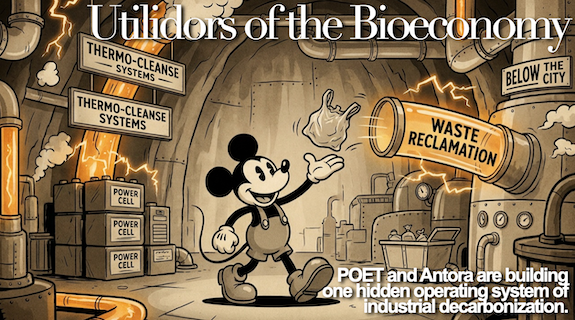
A plastic bag tumbles down Main Street U.S.A., lifted by a gust of Florida wind. For a moment it floats almost gracefully, hovering past strollers and churro carts like an accidental extra in Mary Poppins. Then it drops to the pavement.
Within minutes, it disappears. Not by magic. Beneath the Magic Kingdom lies one of Walt Disney’s least glamorous obsessions: waste management. Hidden below the park, custodians feed trash into a network of pneumatic vacuum tubes known as AVAC — Automated Vacuum Assisted Collection — which sucks garbage through underground pipes at speeds approaching 60 miles per hour toward remote compactors guests never see. The famous Utilidors do the same for food deliveries, maintenance crews, costume changes, and logistics. Walt Disney understood that the visible experience depended entirely on invisible systems.
Industrial decarbonization is entering its Utilidor era.
Last week in Big Stone City, South Dakota, POET and Antora Energy quietly commissioned one of the world’s largest thermal energy storage systems: a 5-gigawatt-hour industrial battery designed not to power roller coasters or castle lights, but to capture something factories normally throw away — heat. Or perhaps more accurately: an opportunity to prevent waste from becoming a wasted opportunity.
The system, installed at POET’s bioprocessing facility in Big Stone City, converts low-cost or surplus renewable electricity into stored industrial heat. Instead of relying on lithium-ion chemistry, Antora stores energy inside insulated blocks of solid carbon heated to temperatures between 1,000 and 2,000 degrees Celsius. Unlike chemical batteries dependent on globally constrained critical minerals, the system relies primarily on abundant carbon materials sourced domestically through existing industrial supply chains.
The operational logic is deceptively simple. Wind and solar power do not always arrive when industrial systems need them. In many regions, renewable electricity periodically floods the grid faster than it can be consumed or transmitted, forcing utilities to curtail generation or sell power at distressed prices. Antora’s thermal batteries function as giant curtailment sinks, soaking up surplus renewable electricity — often during off-peak periods when prices can fall below $20 per megawatt-hour — and converting it into continuously available industrial heat.
In Disney terms, this is not a new attraction. It is a new backstage operating system. Ethanol plants are not primarily electrical machines. They are thermal organisms. Distillation columns, evaporators, dryers, cook systems, and fermentation infrastructure consume heat relentlessly, day and night. A typical 60-to-70-million-gallon-per-year dry-mill facility may require 20 to 25 megawatts of continuous thermal energy, most of it supplied by fossil gas combustion.
That dependence carries consequences. Natural gas often accounts for up to 40 percent of a plant’s variable operating costs and as much as 70 percent of direct operational greenhouse gas emissions. Antora’s wager is that intermittent renewable power can be transformed into something industrial operators value far more: continuous, dispatchable heat.
The scale of the Big Stone City deployment is difficult to overstate. The installation consists of hundreds of modular thermal battery units storing enough energy to deliver industrial-scale heat output continuously over multiple days. At full operation, the system is capable of fundamentally altering the thermal economics of a modern biorefinery. And the economics extend far beyond fuel savings alone.
By replacing fossil combustion with stored renewable heat, facilities can sharply reduce their Carbon Intensity scores under programs such as California’s Low Carbon Fuel Standard and the federal Section 45Z Clean Fuel Production Credit. A Midwest ethanol plant lowering its CI score from roughly 60–70 gCO₂e/MJ into the sub-40 range can unlock incremental revenues estimated at $0.12 to $0.18 per gallon — potentially generating $8 million to $12 million annually for a single 65-million-gallon facility.
Operational advantages emerge alongside the carbon economics. Stable thermal delivery improves fermentation consistency and process control. Operators gain flexibility to shift energy-intensive operations toward periods when stored heat is abundant. Nitrogen oxide emissions decline alongside fossil combustion. Carbon capture systems can continue operating even when renewable generation fluctuates.
This is the industrial “plussing” Walt Disney championed: invisible system improvements that quietly transform the entire experience aboveground. Eric McAfee has described this evolution as “Third Generation” bioenergy — the transformation of ethanol facilities from fuel plants into integrated carbon-management platforms capable of functioning as industrial carbon siphons. In that framing, the thermal battery is not simply a cleaner boiler. It is part of a larger redesign of how industrial carbon, electricity, heat, and agricultural systems interact. The engineering logic is increasingly persuasive.
The deployment logic is harder.
Capturing surplus renewable electricity and converting it into industrial heat sounds straightforward in principle. In practice, it requires synchronizing utility pricing, transmission availability, thermal integration, tax incentives, carbon markets, construction schedules, and long-duration financing into a single continuously operating industrial organism. That is not a boiler replacement. It is a partial redesign of the industrial energy architecture surrounding the plant itself.
To make the system work economically, Antora partnered with Otter Tail Power to create a bespoke electric rate structure approved by the South Dakota Public Utilities Commission. The arrangement allows the thermal batteries to rapidly charge during periods of surplus generation without shifting costs onto other utility customers. In effect, the project turns the ethanol plant into a flexible grid-balancing asset capable of absorbing excess renewable generation while stabilizing industrial energy demand. Yet the capital realities remain daunting.
Estimated installed costs for thermal storage systems of this magnitude range between roughly $100 and $150 per thermal kilowatt-hour, placing a 5 GWh deployment somewhere between approximately $500 million and $750 million in capital expenditure before financing costs, integration expenses, or supporting infrastructure are fully considered. A conventional natural gas boiler may cost only a few million dollars and arrives as relatively standardized industrial equipment. A gigawatt-scale thermal storage installation, by contrast, is currently a monumental civil engineering project involving utility coordination, thermal integration, grid negotiations, tax structuring, and long-duration capital commitments.
In technology terms, Big Stone City increasingly looks proven. In financing terms, it still resembles a moonshot assembled from stacked incentives, bespoke utility structures, federal tax credits, and unusually sophisticated counterparties.
The original technology platform benefited from early Department of Energy support during the first Trump Administration, helping de-risk initial development. To complete commercial deployment, major climate-tech investor Grok Ventures stepped forward with project-level financing support. The economics further depend on a latticework of federal incentives including Sections 45X, 45Z, and the Investment Tax Credit, alongside favorable utility arrangements capable of monetizing off-peak renewable power.
That complexity matters. POET is not a typical ethanol producer. It operates 35 bioprocessing facilities, exports globally, and possesses the engineering depth, balance sheet strength, and operational sophistication necessary to navigate multi-layered industrial finance structures. Smaller independent producers may not.
This is the hidden fragility surrounding industrial decarbonization. The technology itself may function beautifully while the replication pathway remains financially brittle. A system that works operationally in one location can still fail commercially if financing costs, tax policy, utility alignment, or carbon credit markets shift even modestly. At the same time, projects like Big Stone City are beginning to reveal the broader industrial and political stakes surrounding large-scale thermal decarbonization. The deployment has already generated hundreds of manufacturing and construction jobs across South Dakota and California while drawing bipartisan praise as a model for rural reindustrialization, domestic manufacturing, and agricultural competitiveness.
The challenge is no longer simply whether industrial thermal storage works. Increasingly, the challenge is whether industrial America can standardize the invisible infrastructure required to deploy it repeatedly, affordably, and without bespoke financial choreography every time. If Big Stone City succeeds, the future of industrial decarbonization may not look especially dramatic from above ground.
Consumers will not see the thermal batteries. Drivers will not think about steam systems or curtailment sinks or carbon intensity scores any more than Disneyland guests think about underground trash tunnels moving refuse beneath their feet at 60 miles per hour. They will simply expect fuel, power, heat, and products to arrive cleanly, reliably, and affordably. Which may ultimately be the point. The most important industrial revolutions are not always the visible ones. Sometimes they are the hidden operating systems quietly preventing waste — economic, energetic, and atmospheric — from accumulating out of sight.
Category: Top Stories

