









The Diesel Hybrid and the Human Scale of Mobility
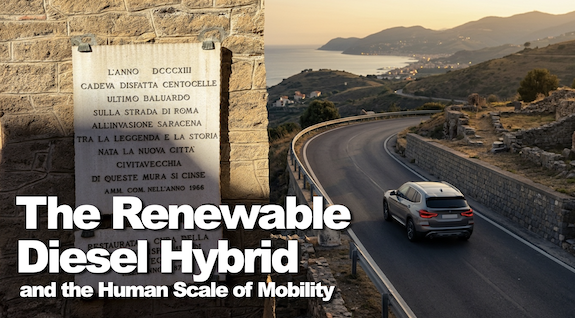
In 813, Charlemagne was near the end of his life, and the old Roman world was near the end of its rope.
The emperor represented a restored Roman order. But restoration on the map was not the same as protection on the ground. When Saracen raiders struck Centumcellae—the ancient Italian port that became Civitavecchia—this was no Charles Martel moment at Tours. No great hammer turned the invader back. The port was devastated. Its citizens fled inland.
Eventually, they returned to the old town.
The precise date is uncertain. The plaque in Civitavecchia says 813; historians have proposed dates a little earlier or later. But the pattern is clear. A system that still looked powerful from above had become too thin to protect every place within it. The people survived by changing position while preserving a path back to the place they loved.
That is a useful way to think about mobility, and a useful way to think about renewable diesel and the diesel hybrid technology. It disappeared from the United States after VW’s DieselGate, so we headed to Europe to test how RD does as a human experience and addressing the aspirations of a low-carbon economy.
So, Flavia and I found a BMW x1 available for rental, headed to her home country of Italy where her language skills would aid us more than in Germany — we planned a trip from Largo della Pace in Civitavecchia to Tropea, then to Sapri, and back to Civitavecchia.
We started towards an Italian main artery, an A12, joined the A1, followed the A2—the modern north–south spine of Italy—and eventually left the fast roads for narrow, winding routes down to the coast. On the return, the coast road was more forgiving: someone had driven tunnels through the mountains, turning exposed hairpins into a connected route.
Italy needs Elon Musk’s Boring Company more than it needs another Tesla—not because tunnels are glamorous, but because a tunnel preserves the possibility of movement when the mountain would otherwise dictate the trajectory.
At Pizzo, where Joachim Murat met his end in 1815, the road seemed to run out of money before it ran out of history. The town was still beautiful, but visibly carrying the accumulated weight of time, underinvestment and departure. We continued toward Sapri because Palinuro was a little too fashionable and the extra half-hour of driving was a little too much.
This was not an ideal season for travel. Italian families were moving in every direction. European and American tourists filled the roads. Old Fiats travelled at 60 kilometres per hour while Porsches and Ferraris appeared at 140. The Autogrills were crowded, hot and short on places to sit.
Because Flavia is Italian, we could leave the official itinerary behind. We visited farmers’ markets, side streets and overlooked places—places where stories have not disappeared so much as fallen below the threshold of attention.
The BMW X1 xDrive20d was carrying two people and roughly 200 pounds of luggage. It was running its air-conditioning through the August heat, climbing hills and descending hairpins. Our working route distance, including a modest allowance for missed turns, town circulation, fuel stops and comfort breaks, was approximately 1,406–1,416 kilometres.
We spent €148 on diesel at €2.16 a litre: about 68.5 litres.
That works out to approximately 4.85 litres per 100 kilometres, or 48–49 miles per American gallon.
BMW lists the X1 xDrive20d’s tank at 54 litres. After one refuelling, the dashboard projected 1,250 kilometres of range. That implied approximately 4.32 litres per 100 kilometres. Under the real conditions we encountered, the equivalent full-tank range was closer to 1,110 kilometres.
The dashboard was optimistic by roughly 12–13 percent. That is a surprisingly small difference for a loaded crossover travelling through mountains, towns, traffic and August heat.
The important point is that this was not a laboratory result. It was a real journey, with hills, luggage, air-conditioning and a driver who wanted to arrive while there was still a day left to enjoy.
Then we began imagining the first leg in an electric BMW.
The electric car would use less energy. That is not in dispute. But its advantage is often stated at the wrong boundary.
A battery is extraordinarily efficient at turning stored electricity into motion. Yet the battery must also carry the energy required for the journey. A 54-litre diesel tank contains far more usable journey energy than a similarly sized crossover battery, without adding hundreds of kilograms. That difference matters under sustained motorway speeds, high payloads, mountains, heat and uncertain charging access.
The relevant measure is not simply energy conversion. It is the whole duty cycle.
The first jump—from Civitavecchia to Tropea—is approximately 698 kilometres. Without hotel charging, the electric BMW would have depended on motorway service areas along the A12, A1 and A2, with the relevant southern motorway segments sometimes still described by the older A3 designation.
Some Italian motorway chargers are now genuinely high-power. Others are slower. Autogrill itself says charging is available only at some locations, operated by the relevant highway network. A charger may be present without being free, working or fast enough when you arrive.
In ideal conditions, an electric crossover might make the journey with two charging sessions. In prudent real-world conditions, it might require three. Tropea’s final 34 kilometres are hilly and winding. There is no convenient charger waiting at the end. The car would need to preserve enough energy to descend into Tropea, spend the night without charging and climb back to the network.
Our normal lunch stop is about thirty minutes. It is not a lazy hour under a shady bough. It is a crowded service area, glaring sun, nowhere to sit and an overheated car whose air-conditioning must remain on. A fast charger could overlap with lunch—if it were immediately available. If there were a queue, lunch would become an hour or more of waiting.
That creates a different kind of travel day.
The diesel BMW could leave Civitavecchia around 11:00 a.m., take a 30-minute lunch, make a brief comfort or fuel stop and arrive in Tropea around 7:00 or 8:00 p.m. The first day would be long, but intact. We could check into La Dolce Vita, eat dinner and begin the holiday.
The electric BMW might leave at the same time, stop once or twice to charge, and arrive late in the evening if everything worked perfectly. With queues, slower chargers or a need to protect the final reserve, the rational plan might have been to stop at Sapri—or an equivalent intermediate point—before the final descent to the coast.
That would not have been a technical failure. The battery would not have died. The journey would simply have become a different journey: an extra hotel night, another dinner and breakfast, additional charging, another morning spent reorganizing the route and one less day in the country we had come to see.
A vehicle can be capable of reaching a destination without being capable of preserving the trip.
Flavia cannot comfortably drive the fast Italian roads. We are effectively a one-driver family. At around eight hours, my happiness and safety begin to decline. Driving unknown roads at ten or eleven at night, with Italian hairpins and mixed-speed traffic, is not an acceptable extension of the holiday. The next day, after driving from eleven in the morning to eleven at night, I would be a zombie.
An 11 a.m.–11 p.m. driving day is not an efficient holiday day. You see the motorway, the service stations and the dashboard. You do not really see Italy.
At that point the electric vehicle has not simply used more time. It has consumed the value of the trip.
This is not an argument against electric vehicles. It is an argument against replacing one orthodoxy with another.
The old orthodoxy said, “You must use gasoline.” Diesel survived because reality kept producing jobs that gasoline performed less well: heavy loads, long distances, ships, trucks, generators and rural machinery.
Dieselgate then revealed something worse than bad engineering: deliberate deception. Volkswagen lied. The punishment was deserved.
But one company’s fraud should not condemn every application of compression ignition forever. Nor should electric propulsion become a universal command issued without regard to driver, road, destination, payload, weather, charging access or daylight.
The next question is what fills the tank.
A modern diesel hybrid need not imply a return to fossil diesel. Renewable diesel made from waste fats, oils and residues—HVO, including HEFA-derived pathways—can preserve the vehicle and fuelling infrastructure while changing the carbon pathway. The machine remains familiar; the fuel becomes progressively less dependent on fossil carbon.
This is where the diesel hybrid becomes more interesting than either side of the usual argument. It is not the old diesel, and it is not an alternative to electrification everywhere. It is a platform for matching propulsion to duty cycle.
Let the urban commuter choose electric. Let the household with dependable home charging choose electric. Let fleets optimize their depot-based routes. But let the one-driver family crossing a country with luggage, hills, uncertain chargers and a finite daylight window choose the machine that preserves the day—possibly running on renewable drop-in fuel.
Policymakers should set stringent real-world emissions standards, measure lifecycle carbon and let technologies compete by duty cycle. Support charging where vehicles routinely dwell. Support renewable liquid fuels where energy density and rapid replenishment remain valuable. Decarbonize the journey without abolishing the journey.
Advanced mobility should widen the set of viable journeys. It should not narrow them to the journeys that fit the infrastructure.
Civitavecchia’s citizens understood this. When the old port failed, they did not abandon the trajectory. They withdrew, preserved themselves and eventually returned to the old town.
Perhaps clean diesel can do something similar. Not a return to the old regime. Not a pardon for Volkswagen. A return, under strict emissions rules and with renewable fuel pathways, to the particular journeys where range, torque and rapid refuelling serve human beings better.
The desire to see a little of the world is not a loophole in public policy. It is one of the reasons mobility exists.
A persistent system does not maximize efficiency at one point. It preserves enough viable trajectories for human beings to arrive with enough life left to enjoy where they have gone.
The BMW did not merely take us from Civitavecchia to Tropea, Sapri and back. It left us enough attention to get off the official route, look around and find stories that were almost forgotten—but not quite.
That is what a human-scale vehicle should do.
Category: Top Stories

