








Mind the Gap: The New Map from Lab to Scale
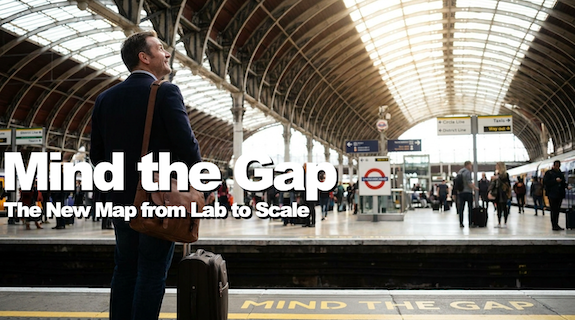
Off the Heathrow Express and into Paddington Station. London! Now, where the devil am I?
Johnny’s on his first UK trip. Paddington is enormous: trains, platforms, soaring arches, and signs pointing toward other signs. Hotel first? Walking, driving, or the Tube? There are black cabs outside, which feels very British, but there is also an Underground sign, which feels equally British. Can you use an American credit card on the Tube, or does he need one of those Oyster things? Where exactly is the Tube anyway?
But first: food. The hotel can wait. There’s a Pret—easy, sandwich, coffee, done. Or, somewhere out there is London: fish and chips, steak-and-ale pie, pubs with names like the King’s Head and the Pig & Whistle, little shops on High Streets, and almost certainly something involving potatoes.
So the choices multiply. Johnny doesn’t know it yet, but he has encountered two entirely different problems: sometimes it’s the problem of the destination, other times is the problem of the route. As they say on the London Underground, it’s a case of Mind the Gap. For the advanced bioeconomy in 2026, that may be some of the best advice available.
From the Wrong Map to the Transit Grid of Scale
For years we have talked about the “Valley of Death”—that treacherous space between an exciting laboratory result and a commercially operating plant. It’s a useful phrase, but it may also give us the wrong map. A valley suggests two sides: you are standing here, commercial scale is over there, and somehow you must descend, cross the dangerous territory in between, climb the other side, and arrive. Lab to pilot, pilot to demonstration, demonstration to commercial—straight line, to .
Except that’s increasingly not what commercialization looks like. It looks much more like Johnny’s Tube map. There are routes, connections, interchanges, delays, and alternatives. Some lines get you there faster but cost more; sometimes you build the infrastructure, and sometimes somebody else already has. Sometimes a connection that didn’t exist yesterday opens today. And sometimes the most important discovery isn’t finding another route to Westminster—it’s realizing that Westminster wasn’t really what you wanted. You wanted a magnificent afternoon in London, and maybe that’s Westminster, maybe it’s Hampton Court, or maybe it’s the V&A. The objective and the destination are not always the same thing, and around the world this week, four developments show just how many new routes are appearing on the commercialization map. Call it the Transit Grid of Scale.
Next Stop: Research Triangle Park
Aether Fuels has been working on one of the oldest scale-up problems: sooner or later, all the individual pieces have to work together. At Research Triangle Park in North Carolina, Aether has integrated its 2.5-barrel-per-day Aurora Tri-Converter and Aurora Upgrader with an existing Fischer-Tropsch reactor, processing mass-balanced renewable natural gas derived from Kentucky landfill gas together with captured industrial . Their Aurora platform achieves >70% lifecycle GHG reductions compared to fossil jet fuel, using mass-balanced RNG from that Kentucky landfill gas and industrial CO2.
Independent testing by AmSpec confirmed that the resulting synthetic aviation fuel meets ASTM D7566 Annex A1 specifications for Fischer-Tropsch Synthesized Paraffinic Kerosene—the FT-SPK pathway approved for blending up to 50 percent with conventional jet fuel. The demonstration builds on earlier standalone Tri-Converter work with GTI Energy and is intended to generate operating knowledge for Aether’s planned 50-barrel-per-day, 2,000-metric-ton-per-year Project Beacon in Singapore.
Two-and-a-half barrels per day is not much of an oil refinery, but it is potentially quite a lot of evidence. Because 2.5 BPD isn’t the destination, nor, for that matter, is the demonstration unit itself—it’s the interchange. A laboratory can establish chemistry, and individual equipment can establish unit operations, but commercial plants have temperatures, pressures, mass flows, catalysts, controls, and equipment that have to coexist continuously. Aether’s route across the gap is integrated demonstration: don’t merely prove that each carriage exists—couple the train together and run it. But that’s only one line on the map.
All Change at Clermont-Ferrand
In France, they’re tackling another scale-up problem from almost the opposite direction. Suppose you have promising biotechnology but don’t have €20 million lying around to build the equipment needed to discover whether it works at meaningful scale. The new answer is simple: don’t build it—share it.
The Biotech Open Platform (BIOP), inaugurated September 29 at Michelin’s Innovation Park–Cataroux in Clermont-Ferrand, represents more than €20 million of initial investment across 5,000 square meters. Its fermentation line reaches capacities up to 15 cubic meters, with semi-industrial purification equipment designed to help take processes from roughly 10 grams toward one tonne of product.
Ten grams to one tonne: between those two numbers lies the scale-up problem—and an awful lot of other people’s money. Danone, Michelin, DMC Biotechnologies, Crédit Agricole Centre France, Clermont Auvergne Innovation, and Greentech founded the initiative, backed by European and regional public support. Potential applications range across proteins, enzymes, and cosmetic actives to agriculture, chemicals, and biomaterials.
The interesting idea here isn’t simply the fermenter; it’s access. What is a 15-cubic-meter fermenter, after all, but an extraordinarily expensive steel cylinder if you can’t afford to run it? A startup facing scale-up traditionally has a rather nasty choice: raise capital and build specialized assets before it knows whether its process will behave at industrial scale, or remain small until somebody is willing to finance the leap. BIOP adds another line to the map: use ours. An asset that might otherwise burden one company’s balance sheet becomes infrastructure available to many travelers. The distance from 10 grams to one tonne hasn’t disappeared, but there is simply another way to travel it.
But Where Are We Actually Going?
Now consider Tersis Technologies, and let’s move much earlier on the map. The company’s work is at TRL 3–4, having filed a U.S. provisional patent application on September 23 covering what it calls “hook-morphology” graphenic carbon derived from thermochemical waste carbon. The nanotube-like stem provides an electron highway while attached graphene sheets preserve usable surface area during charge/discharge cycles in supercapacitors — that’s intensely novel. There is no issued patent yet and no commercial performance data yet—electron microscopy, yield optimization, separation methods, electrode testing, and cell testing all remain ahead. Good. That’s precisely what TRL 3–4 is for.
So why put Tersis on our Tube map at all? Because it raises the other question Johnny encountered at Paddington: not How do I get there? but Where do I actually want to go? After all, a lender doesn’t care about your elegant reaction chemistry—they care whether the debt service gets paid on a rainy Tuesday in November.”
Thermochemical char can be a low-value coproduct, a soil amendment, or even a disposal problem. Tersis is investigating whether that carbon can instead be processed into engineered materials for supercapacitor and hybrid battery-supercapacitor electrodes. Whether the technology ultimately works is precisely what the laboratory program still has to establish, but the strategic question is already fascinating. What if the thing at the end of your process that you thought was residue is actually the beginning of another journey? What if a waste-to-energy project is also a carbon-materials project? What if the route to better project economics isn’t simply making more of the original product, but finding a more valuable destination for something you’re already making?
Johnny wanted lunch. Pret was one answer, but Pret wasn’t the objective.
Now Call the Banker
Eventually, every commercialization journey arrives at one particularly imposing interchange: Money. And here the map becomes more interesting again. Ecostrat, New Energy Risk, and Netherlands-based Yilkins have formed an alliance intended to bring two protections into the same financing conversation: technology-performance coverage and feedstock-supply insurance. The logic begins with two wonderfully uncomplicated questions: Will the technology work? and Will the feedstock show up?
Yilkins brings drying, torrefaction, and carbonization technology designed to handle more than 100 forestry, agricultural, and processing residue types. New Energy Risk provides technology-performance coverage, while Ecostrat brings biomass-supply-chain due diligence and its Feedstock Supply Insurance methodology.
Individually, each risk can look manageable; together, they can become something nastier. Suppose the plant doesn’t quite make design throughput—that’s technology risk. Suppose feedstock arrives wetter, farther away, or more expensively than expected—that’s feedstock risk. Now put them together: the plant needs more feedstock to make less product, input costs rise while output falls, margins compress, debt-service coverage gets skinny, and the banker reaches for the red pencil. One disrupted Tube line is annoying, but lose the line and the interchange you were counting on, and Johnny may be spending the afternoon stuck at Paddington.
That’s why combining the protections is so compelling. The object isn’t to persuade the lender that uncertainty has disappeared—it hasn’t. The object is to keep separate uncertainties from combining into a compound project risk the lender cannot accept, allocating pieces of that risk to parties willing and able to carry them. A lender doesn’t finance a gasifier, nor do they finance a pile of wood chips; a lender finances the probability that the whole machine keeps producing enough cash to pay the debt. That’s bankability.
Here is another route across the gap: don’t merely reduce uncertainty—rearrange it. Measure it, separate it, transfer what can be transferred, insure what can be insured, and preserve enough room in the project for the surprises that cannot. The destination is FID, but the route may run through risk transfer.
Four Stops, One Map
Now step back and look at the whole picture. At Research Triangle Park, Aether says: run what needs demonstrating.At Clermont-Ferrand, BIOP says: share what doesn’t need owning. Tersis asks: find value where you weren’t looking for it. And Ecostrat, New Energy Risk, and Yilkins show us how to transfer the risks somebody else can carry better.
Four developments. Four very different answers to the same commercialization problem. And not one of them says simply: build a bigger laboratory.
That may be the real news. For decades, industrial biotechnology has been described principally as a scale problem—get from grams to kilograms, kilograms to tonnes, pilot to demonstration, demonstration to commercial. Scale still matters enormously, but perhaps the harder problem is becoming navigation. Which assets must we own? Which can we share? Which risks must we eliminate, and which can we transfer? Which product should we make, which market should we serve, and which destination are we actually trying to reach? And—most dangerously—which of yesterday’s answers are we still treating as today’s facts?
Mind the Route
That’s where developers can become prisoners of their own maps, locked into a rigid mantra: We are building this size plant, using this feedstock, with this technology, making this product, for this customer, using this financing structure.
Perhaps. But which parts of that sentence describe the core objective—and which describe a route somebody circled on the map three years ago?
If Johnny’s hotel is the objective, he has route optionality: taxi, Tube, bus, or walk. A closure on the District Line doesn’t destroy his London trip. If Johnny’s objective is lunch, he has something even more powerful: destination optionality—Pret, pub, restaurant, or High Street. And if the real objective was simply one magnificent afternoon in London, perhaps he doesn’t need Westminster at all when there is Hampton Court, the V&A, or whatever wonderful thing he hasn’t heard of yet.
That’s the deeper value of optionality: you can change the route without abandoning the objective, and sometimes you can change the destination without abandoning it either. Persistence isn’t remaining aboard the same train because three years ago somebody decided this was the train—persistence is remembering why you got on the train in the first place.
The Map is Not London
There is one final thing worth remembering about that famous Underground map: it isn’t a map of London. Not really. It doesn’t show the pubs, the museums, the offices, the parks, or the little shops Johnny discovers along the way. It doesn’t tell him whether it’s raining, whether the V&A has something extraordinary on, whether the pub somebody recommended is terrible, or whether walking the last half-mile might become the best part of his afternoon. It is a brilliantly useful representation of one system for moving through London—nothing more.
A process-flow diagram isn’t the project; a TRL number isn’t commercialization; a financing model isn’t the business; and a project schedule isn’t the future. They’re maps—necessary maps, valuable maps, but maps nonetheless.
By tomorrow afternoon, Johnny Jones will be getting the hang of London. He’ll tap in without thinking, know when to take the Tube and when to walk, and while he may never find the exact pub he set out looking for, he may well find a better one. London hasn’t become less complicated; Johnny has simply become a better navigator.
And perhaps that’s the emerging playbook for the bioeconomy: run what needs demonstrating, share what doesn’t need owning, find value where you weren’t looking for it, and carry the risks you understand while transferring the ones somebody else can carry better. Keep the objective, keep your options, and never confuse persistence with staying aboard the wrong train.
When the doors open and everyone else seems terribly certain where they’re going, remember the best advice London ever gave an innovator: mind the gap—and then mind something even more important: which train you get on next.
Category: Top Stories

