








Interesting and developing applications for Carbon Dioxide
By Sam Rushing, president, Advanced Cryogenics, Ltd
Special to The Digest
Recent plans for the US to remove CO2 and other greenhouse gases from the 2009 Endangerment Finding, represents ever more climate change denial; however, the world continues to endure significant adverse changes due to climate change. The tide will turn in due time, and the US being the world’s historically largest carbon emitter, (now only exceeded by China), will then be on course – however ever more damage from such gases will occur during such time. On the other hand, the best US industry can do, is to make a truly concerted effort to reduce carbon emissions. A few ways are found in this article; or at the least we conserve precious water resources, which will be challenged during the rise of overwhelming water consumption in the expansion of power plants to supply power to such data centers – here supercritical CO2 (sCO2) can replace or even eliminate cooling water consumption in power plants.
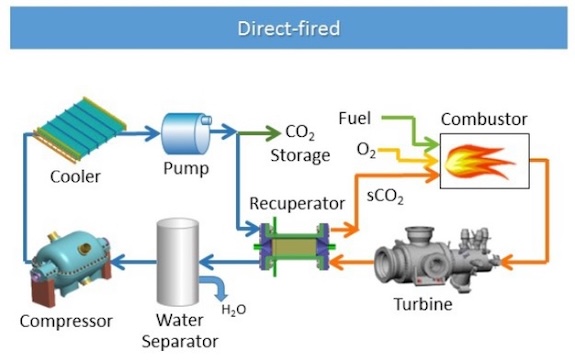
Direct fired sCO2 turbine
CO2 applications are key to true market growth, despite how some gas companies have grown via acquiring business which competitors once enjoyed – these were mostly unruly independents. Then, there are the bids occur, and companies either bid to win, or remain status quo. As to this form of back and forth bidding and successfully landing existing of accounts, this has resulted in little more than price reductions. As to such price reductions in the markets, this has represented no real gain in the bottom lines of industry players. Some observers felt the series of acquisitions and mergers, particularly of aggressive competitors, has led to more disciplined pricing, eventually leading to growth in market prices, and income for investment. Such fair pricing is necessary to provide a reasonable return to the national and multinational gas company leaders.
All of the above has occurred over and over again, throughout the history of the CO2 and other gases industries, which more than likely, will occur again throughout the ages. On the other hand, as mentioned before, applications for the product which are either new or upgraded, leading to increased consumption of product in the industry, will be the true means of significant market growth. This is hoping for levels beyond the usual 2-3%/annum organic growth, consistent with the overall economy and population found in the markets served.
Therefore, the industry is in constant need or new and improved applications for the product. Some of these applications are borne out of necessity, and out of true creativity. Many such applications are extensions of a smaller take on the same, such as greenhouse enrichment, and enrichment of plant growth in the field, for premium, expensive crops, such as today’s reintroduction to the cannabis industry.
Emerging and Expanding Applications
Valuable fruits, vegetable & Cannabis Greenhouse Enrichment – The veil has slightly opened on a once illegal industry, that being cannabis – in fact, it is one of the fastest growing industries globally. The fully legal status of cannabis in Cannabis precipitated much of this growth in Canada, which is the first industrialized country to become fully legal for recreational product. To continue on the cannabis front, to some in the CO2 industry, this may be the most outstanding new application which seems to have potential for large expansion. In fact, the cannabis industry is extremely cautious in making known their presence, in part due to the partly or even fully legal nature of their presence in certain states; while being technically illegal on a federal level. Thinking of Florida, for example, there are plans and current activities for very significant growth for new cannabis crops. The state has allowed the presence of a legal medical market; however recreational use is illegal. This is the case in many other states where prescription use is allowed.
With respect to cannabis, CO2 supercritical extraction will likely become the norm for the production of CBD oils, since CO2 is truly a ‘natural’ product v. using hydrocarbons such as hexane, or even propane. If the buyer of a CBD product were to know their medicinal agent were extracted with hydrocarbons, they could seek alternatives – just understanding the expectations surrounding purity and well – being. Then, the potential for plant growth enrichment via CO2 atmospheric enrichment in greenhouses, and even in the field – all due to enhancing growth of an expensive crop. As to the actual application in greenhouse enrichment, this would require raising the current atmospheric level of carbon dioxide of about 408 ppm, by about 600 ppm; where adding before sunrise would benefit plants due to the highest photosynthetic activity of the day. Enhanced Greenhouse Enrichment, in any event, represents taking a page from nature, and improving such sequestration of CO2.
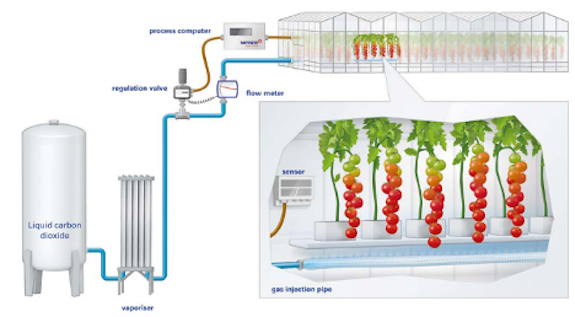
CO2 enrichment of greenhouse
Concrete – One of today’s and future uses for CO2, to add economic value, as well as permanent sequestration is to cure concrete. CO2 is added to wet concrete; and simple chemistry yields a solid calcium carbonate, via the reaction of CO2 with calcium and water. Remember, cement is a product of materials mixed and crushed, such as shale, chalk, fly ash, iron ore, gypsum and limestone; also sand, gravel, and water. Some estimates of the carbon dioxide contained in the enhanced product are about 5%; which would represent long term sequestration. Furthermore, building materials such as calcium carbonate for applications such as drywall production are an excellent means of sequestering carbon.
Aquaculture – CO2 is provided applied to a lab – developed bacteria, yields a protein comparable to amino acids which are contained in small fish. Fishmeal is then replaced with this form of protein and other nutrients. Hundreds of billions of small fish are saved, rather than catching them for fishmeal.
Chemicals – If organic chemicals can be produced with the replacement of hydrocarbons with CO2, this in itself would limit numerous gigatons of CO2 emissions from the fossil fuels industry. There are a number of proprietary bolt – on appliances to CO2 sources, often using the right catalysts, and enzymes, which yield products such as potash, polyols, and polymers. Further, proprietary manufacturing of ethanol is now being produced from steam derived from geothermal plants combined with hydrogen sources. Many more proprietary, often small to lab – sized operations are testing and proving the conversion of chemical products to eliminate hydrocarbons, by the application of CO2 molecules. This field will have, and has experienced manufacturing materials to make detergents, solvents, and plastics. Of course, CO2 combined with hydrogen, assuming the hydrogen is available and affordable, yields methanol; which is a fuel and chemical for many applications.
Improvement of electrical production – CO2 under heat and pressure, as a supercritical fluid can replace steam which drives turbines. There is less energy consumed with an easier to compress CO2, and liquefy, than the production of steam to drive the turbines in power production. This technology would save water and energy; while using CO2 in an environmentally friendly manner. This could be a precious water saving replacement with sCO2 – where it is unknown as to the overwhelming demand for cooling water used to drive ever more electrical production in the data center space.
Plastics and carbon based materials – Products such as graphene and carbon nanotubes can be made today via electrochemical processes; now expensive, however with adaptions which can yield exceptionally strong materials, electrical conductors; and carbon fibers for the manufacturing of many products including cars, and aerospace products. Further, flue gas feedstock along with microbes, oxygen and hydrogen can be feedstocks for the production of biopolymers. Such biopolymers yield many consumer goods and building materials. Numerous approaches have been tested, and found success; however, much of this requires stable pilot operations to be followed by affordable scaled up operations. The future, however, will yield plastics and components thereof from carbon dioxide, rather than hydrocarbons. The reduction of hydrocarbon exploration, development and processing will surely represent a smaller carbon footprint, while producing everyday useful products. Using CO2 in the conversion to green polymers, which represent sustainable materials and fashion, from sunglasses to synthetic leather.
- e.coli converting CO2 – Strains of E. coli have been developed to consume CO2 rather than sugars and organic molecules. Therefore these strains of bacteria would eat CO2 and be used to produce organic carbon molecules, to produce biofuels, and even food products.
Formic acid – In a catalytic reactor, CO2 has been used to produce formic acid. Formic acid has many uses, from a preservative, to uses in fuel cells.
Algae Cultivation & Biofuels – Via feeding CO2 to algae, accelerating growth, which has destinations such as production of biofuels/biodiesel, carbon fiber, and food products.
Green Water Treatment – Beyond killing coliforms and waterborne viruses in agricultural water and aquaculture, CO2 used from commercially recovered sources such as fermentation, replace sulfuric acid in lime neutralization and Ph reduction in municipal water treatment systems, and industrial water neutralization applications. Further, a means of sequestrating CO2.
Using a genetically modified yeast to convert CO2 gas into solid carbon based building materials – Similar to other crustaceans, abalone can convert ocean – borne CO2 and minerals into calcium carbonate to build their shells, which are rock – hard. The enzyme which abalone uses to mineralize the CO2 has been isolated, yeast is engineered to produce it. Then, genetically modified yeast has produced solid carbonate. All of this could lead to massive calcium carbonate brick production from billions of tons of carbon dioxide available for the process. Should this process be scaled up, the use of a genetically modified yeast would then convert CO2 gas into solid carbon – based building materials.
Dyes – European companies have developed dying processes of textiles with CO2, rather than traditional dying requiring large sums of water, and effluent containing high amounts of dye and chemicals. In summary, supercritical CO2 allows dye to dissolve more readily; therefore fabrics taking on color readily, and a reduction of chemical usage in the process. The process is a closed-loop system. The payback represents a significant savings from the reduction of effluent streams, and wastewater cleanup.
These are a few applications under development, test, commercialization; or currently interesting and well in place. When using large sums of CO2 to produce such products, like building materials, plastics, fuels, and chemicals; which ultimately, we can help save the planet, from growing CO2 emissions and severe climate change.
About the author
Sam A. Rushing is president of Advanced Cryogenics, Ltd, a major CO2 consulting firm covering all aspects of CO2, and serving all markets with quality work. Please contact Sam for your carbon dioxide consulting requirements.
Phone: 305 852 2597, email: [email protected], web: www.carbondioxideconsultants.com
Category: Thought Leadership

