









From cornfields to the Cascades: The Farm Bill Comes to Town
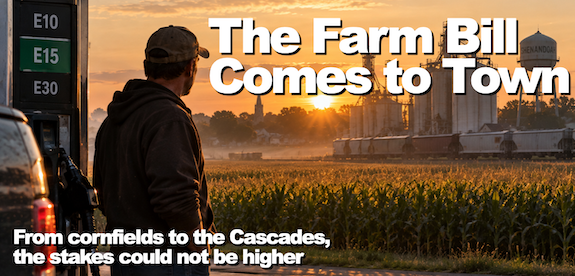
In Shenandoah, Iowa, where the corn rustles in the night, and in the towering timberlands of Washington’s Columbia River Gorge, the Senate Agriculture Committee’s proposed 2026 Farm Bill is a blueprint for survival. Between a statutory promise penned in Capitol Hill committee rooms and a real paycheck deposited into a small-town bank account lies an ocean of real-world friction: a retail fuel pump that refuses to cooperate, a multi-hundred-million-dollar bio-jet refinery waiting for capital, and the unyielding arithmetic of project finance.
The morning shift
The sun has not yet cleared the high Iowa corn, but the yellow incandescent lights are already flickering on in the modest frame houses running parallel to the Burlington Northern tracks in Shenandoah.
Near the bend where Southwest Street curves into Seventh Avenue, there are rooms for rent in old houses that have sheltered three generations of Midwestern labor. Imagine a worker rising in one of them—stretching, pulling on his durable work shirt, splashing cold water on his face, and preparing for the early morning shift down at the ethanol plant.
Across town, the rest of the local economic engine is sputtering to life: shift workers preparing to manufacture windows and doors at the Pella plant, nurses checking in at the county hospital, tellers unlocking the bank, and greengrocers setting out crisp early-autumn produce. A triple-axle grain truck rumbles past, its air brakes hissing in the cold air.
Shenandoah is a farm town, certainly. But if you know its history, you know it has never been just a farm town.
A century ago, in the roaring 1920s, rival seed merchants Henry Field and Earl May realized that selling garden seeds out of paper catalogues was an enterprise constrained by the speed of the U.S. Postal Service. Their solution was brilliantly audacious: they built high-power AM radio stations. Their call signs, KFNF and KMA, blasted agricultural advice, gospel hymns, and country fiddling across the Midwest. A quiet Iowa settlement transformed overnight into the roaring broadcast capital of rural America, proving early that the true value of agriculture does not end at the farm gate, but begins when you amplify its reach. They were adding value to the agricultural baseline long before management consultants invented the term “bioeconomy.”
Our worker turns his pickup toward the Green Plains ethanol plant, but first, he pulls into the local filling station.
He selects standard E10, clicks the nozzle, and watches the digital dollars roll rapidly past the gallons on the pump face. Wouldn’t it be an extraordinary act of economic alignment if E15 were available right here on the corner, priced with a wide enough discount to make a genuine dent in his weekly budget? Perhaps, in a slightly more rational future, he might even drive an affordable flex-fuel vehicle engineered to run seamlessly on high-octane E30.
Here is the central irony of the modern Midwest: a few minutes down the road, a world-class biorefinery turns corn starch into clean-burning fuel, yet the very worker who helps manufacture the product enjoys precious little choice about how much of it goes into his own gas tank.
That is precisely where the 2026 Farm Bill enters our story.
Fourteen billion dollars, meet the gasoline receipt
The Senate Agriculture Committee has formally advanced a proposed Farm Bill containing a long-sought prize: permanent nationwide authorization for year-round E15 sales. It is a calculated federal hammer designed to smash the seasonal summer volatility that has plagued 15 percent ethanol blends for a decade.
Over in the Senate, Chuck Grassley has been beating the drum, pointing to a projected $14 billion economic windfall for the corn economy if year-round E15 goes nationwide.
Fourteen billion dollars. It is an intoxicating, breathtaking number—a figure with enough trailing zeroes to make a press secretary weep with joy and fill a decade of political mailers.
Yet not a single cent of those fourteen billion dollars will show up as a discount on our Shenandoah worker’s gasoline receipt unless someone builds the physical bridge between the policy and the pump.
And that requires vastly more than sticking a splashy new E15 sticker over a rusted metal dispenser.
A retail station owner looking to sell E15 must first conduct a grueling, unglamorous audit of the underground infrastructure. Are the subterranean storage tanks, the submersible turbine pumps, the pipe sealant, the emergency valves, and the dispenser meters UL-certified for higher alcohol concentrations? Does the distributor carry the blend year-round without a supply-chain surcharge? Does the station owner have room for another dedicated fuel stream, and can they see a path to recovering a $100,000 infrastructure retrofit? Even if E15 is priced lower per gallon, the driver’s actual savings per mile depend on the exact price spread weighed against ethanol’s slightly lower energy density per unit volume.
Legislation can sweep away a regulatory hurdle in Washington with the stroke of a pen. It cannot install an Underwriters Laboratories-approved hose on Seventh Avenue, nor can it force a wholesale distributor to lower his terminal rack price.
For the ethanol plant downstream, the macro math is undeniably attractive: expanded retail access drives structural ethanol demand, which stabilizes grain bids, maintains plant margins, and keeps local contractors employed. The fundamental question, however, remains stubbornly local: does a macro policy projection made inside the Beltway actually make the leap to the corner gas station in Shenandoah?
And as it turns out, the proposed Farm Bill is far from finished with Iowa’s cornfields. The next market it envisions for that ethanol is not at the corner intersection.
It is cruising at 35,000 feet.
Another morning, another harvest
Two thousand miles to the west, before the first glint of sunlight hits the Columbia River, the morning lights are coming on in a home nestled in the dense timber west of Stevenson, Washington.
The father works in commercial forestry management, wrestling with timber stand density, fire breaks, and harvest schedules. His wife works at a historic resort lodge nearby, catering to tourists who trek out from Portland to drink in the majestic, mist-shrouded gorge, the alpine rivers, and the virgin forest canopy. Their child is rubbing sleep from his eyes, getting ready for school.
The father starts the engine, drops his wife off at the lodge, and turns back toward town. Crawling down Rock Creek Drive, he passes the local food bank before pulling up to the drop-off line at Stevenson Elementary, then setting out toward the timberlands.
Like every working person, he carries a quiet, unheralded ambition for the year ahead: to earn enough of a margin on his hard labor that he can pull his truck up to that food bank to drop off a donation, rather than ever having to pull up to ask for a box.
The forest above him is his office, his timber supply, and his livelihood. It is also the very scenery that fills the resort’s rooms, protects the regional watershed, shelters wildlife, and defines the mountain town his family calls home.
A working forest can be many wondrous things. A guaranteed, recession-proof paycheck is not one of them.
Which brings us to a remarkable, unexpected convergence between a cornfield in Page County, Iowa, and a timber slope in Skamania County, Washington.
Two harvests. One aircraft fuel tank.
The grain truck bouncing across the Iowa rail tracks and the logging rig hauling heavy logs down the winding mountain roads of the Cascade Range do not appear to belong in the same industrial narrative.
One carries the annual yield of an agricultural field; the other carries the multi-decadal harvest of a managed forest.
Yet the proposed Farm Bill draws them together into the exact same sentence through the magic of Sustainable Aviation Fuel (SAF).
Under Title IX, Section 9001 explicitly folds SAF into the statutory definition of advanced biofuels. Section 9003 expands USDA biorefinery assistance to cover dedicated SAF facilities, dangling competitive capital grants of up to $10 million for qualifying pilot and demonstration retrofits. To top it off, Section 9011 instructs the USDA to construct a grand, department-wide SAF strategy.
That is the statutory blueprint. Now comes the hard chemistry.
In Shenandoah, the processing route goes through Alcohol-to-Jet (AtJ). Corn starch becomes ethanol through standard fermentation; that ethanol is subsequently catalytic-dehydrated into ethylene, oligomerized into synthetic paraffinic kerosene, and hydrotreated into a drop-in jet fuel component. It is a proven, elegant chemical bridge that turns an agricultural commodity into high-value aviation fuel.
Up in Stevenson, woody biomass takes a completely different chemical highway. Through high-temperature Gasification, forestry slash and wood waste are converted into synthesis gas (), which is scrubbed clean and processed through Fischer-Tropsch (FT) synthesis or catalytic pyrolysis to yield drop-in synthetic jet fuel.
[ Iowa Corn Starch ] ──> [ Fermentation ] ──> [ Ethanol ] ──> [ AtJ Dehydration/Oligomerization ] ──┐
                                                                                                    ├──> [ Drop-in SAF (Jet A-1) ]
[ Cascade Forest Slash ] ──> [ Gasification ] ──> [ Syngas ] ──> [ Fischer-Tropsch / Pyrolysis ] ───┘
The feedstocks are not interchangeable. The refining hardware is vastly different. The capital costs are miles apart.
Yet their ultimate destination is identical: a fully certified, drop-in kerosene molecule destined for the wing tank of a commercial jetliner.
Notice, however, the single most critical word in the commercial lexicon: purchased.
An airline fleet cannot fly on statutory eligibility, nor can a jet engine burn an earmark. Airlines require fully ASTM-qualified, drop-in fuel delivered continuously to airport hydrants at a price that doesn’t obliterate their operating margins. A project developer cannot secure a dollar of non-recourse project debt without a creditworthy off-taker signed to a long-term, bankable off-take agreement.
Moreover, the developer must prove the cold, hard process engineering math: What is the fuel yield per bone-dry ton of biomass? How much external hydrogen and parasitic power does the process devour? What is the lifecycle carbon footprint? And what remains after paying the crushing debt service on a multi-hundred-million-dollar pioneer plant?
The Farm Bill can push a project to the starting line. It cannot run the grueling 26-mile marathon of commercial operations.
Carbon has entered the balance sheet
For any executive attempting to build a modern SAF plant, the market price of corn or woody residues is merely the entry fee. The real battlefield is fought on the ledger of Carbon Intensity (CI).
CI represents the cradle-to-grave lifecycle greenhouse gas emissions of a fuel, calculated down to the precise milligram of equivalent per megajoule of energy (). In the contemporary bioeconomy, CI is not an academic environmental metric—it is cash money.
A fuel pathway’s CI score dictates its baseline value under federal programs, state-level Low Carbon Fuel Standards, and international aviation mandates. That means farm-level climate-smart agriculture, no-till practices, solar-powered ethanol processing, carbon capture and storage (CCS), and forest logistics are no longer feel-good PR footnotes; they are core parameters that dictate whether a plant generates a massive profit or goes bankrupt.
Hovering over this entire landscape is Section 45Z of the Internal Revenue Code—the Clean Fuel Production Credit. For qualifying clean fuels, the value of the credit scales directly with the fuel’s lifecycle emissions reduction below a strict baseline. But 45Z comes with its own strict statutory boundaries: the credit applies only to fuels produced and sold within a tight statutory window currently expiring on December 31, 2029, and the legacy standalone SAF tax credit rate under Section 40B sunsets after 2025.
The IRS does not hand out 45Z tax credits simply because a developer slaps a green leaf on its logo. The project must survive intense lifecycle carbon accounting and rigorous regulatory verification.
Similarly, Renewable Identification Numbers (RINs) under the federal Renewable Fuel Standard (RFS) provide vital economic tailwinds, but navigating the regulatory pathways is a high-wire act. Converting ethanol into jet fuel does not automatically preserve every credit or market attribute of the original fuel gallon.
Here is the stark financial reality facing project developers: a USDA Farm Bill grant can help buy a piece of equipment or fund an engineering study, but the long-term bankability of the biorefinery rests entirely on feedstock reliability, process yields, operating margins, tax credits, and firm off-take agreements.
A grant is a welcome injection of capital. It is not a business model.
And back in Stevenson, long before anyone loads a single stick of woody biomass into a high-pressure gasifier, an even more fundamental question must be answered on the ground: Where will the wood come from, who is going to harvest it, and how much can be removed without harming the forest ecosystem?
The forest needs a market—and a plan
This brings us to the proposed Forestry Title, which contains a quietly transformative provision: extending federal stewardship contracts and agreements from the historical 10-year limit up to 20 years.
To a Wall Street financier or a timber operator, that single change is momentous. A 20-year stewardship agreement offers a long-term horizon, providing the supply certainty needed to secure equipment financing or build a wood-processing facility that requires a steady stream of biomass over decades.
The bill also expands collaborative forest restoration and wildfire mitigation projects up to 10,000 acres, while granting categorical exclusions for targeted hazardous-tree removal projects covering up to 6,000 acres. These are targeted, legislated tools designed to clear dangerous fuel ladders out of fire-prone forests—not a free pass to clear-cut wilderness without environmental oversight.
Then comes the age-old industrial question: what do you actually build with the harvested wood?
The proposed Community Wood Facilities Grant Program steps into this gap, offering up to a 50 percent federal cost-share capped at $5 million per facility, while expanding the maximum capacity for eligible community wood-energy systems up to 40 megawatts. Complementary funding under the Wood Innovations Grant program further bolsters commercial utilization of timber byproducts.
[ Managed Forest Stewardship ] ──> [ 20-Year Supply Agreement ] ──> [ Fire-Risk Reduction ]
                                                                             │
[ Community Wood Grant ($5M Max) ] ──> [ Regional Wood Processing ] <────────┘
                                                    │
                                                    └──> [ Local Bio-Heat / FT Biorefinery Feedstock ]
Let us be completely realistic: not every slash pile or fallen branch belongs in a high-tech biorefinery. Much of that organic matter must stay on the forest floor to preserve soil nutrients, prevent erosion, and maintain habitat. Some material is far too remote to logistically haul out, and some already commands top dollar at local paper mills or particleboard plants.
Yet developing a legitimate, paying market for low-value thinning residue fundamentally alters the economics of forest management.
A 20-year supply horizon gives loggers the confidence to invest in specialized equipment. A local community wood facility creates an immediate regional buyer for low-grade timber. And down the line, an advanced thermochemical fuel plant could provide a lucrative destination for wood waste that currently rots or burns in catastrophic wildfires.
No one is promising that a $500 million forest-to-jet fuel refinery will be built in Skamania County tomorrow morning. What the bill offers is a chance to test whether forest management, wood product manufacturing, and clean fuel technologies can form a self-sustaining ecosystem that protects the forest while supporting the town nestled beneath it.
Which brings us down from the timber stands, past the elementary school, and back into the heart of town.
The town is part of the refinery
Imagine a project developer walking into a county commissioner’s office near Shenandoah or Stevenson to present plans for a shiny new bio-processing plant.
The initial executive meetings will center on feedstocks, conversion yields, off-take counterparties, and project finance.
The very next meeting, however, will be about water rights, electrical sub-station capacity, heavy-haul road access, fiber-optic broadband, trade workforce availability, and local mechanical contractors who can weld high-pressure stainless piping at 2:00 AM.
This is where the Farm Bill’s Rural Development Title proves its quiet worth.
The proposed Last Acre program targets the stubborn final mile of broadband connectivity to farms, ranches, and rural industrial sites. Upgraded rural water and wastewater grant programs provide small municipalities with the capital needed to upgrade municipal capacity. Meanwhile, an increase in the Rural Microentrepreneur Assistance Program’s maximum loan ceiling from $50,000 to $75,000 gives small rural service providers the leverage to expand.
A $75,000 microloan will obviously not build an Alcohol-to-Jet refinery. But it might help a local diesel mechanic buy a modern diagnostic rig so he can service the specialized trucks hauling feedstock to the plant. A high-speed broadband connection won’t solve a catalyst degradation problem in a reactor, but it allows a farm manager to leverage precision agriculture tech that lowers the crop’s CI score.
These are distinct, interconnected tools designed to strengthen the broader economic fabric.
A biorefinery cannot exist as an isolated island of technology; it requires a functional community around it. Conversely, a town cannot thrive on a single industrial employer alone.
Shenandoah needs its ethanol workers, but it equally needs the carpenters at Pella, the nurses at the hospital, the local bankers, and the family-owned shops along its main avenue. Stevenson needs its foresters, but it depends just as heavily on the resort workers, the teachers, the civil servants, and the volunteers keeping local charities afloat.
The true promise of industrial policy is not simply building a factory—it is weaving that factory into a resilient, multi-faceted local economy.
The Digest take: three tests, not one promise
The Senate Agriculture Committee’s Farm Bill has cleared an important hurdle, but it remains a legislative proposal, not enacted law. Its provisions must survive floor debates, House reconciliations, appropriations fights, and administrative rulemaking before a single dollar trickles down.
The true benchmark of this legislation is not how many programs are listed in its pages or how many press releases are issued on Capitol Hill.
The benchmark is whether its policies can pass three real-world tests:
                  ┌─────────────────────────────────────────┐
                  │          THE THREE TESTS                │
                  └────────────────────┬────────────────────┘
                                       │
         ┌─────────────────────────────┼─────────────────────────────┐
         ▼                             ▼                             ▼
┌─────────────────┐           ┌─────────────────┐           ┌─────────────────┐
│  AT THE PUMP    │           │  AT THE PLANT   │           │   AT THE TOWN   │
│                 │           │      GATE       │           │      LINE       │
│  Can E15 clear  │           │  Can SAF clear  │           │  Can the town   │
│   retail pump   │           │    CI/45Z and   │           │   support and   │
│  hurdling and   │           │  secure bankable│           │   sustain the   │
│  deliver real   │           │    off-take?    │           │    workforce?   │
│ driver savings? │           │                 │           │                 │
└─────────────────┘           └─────────────────┘           └─────────────────┘
-
At the pump: Can nationwide E15 authorization translate into real-world retailer adoption, certified equipment, reliable rack supply, viable retail margins, and a price point that convinces a driver to choose it? Replacing a pump sticker is easy; re-engineering retail fuel infrastructure is hard.
-
At the plant gate: Can a proposed SAF project secure long-term feedstock contracts, prove its conversion efficiency, lock down its CI score to capture 45Z value, secure a creditworthy airline off-taker, and convince a syndicate of commercial lenders to finance construction? A $10 million grant ceiling is a welcome kickstart, but it won’t satisfy a bank’s risk committee.
-
At the town line: Can the host community provide the infrastructure, housing, schools, water capacity, and skilled workforce required to convert steel in the ground into sustained prosperity?
The Farm Bill can unlock doors across all three domains. But Congress, the USDA, fuel retailers, technology developers, Wall Street financiers, commercial airlines, and local civic leaders still have an immense amount of heavy lifting to do before anyone walks through them.
You cannot fly an airliner on a press release, you cannot fill a gas tank with a statutory authorization, and you cannot pay the family grocery bill with a macro projection.
Tomorrow morning
As twilight falls across the Midwest, our Shenandoah ethanol worker turns off his ignition and steps into his home. The grain trucks have emptied their loads; the shifts at Pella, the hospital, and the local stores have drawn to a close.
Two thousand miles west, in Stevenson, the family gathers around the kitchen table after a long day split between the managed forest, the resort lodge, and the classroom. Along Rock Creek Drive, the quiet lights of the food bank shine in the darkening gorge.
Tomorrow, long before the sun clears the horizon, the lights will flick on once again in the houses along Seventh Avenue and in the homes overlooking the Columbia River.
In Washington, a $14 billion projection for the agricultural economy makes for a grand headline. In Shenandoah, a worker filling his tank simply wants a fuel choice that makes economic sense for his family budget.
In the nation’s capital, 20-year stewardship contracts and multi-million-dollar grant programs represent victories in policy strategy. To the father driving past the food bank in Stevenson, economic security is measured by a far more intimate metric: whether his family has enough abundance this year to give back to their community.
The macroeconomic projections and the household budgets are not competing realities—the former exists solely to serve the latter.
The Farm Bill may be written in the marbled halls of Washington, but its ultimate test will be written at dawn in towns like Shenandoah and Stevenson—where corn and timber are transformed into fuel, where policy becomes a dependable paycheck, and where the people who power the bioeconomy wake up and do it all over again.
Summary of key Farm Bill provisions analyzed
Editorial & Reference Note: Analysis draws directly from the section-by-section summary of the proposed 2026 Farm Bill. Statements regarding the September 16 committee vote, nationwide E15 market projections, Section 45Z Clean Fuel Production Credit mechanics, retail equipment compatibility standards, and technical SAF conversion pathways (AtJ and FT) reflect current industry data, statutory tax law, and standard engineering specifications. Narrative characters represent illustrative composite figures created to ground macro policy in everyday rural life.
Category: Top Stories

