









America’s Refinery Crisis Needs an E30 Hybrid Solution
By David Hallberg & Doug Durante
Special to The Digest
America’s energy challenge is no longer primarily about crude oil supply—it is about refining capacity and fuel production bottlenecks. Even with ample domestic oil production, the system is struggling to turn crude into the diesel and gasoline the economy actually uses. The most effective response is not simply more drilling or more imports, but a structural shift in how America makes and uses transportation fuel: a national high-octane fuel standard that pairs E30 with widespread hybrid vehicles.
Recent market signals make the problem clear. Diesel refining margins have surged to record levels, with crack spreads exceeding $100 per barrel, while gasoline margins have also tightened. At the same time, crude oil prices have fallen from their geopolitical peaks. This divergence shows that the constraint is not crude supply—it is the ability to convert crude into finished fuels, especially middle distillates like diesel.
Global disruptions have intensified the strain. Reduced refining output abroad, constrained shipping routes, and tight inventories have limited the availability of refined products. While U.S. refiners are running at high utilization, refining capacity cannot expand quickly enough to meet demand shocks.
The impact is felt far beyond energy markets. Diesel is the backbone of the real economy: it powers agriculture, freight, construction, and manufacturing. When diesel prices rise, costs cascade through supply chains, raising food prices, increasing the cost of goods, and slowing economic activity. The result is a damaging combination of persistent inflation and weaker growth.
Conventional policy responses—boosting crude production, tapping the Strategic Petroleum Reserve, or relying on foreign supply increases—do little to address the core constraint. They increase feedstock availability, but not the system’s ability to efficiently convert that feedstock into usable fuels. Misguided responses like attacking the RFS and blaming biofuels are the products of special interests and uninformed policymakers, a situation we are experiencing right now as reports of scaling back RFS volumes are coming out of the Trump administration when it is those very fuels helping to keep prices from going even higher. It is the implementation of the RFS and its complicated RIN system that needs correction. However, that does little to address the refining constraints. America needs a different approach.
Let American agriculture compete with the refinery
The United States should begin a phased transition toward a national E30 high-octane fuel standard, paired with increasingly efficient hybrid vehicles.
Ethanol is uniquely valuable because it provides both renewable fuel volume and high-octane content outside the petroleum refining system. This reduces pressure on refineries in two ways: it displaces petroleum gasoline blendstock and supplies octane that would otherwise need to be manufactured through energy-intensive refining processes.
A simple comparison illustrates the effect. Producing 100 gallons of E10 requires roughly 90 gallons of petroleum-based blendstock. E30, by contrast, requires about 70 gallons of petroleum blendstock and 30 gallons of ethanol. That shift meaningfully reduces the volume of gasoline that must pass through constrained refining capacity.
Importantly, ethanol does not replace diesel or jet fuel. Instead, it allows refiners to focus more of their capacity on the hardest-to-substitute products—especially middle distillates—while agriculture supplies a larger share of gasoline energy and octane.
Hybrids make the transition practical
The timing for this shift is favorable because American consumers are already rapidly adopting hybrid vehicles. The effort to force EVs into the vehicle mix was a mistake—there were too many unresolved issues ranging from cost to recharging and importantly, to consumer acceptance. A measured, gradual integration might have been more successful but too much, too fast has resulted in rethinking the role of EVs at every level.
Hybrids change the equation. They reduce total fuel consumption while preserving liquid-fuel compatibility, making it easier to introduce higher ethanol blends without sacrificing performance or convenience.
Future hybrid engines optimized for high-octane E30 (around 100 RON, or 93 or more octane at the pump) could take advantage of ethanol’s combustion properties through higher compression ratios, turbocharging, and improved thermal efficiency. Combined with electrification, this enables a transportation system that uses significantly less petroleum per mile traveled. Recognizing the reality of continued use of oil, the strategic outcome is straightforward—less fuel consumed and importantly, less reliance on petroleum for the energy we still need.
This approach is fundamentally different from expanding oil transport routes or increasing crude supply. Those strategies move or add barrels. E30 reduces the number of barrels required in the first place. Want proof? As we have written in previous articles and papers, a 42-gallon barrel of oil produces roughly 20 gallons of gasoline, the remaining volume is processed into diesel fuel, jet fuel, heating oil, etc. And, the 20-gallon yield requires further processing to bring it to sufficient octane rating, using more energy and inputs. Although not typically marketed in barrels, a 42-gallon barrel of ethanol is 42 gallons of high octane, finished fuel, thus replacing a barrel of oil at a 2:1 ratio in terms of gasoline. We view this as refiners “outsourcing” octane with ethanol which is acknowledged by refiners in Congressional testimony as the lowest cost octane available to them. In so doing, refineries increase their refining and processing capacity to produce the aforementioned other products.
A Strategic Renewable Octane Reserve
E30 also strengthens America’s energy security in a way that complements the Strategic Petroleum Reserve.
The SPR is designed to address crude oil disruptions, but crude must still be refined before it becomes usable fuel. That means SPR effectiveness is ultimately constrained by refining capacity.
As described above, ethanol provides a parallel system: a renewable source of both fuel volume and octane that bypasses much of the refining bottleneck. Unlike crude oil, it is replenished annually through agricultural production.
This creates what can be understood as a Strategic Renewable Octane Reserve—a flexible, domestically produced fuel component that enhances resilience during supply shocks.
Economic and health benefits
The benefits of reducing petroleum dependence extend beyond energy markets.
The United States remains a major crude oil importer in key segments of its fuel system, even as it exports petroleum overall. Reducing gasoline’s petroleum content would lower exposure to global price volatility and reduce import dependence on refined products.
There are also meaningful public health implications. Transportation fuels containing petroleum-derived aromatics contribute to particulate pollution and other harmful emissions linked to respiratory and cardiovascular disease. While ethanol is not a complete solution to transportation emissions, displacing a portion of petroleum-based gasoline components can reduce exposure to some of the most harmful pollutants.
When combined with improved vehicle efficiency, lower petroleum consumption, reduced import exposure, and agricultural value creation, the long-term economic gains could plausibly reach hundreds of billions of dollars annually as the vehicle fleet and fuel infrastructure evolve.
Those gains would circulate within the domestic economy—supporting farmers, biorefineries, automakers, and consumers—rather than being absorbed by imported fuel costs and global supply shocks. Increasing ethanol demand to the levels we suggest could finally unleash the promise of cellulosic and other biomass feedstocks that have been floundering. Even if cellulosic ethanol magically cracked the code and could produce the billions of gallons called for under the RFS, where would they put it absent a bold initiative like what we are suggesting? Knowing there is demand could jump start thermal, enzymatic, acid, and countless other processes to ensure a steady supply of ethanol to compliment todays efficient corn ethanol.
America’s Comparative Advantage
The United States does not need to choose between its petroleum industry, agricultural sector, and automotive manufacturers. It can align them.
Refiners can focus on producing the most difficult and valuable fuels, particularly diesel and jet fuel. Farmers and ethanol producers can supply a larger share of gasoline energy and octane. Automakers can design engines optimized for high-octane E30 and hybrid efficiency. Consumers benefit from greater stability and lower exposure to global fuel volatility.
This is not an anti-oil strategy.–it is an oil-efficiency strategy.
The key lesson from today’s elevated refining margins is clear: energy security is no longer just about crude production or storage. It is about the system’s ability to convert crude into usable fuels efficiently and affordably.
A national E30 Hybrid Fuel Standard directly addresses that constraint. The cheapest and best barrel of oil is the one America no longer needs to refine!
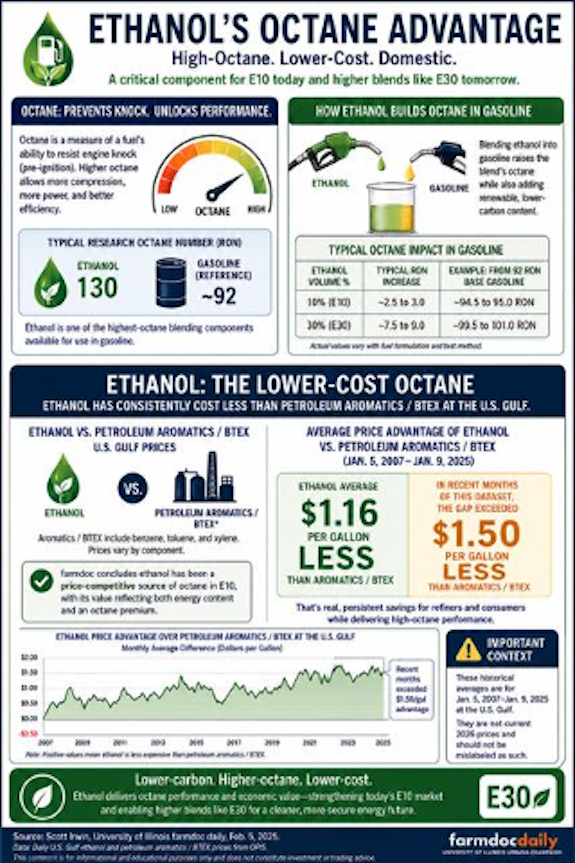
Above: E30 Octane Cost Savings vs BTEX .PNG
Executive Summary: America’s energy system is constrained less by crude oil supply and more by a tightening refining bottleneck that is driving record fuel margins and higher consumer costs. A national shift to an E30 high-octane fuel standard combined with widespread hybrid vehicle adoption would reduce pressure on refineries by displacing petroleum blendstock and supplying renewable octane. This approach would improve fuel system efficiency, lower exposure to global refining shocks, and strengthen energy security. Over time, it could also generate substantial economic and environmental benefits by reducing import dependence and improving transportation efficiency.
About the Authors. Messrs. Hallberg and Durante are respectively the founders of the Renewable Fuels Association and the Clean Fuels Development Coalition, representing a combined 80 years of experience in biofuels policy and implementation.
Category: Thought Leadership

