








Challenges Associated With Recovering Co2 From Flue Gas V. Concentrated Sources Such As Ethanol
By Sam A. Rushing, Advanced Cryogenics, Ltd.
Special to The Digest
Flue gas is the most prevalent source of CO2 off-gas from all processes globally; among the lion’s share of this flue gas is the ever – present electric power plant, primarily fueled by coal, and then secondly, natural gas. The CO2 found in coal fired power plant off gas is among the dirtiest forms of CO2, even with many of the improvements in the plants; still this will yield sulfur and nitrogen compounds (SOx and NOx); among other rather nasty compounds and elements; all let to the atmosphere. This article focuses on the difference between recovering CO2 from flue gas sources v. concentrated sources, primarily ethanol plants.
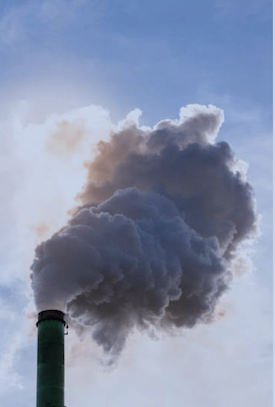 Today’s challenges with carbon dioxide are among mankind’s greatest challenges, that being from an economic, technical perspective – ultimately a daunting task in terms of the mass volume of CO2 reduction needed to balance the globe. This balance is very readily noticed when considering the rapidly shrinking polar ice caps, to the rise in sea levels; to the growing deserts globally, to increasing temperatures globally over the century – which has been underway and accelerating more rapidly over the last number of decades and years.
This is an extremely challenging task, that being reducing the ever-growing new level of emissions to the atmosphere, much less reduction of an overwhelmed ocean and atmospheric CO2 presence – since CO2 is the product of combustion, and fossil fuels drive most of today’s energy needs.
On the other hand, the endless opportunities with respect to fostering, developing, and implementing forms of biofuels does now present a unique opportunity to stem this tide – however, with intense fossil fuel based lobbying and favorable politics, biofuels have been misbranded in a negative light with respect to the misunderstood ‘food v. fuels’ controversy. Further, biofuel developments are hindered due to today’s capital crunch, and the lack of significant focus on the only solution to the energy and emissions crisis – that being the absolute need for the strong development of renewable fuels v. the old thinking and utilization of fossil fuels. Fossil fuels are finite, and the energy and emissions output required to recover ever-more challenging locations of petroleum make the emissions problem even worse. Further, the oil companies somehow felt the new benchmark for oil should be nearing $150/barrel, back in 2008 (more recently over $100/barrel during the Iran war, and intermittently over the years, $100 and more per barrel); and prices will reach a new high ‘normal’ benchmark. In any event, petroleum and coal are not the answer to long term energy sustainability, a decent carbon footprint left behind, and a means of creating the badly needed self sufficiency with fuels and utilize resources which are clearly in front of us in this country and internationally.
The potential for 45Q and IRA do offer some relief, such as the $85/ton tax credits for flue gas projects; with limitations and time schedules applicable; and the same for DAC (direct air capture) at $180/ton.
On the other hand, today, there is the need to recover CO2 from the ever – growing number of coal – fired power plants, the dirtiest and worst contribution to the ever-growing CO2 count which is emitted to the atmosphere – some 40% of today’s emissions and ever growing. This ever-growing flue gas content will be found in rapidly developing world, that being primarily China and India; and considering the end result from such massive new coal fired power plants, the need for renewable energy and biofuels then becomes ever – more essential; then in the case of the developing world.
FLUE GAS V. CONCENTRATED FORMS OF CO2 BY-PRODUCT SUCH AS ETHANOL OFF – GAS; A DAY V. NIGHT COMPARISON
With respect to the difference between recovering CO2 from flue gas v. concentrated CO2 sources (fermentation sources, anhydrous ammonia off gas, ethylene oxide off gas, titanium dioxide product, and some natural wells) – this difference is essentially day v. night in terms of economic magnitude.
Initially, most concentrated sources, up to 99% and higher such as from ethanol, off the spigot from the ethanol plant as a by-product, this gas is water – saturated and is recovered at pressures from atmospheric to less than 10 psig. The raw gas is then taken via a blower, of sometimes a booster plant, to a CO2 liquefaction and purification plant. The off-gas from fermentation is generally a very clean source, relatively speaking, when considering most other options – another clean source in relative terms is by-product from anhydrous ammonia production.
CO2 is always liquefied and transported in a liquid state; due to the sheer volume if the gas happens to be in a gaseous state. When used in various applications, often the CO2 is then vaporized; however, it is stored and transported as a (condensed) liquid product, often under pressures between 250 and 300 psig. The liquid CO2 production plant consists largely of feed compression, ammonia refrigeration, and some purification process for a clean source, like ethanol, and a dirty source would then mean much more purification and expense needed to fulfill most requirements (such as product from coal combustion). When considering the other concentrated sources such as ethylene oxide, the raw gas is concentrated again, however, there are numerous constituents in this raw gas, as would be in some natural wells, which can require much more process equipment, and often special front end plant metallurgy – as with ethylene oxide; and in the case of natural wells, and other concentrated sources, outside of most ethanol sources, catalytic oxidation is then a further requirement, plus often much more process equipment.
The result, when looking at most of the concentrated sources, places ethanol and one of the best concentrated forms of CO2 sources for industry, from a less costly perspective for process and liquefaction to yield a food and beverage grade. The ISBT standard (a beverage technology group involved in CO2 specification methodology & definition), is the requirement for soft drink and other beverage needs; and is the best benchmark, in terms of purity sought when going to virtually all the merchant markets.
With respect to a merchant plant which would recover, liquefy and purify the CO2 for a beverage grade product, new assets may approach $12million to $18million for fully installed liquid CO2 plants which range from 400 to 800 tons per day in capacity – this is for a concentrated, clean CO2 source from fermentation. Once again, considering a raw relatively clean source of CO2, often near or more than 99% (v) CO2 content – like ethanol.
On the other hand, the proven facilities thus far for recovery of flue gas, formally operating for the merchant markets, which began in the late 1980s, were facilities which are owned and operated by The AES Corporation, in Cumberland, MD and Shady Point, OK. Shady point is long closed; and it is unclear if Cumberland is only operating off a ‘peaking power plant’ in Maryland; therefore periodic, at best. The source was off gas from coal fired cogeneration plants, which yield a raw content of CO2, probably 12 – 14% (v). What is needed to produce a purified merchant or even a crude liquid
CO2 from flue gas, is a whole additional plant, placed in front of the liquefaction / purification plant, similar to that spoken for the case of a concentrated by-product from ethanol, as described above. This requirement for a whole separate plant which concentrates the CO2, thus making liquefaction and purification possible has always made flue gas recovery economically impossible in the developed world. Some small flue gas-based CO2 plants are operating in the developing world, due to selling prices for merchant CO2 being very expensive v. much less in the developed world. The flue gas based CO2 plants which have operating history, as found in the U.S. and similarly elsewhere use a solution technology for the recovery and concentration of the CO2 prior to liquefaction and purification, this has always been an MEA technology – one of a family of amine solutions, which is the heart of the process; and in the late 1980s to early 1990s, the price for these plants with a capacity of about 200 – 250 tons per day, was $25million – this would be the recovery plant (MEA concentration plant) and the traditional liquefaction/purification plants together installed. In those days, a plant sourced from ethanol, on the other hand, would have probably cost up to $2 -5million fully installed. So, in this context, the difference was five to ten times greater for flue gas v. a concentrated source such as ethanol by-product. Please see the attached image for a flue gas CO2 process.
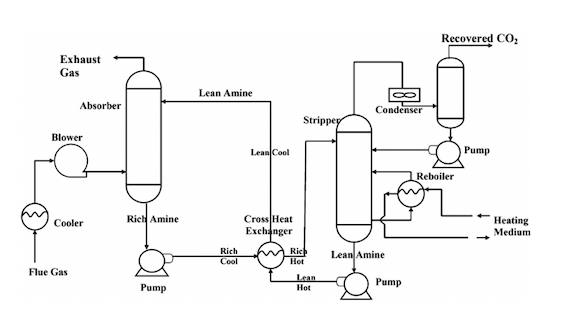
MEA recovery process diagram
Today, when scaling up to the world class sizes of plants, that being 400 to 800 tons per day, the difference between the concentrated source such as ethanol, and the lean flue gas from combustion (depending upon fuel type, how impure the flue gas is, etc) could be anywhere from 5 to 10 times greater. This is worlds of difference, and the only reason the flue gas projects worked for AES Corporation many years ago, was the subsidy in terms of using the cogenerated steam in the solvent recovery process – otherwise called a steam host; which then allowed the greater project to count the capital investment for the CO2 project as part of the power plant; and then eliminate the expensive amortization; and perhaps further costs. This opportunity for the deferred amortization, or similar definitions, was the product of an energy law which expired in the early 1990s.
Therefore, in real world terms, when producing CO2 from ethanol v. flue gas, the difference is extraordinary and unaffordable – this assumes economics similar to the only long term commercially proven process, that being amine technology, primarily; however, some efforts are underway at demo plants using membrane technologies. However, should subsidies appear, or technologies appear to make a substantial difference (such as vastly improved solvents), some of this may change, but I truly believe this is unlikely.
Today, many firms are trying to test (via government grants and sponsorship) their so-called proprietary processes other than MEA solvents, for flue gas recovery of CO2 – and in this context, no such process or technology has been commercially implemented for long term proven application in the industry – therefore, no proof of commercial viability exists to scale up. Many of the proposed new flue gas recovery schemes are theoretical and are seeking government sponsorship for the lab or demo facilities – and most experts, including various federal agencies, suggest the implementation of any successful technologies such as those which are being proposed, and not proven, other than MEA – or similar solvents, may be years to a decade out at best before successful operational history and viability is seen. As to membrane systems, when considering my work with membranes, they have proven to be fully unaffordable, and technically questionable.
Gaining traction today is even worse, with an the current government ‘cancelling’ the endangerment finding; of course, which is real and true to what we are observing even greater today, with a world on fire, record temperatures, and many experts fearing water supplies to be extremely limited and emissions to be out of control over the next few decades. If we are lucky enough to escape this regime, we might have a government which cares about the state of the earth and the environment.
The demo flue gas recovery projects which are under review are generally associated with power projects, and the carbon dioxide produced, assuming the new technologies suggested happening to work – from a technical and economic perspective; will end up placing the CO2 in a sequestration mode v. into the commercial markets. Therefore, most of these new technologies are only trying to liquefy, not purifying the product for consumer use; but only for sequestration.
Sequestration is another subject which has a way to go in terms of proof, development, and acceptance – such as acceptance by landowners, acceptance that the sequestered CO2 will not then leak out into the atmosphere – and return to ground zero; or perhaps poison a community if it should leak out.
Many challenges, hurdles, and ultimately the cost of achieving these daunting goals to recover huge sums of lean CO2 from flue gas – remember flue gas is very lean v. a by-product from fermentation- so the challenge is to make such projects work in technical and economic terms. Should flue gas be recovered from natural gas fired or other relatively lean hydrocarbon fuels v. coal; this would yield a very lean CO2 flue gas, this making this recovery task even more difficult.
The future of CO2 recovery from flue gas is essential for mankind’s survival, particularly as more and more coal fired power plants are being built, and more petroleum is being consumed for manufacturing, chemical process applications; and transportation needs. Separately, should the world embrace the enormous biofuels options available and separate politics and fossil fuel lobbies from what is truly needed for energy independence and renewable energy, the carbon footprint would become more manageable; and the planet would have a fighting chance to survive the consequences of global warming.
About the author
Sam A. Rushing is a chemist and president of Advanced Cryogenics, Ltd., a global CO2 and cryogenic gas consulting firm. All work from technical, process, market, and business related criteria are skillfully handled by the company. The company is supported by decade’s long expertise in all phases of the CO2 & cryogenic industries and unique CO2 topics; along with all sources of CO2. Please contact the following for information on consulting expertise. Tel 305 852 2597; email: [email protected]
Category: Thought Leadership

