Author Archive: Jim Lane

rss feed

The Persistence Project: Break the strain before scale breaks you

The Persistence Project: Break the strain before scale breaks you

October 7, 2026 |

In 1844, railroad magnate Isambard Kingdom Brunel had the sort of problem most technology developers would envy: his new technology worked. The idea was atmospheric railway propulsion. Take the locomotive off the train. Instead, place stationary steam engines along the route, use them to pump air from a pipe running between the rails, put a […]

Read More

The Digest’s 2026 Multi-Slide Guide to the Northeast Renewable Diesel and RNG Cluster

The Digest’s 2026 Multi-Slide Guide to the Northeast Renewable Diesel and RNG Cluster

October 6, 2026 |

The Story: The Northeast operates as a policy-driven demand basin rather than a self-sustaining production cluster. While state statutes in New York and Rhode Island mandate rising biofuel blends in heating oil and Massachusetts enforces commercial food-waste disposal bans, PADD 1 possesses zero renewable diesel production capacity. Lacking convertible refinery infrastructure, the region cannot replicate […]

Read More

Bring Out Your Carbon!

Bring Out Your Carbon!

October 6, 2026 |

OFFICIAL: Bring out your carbon! Bring out your carbon! (A FORESTER steps out from behind a bush, holding two pinecones.) FORESTER: Got some here! (The Official stops the cart, takes one of the pinecones, examines it through a magnifying glass, and pokes it with a stick.) OFFICIAL: That’s not carbon. FORESTER: Of course it’s carbon. […]

Read More

The Digest’s 2026 Multi-Slide Guide to the Pacific Northwest SAF Cluster

The Digest’s 2026 Multi-Slide Guide to the Pacific Northwest SAF Cluster

October 5, 2026 |

The Story: Washington State consumes eight hundred forty-eight million gallons of jet fuel annually and hosts world-class research institutions, yet generates only fifty thousand gallons of sustainable aviation fuel. This seventeen-thousand-fold gap highlights a fundamental deficiency: the Pacific Northwest functions as a pre-cluster lacking an inheritable operating production asset. Furthermore, Washington’s generous statutory incentive remains […]

Read More

How a speck of algae changed neuroscience and led to a Nobel Prize

How a speck of algae changed neuroscience and led to a Nobel Prize

October 5, 2026 |

It’s an otherwise forgettable puddle by the side of Highway 2 in Iowa, just outside of Clarinda. I know, you’d rather look at the magnificent corn. But, let’s look at that little speck of algae, swimming toward the light. That one, over there, the green speck in the puddle, moving towards the light source outside […]

Read More

The Digest’s 2026 Multi-Slide Guide to Mobile Algae Cultivation Systems

The Digest’s 2026 Multi-Slide Guide to Mobile Algae Cultivation Systems

October 1, 2026 |

The Story: Mobile algae cultivation systems lack verified operating deployments, vendor deliverables, or measured productivity data. Moving a cultivation unit cannot supply the required sunlight, land, water, or carbon dioxide, as these critical inputs remain inherently site-bound. At demonstrated fuel yields, producing one million gallons annually requires four hundred to six hundred seventy acres of […]

Read More

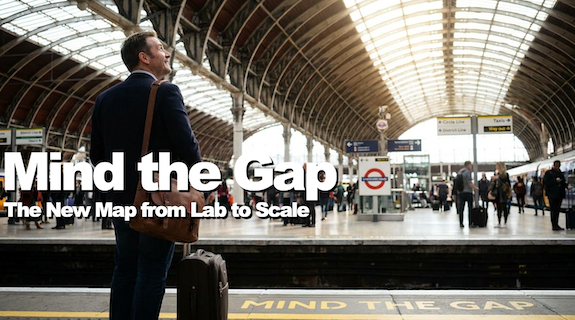
Mind the Gap: The New Map from Lab to Scale

Mind the Gap: The New Map from Lab to Scale

October 1, 2026 |

Off the Heathrow Express and into Paddington Station. London! Now, where the devil am I? Johnny’s on his first UK trip. Paddington is enormous: trains, platforms, soaring arches, and signs pointing toward other signs. Hotel first? Walking, driving, or the Tube? There are black cabs outside, which feels very British, but there is also an […]

Read More

The Digest’s 2026 Multi-Slide Guide to Field-Deployable Biocatalysis

The Digest’s 2026 Multi-Slide Guide to Field-Deployable Biocatalysis

September 30, 2026 |

The Story: Field-deployable biologicals function at the crop root, seed, or soil, but the application point does not dictate manufacturing location. Products like microbial nitrogen fixers are manufactured centrally and distributed locally through agricultural supply chains. High product value density drastically weakens the freight rationale for building local production facilities. While on-site enzyme production at […]

Read More

The Digest’s 2026 Multi-Slide Guide to Distributed Plastic-to-Fuel

The Digest’s 2026 Multi-Slide Guide to Distributed Plastic-to-Fuel

September 29, 2026 |

The story: Plastic conversion fails on feedstock specification rather than converter plant capacity. Although small-scale converters are often assumed to produce sub-commercial fuel, large plants have underperformed while smaller units operated continuously. Because baled transport costs roughly seventy dollars per ton compared to nearly three hundred forty-five dollars for primary and secondary sorting, eliminating freight […]

Read More

The Comeback: How Canada’s Forests Can Fuel the High Seas

The Comeback: How Canada’s Forests Can Fuel the High Seas

September 29, 2026 |

When the Pittsburgh Penguins lowered Mario Lemieux’s iconic Number 66 from the rafters on a cold December night in 2000, it was not merely an athletic resurrection, but a masterclass in the quiet economics of unannounced capability. Lemieux had survived Hodgkin’s lymphoma, endured years of crippling spinal agony, and spent forty-four months in retirement while […]

Read More

}