








Mahalo! Hawaii’s Clean Fuel Standard Becomes Law
I was topping off the rental car at an Aloha gas station near Honolulu Airport when the pump thanked me. Mahalo.
It’s such a small thing that most visitors probably don’t even notice anymore. You replace the nozzle, glance at the receipt, and there it is on the screen: Mahalo. Thank you. It may be the one Hawai’ian word almost everyone carries home. Most of us arrive already knowing two words. Aloha welcomes us. Mahalo sends us on our way. Between those two simple words lies an entire way of thinking about people, place and gratitude.
I’ve been coming to Hawai’i for fifty-three years. My family once had a home here, and our connection reaches back much farther than my own visits. Since our first arrival in 1842, we have crossed the Pacific by whatever marvel the age provided—from whalers to Matson steamships, Pan Am’s gleaming 747s, and now the steady procession of wide-body aircraft descending over Pearl Harbor and Honolulu with a rhythm that still reminds me of the opening sequence of Hawaii Five-O. Every generation has made the same journey, powered by whatever energy the times could provide.
One thing has never changed. It takes a lot of energy just to get to Hawai’i. It takes a special kind of energy to keep Hawai’i growing, thriving, and still looking like Hawai’i.
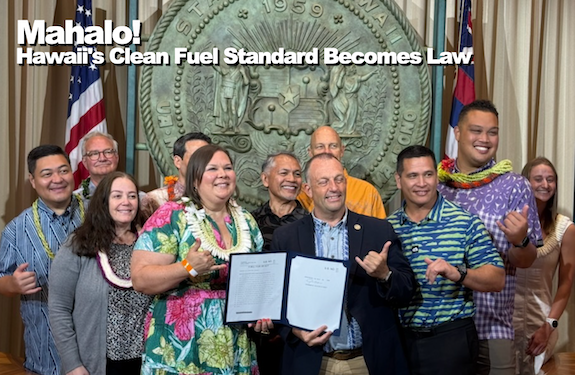
That thought returned to me this week as Governor Josh Green, M.D., signed Senate Bill 2999 into law, making Hawaii the fifth state in America to adopt a Clean Fuel Standard. Most stories will explain the legislation—and they should. It is an important piece of public policy that will shape transportation fuels across the islands for decades to come.
But standing beside that fuel pump, I found myself thinking less about legislation than about gratitude. Who, exactly, are we thanking?
Certainly, there are people whose persistence deserves recognition. Senator Chris Lee and Representative Nicole E. Lowen spent years building support for the legislation. Governor Green placed his signature where years of work met opportunity. Transportation Director Ed Sniffen and his colleagues now inherit the painstaking task of transforming legislative language into a functioning market. Renewable fuel producers, farmers, airlines, trucking companies, ports, researchers, entrepreneurs and investors will all play their part. Organizations across the clean fuels community patiently advanced the conversation through years when the outcome was anything but certain.
Every one of them deserves a heartfelt mahalo.
Yet in Hawai’i, gratitude has always seemed to reach beyond people alone.
It extends to the islands themselves—to the volcanic mountains rising from the Pacific, to the trade winds that cool an afternoon, to reefs and rainforests, to fertile valleys and working harbors, and to the generations who will inherit all of them. Visitors often think they understand Hawaii because they have learned the word aloha. Yet Hawaiians have long understood that aloha is less a greeting than a way of living in relationship—with one another, with the land, with the sea, and with the future.
Seen through that lens, Hawai’i’s Clean Fuel Standard feels less like a reaction to today’s politics than the latest chapter in a much older story.
Transportation is Hawai’i’s largest source of greenhouse gas emissions. It is also the state’s largest source of air pollution affecting the health of the people who breathe island air every day. That simple fact helps explain the urgency behind the legislation. Cleaner transportation is not merely an environmental aspiration; it is a public health strategy.
Energy itself has always carried unusual meaning in Hawai’i. Every gallon of gasoline, every drum of jet fuel, every container unloaded at Honolulu Harbor has already completed an extraordinary voyage across the Pacific. Energy is never an abstraction here. It arrives by tanker. It departs through tailpipes, ship funnels and jet engines. Every drop has traveled. Every decision about energy travels, too. The genius of Senate Bill 2999 is that it does not attempt to dictate a single technological future. Instead, it asks a deceptively simple question: which fuels can move people and goods while leaving behind a smaller carbon footprint?
The answer is measured through lifecycle carbon intensity rather than ideology. Fuels that reduce emissions generate credits. Higher-carbon fuels generate deficits. Renewable diesel, biodiesel, sustainable aviation fuel, renewable natural gas, electricity and technologies not yet fully imagined are all invited to compete. Government establishes the destination. Innovation discovers the route.
Governor Green has described this philosophy as building “co-beneficial models”—approaches where healthier communities, stronger economic opportunities and environmental stewardship reinforce one another instead of competing. Hawai’i’s Clean Fuel Standard embodies exactly that idea. Rather than asking residents to choose between prosperity and sustainability, it assumes the two belong together.
That is a remarkably Hawai’ian way of thinking.
The islands have always rewarded adaptability. Polynesian navigators crossed the largest ocean on Earth by understanding currents, stars and winds rather than forcing nature to conform to their wishes. Each generation has found new ways to prosper while remaining conscious of the extraordinary place it calls home. The Clean Fuel Standard continues that tradition.
Over the coming years, the Hawai’i Department of Transportation will establish lifecycle benchmarks and oversee a market designed to reduce transportation fuel carbon intensity by at least ten percent below 2019 levels by 2035 and by fifty percent by 2045. Alternative fuels will enter the program beginning in 2028, followed by conventional gasoline and diesel in 2029. The process will remain open to public participation through the department’s new Energy Security, Community and Culture Portal, ensuring that the conversation continues long after the governor’s signature has dried.
The larger destination is resilience.
A successful Clean Fuel Standard does more than lower emissions. It creates markets for innovation. It encourages investment in cleaner technologies. It expands opportunities for homegrown renewable fuels and for turning local waste streams into valuable energy resources. Materials once viewed simply as disposal problems may become tomorrow’s transportation fuels. It rewards measurable environmental performance rather than good intentions, creating new opportunities for agriculture, engineering, manufacturing and skilled trades.
Success will ultimately be measured not only in cleaner air but in whether Hawai’i’s families can continue to afford the paradise they call home. The legislation was intentionally designed to minimize cost-of-living impacts while encouraging investment that creates good-paying jobs here at home. That combination of environmental stewardship and economic opportunity is precisely what gives the policy its staying power.
Cory-Ann Wind, a Hawai’i native who serves as Director of State Regulatory Affairs for Clean Fuels, called the legislation “a pivotal moment in Hawai’i’s commitment to a sustainable future.” Coming from someone who knows both the islands and the industry, those words carry particular weight.
Perhaps that is Hawai’i’s greatest lesson.
For generations the islands have reminded visitors that paradise is not something simply inherited. It is something continuously cared for. Anyone can inherit beautiful islands. Keeping coral reefs alive, mountain forests healthy, harbors busy, communities vibrant and families prosperous is the harder task. It requires patience. It requires stewardship. It requires making decisions that honor both today’s needs and tomorrow’s inheritance.
Every civilization eventually writes its deepest values into law. In Hawai’i, those values have never been limited to economic growth alone, nor solely to environmental preservation. They ask a more enduring question: how do we care for the place that cares for us? The Clean Fuel Standard is one answer.
Years from now, few people will remember Senate Bill 2999 by number. They may not remember the exact implementation dates or the mechanics of credits and deficits. What they may remember is that Hawai’i chose a future that allowed the islands to remain prosperous without asking them to become something other than themselves.
One last mahalo.
To the people of Hawaii, certainly. But also to the many friends beyond the islands who quietly helped this day arrive.
The Low Carbon Fuels Coalition worked patiently and persistently toward this outcome, often far from the spotlight. Yet if there is one person I have watched wear out the air miles between Honolulu and the mainland over the years, it is Tim Zenk and his team at Earth Finance. While others were making speeches, Tim was usually catching another flight, sitting through another meeting, building another relationship, solving another problem. He’ll probably be the last person to ask for recognition, which is precisely why he deserves a little. Mahalo, Tim — and to all those, including Team Neste, who worked behind the scenes.
Now, we can say Aloha with a glad heart. It takes a lot of energy to run a paradise like Hawai’i — and now, it’s cleaner.
Category: Top Stories

