








The Parallax of Oil Prices
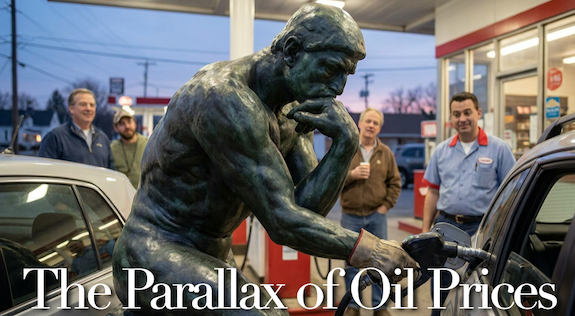
“Why don’t we ever learn?” Doug Durante recently posed the question directly in a thoughtful essay on America’s enduring vulnerability to global oil shocks.
It is a fair question, and a frustrating one. Every generation seems to rediscover the same lesson about oil dependence the hard way — through war, embargo, refinery shutdowns, price spikes, or lines at the pump. Then the crisis fades, prices soften, and attention drifts elsewhere. We return to normal life until the next disruption reminds us how exposed we remain.
But perhaps the deeper truth is this: the problem is not that we fail to learn. The problem is that societies cannot permanently operate in emergency mode.
People do not wake up every morning contemplating refining capacity in California or instability in the Strait of Hormuz. They think about school drop-offs, grocery bills, payrolls, aging parents, and whether the air conditioning will survive another Florida summer. Fuel remains mostly invisible until suddenly it isn’t.
That is the strange thing about oil markets. They create what might be called a parallax of price.
In astronomy, parallax describes how an object appears to shift depending on the observer’s position. Oil prices behave similarly. When prices are low, the world appears stable. Consumers interpret affordability as security. Politicians declare “energy independence.” Markets reassure themselves that the system is functioning normally. Yet the apparent calm can be deceptive.
Oil is not merely a commodity. It is a globally synchronized system whose price compresses enormous complexity into a single number posted on a roadside sign. Hidden inside that number are wars, shipping routes, refinery outages, OPEC calculations, currency flows, trader psychology, insurance rates, and geopolitical risk premiums stretching across continents.
When prices fall, those underlying tensions do not disappear. They simply become harder to see.
Then comes the disruption. An embargo. A revolution. A drone strike. A pipeline shutdown. A refinery closure. Suddenly the invisible structure underneath the system reappears, and society rediscovers its exposure all at once.
This is why the recurring argument over ethanol and renewable fuels deserves a more careful framing than the old binaries of “energy independence” versus “subsidy” or “oil” versus “green.”
The real issue may be resilience. Higher ethanol blends as Brazil has, as E85 affords, do something subtle but important: they partially decouple the retail gallon from the full force of global oil volatility. Not completely, of course. Oil remains deeply embedded in transportation, agriculture, petrochemicals, and global trade. But a gallon containing 85 percent domestically produced ethanol contains less embedded geopolitical exposure than a gallon containing 10 percent. That matters.
The value is not simply lower carbon intensity or farm support or octane enhancement, though those all matter too. The value is reduced exposure to forces beyond the driver’s control.
Brazil understood this after the oil shocks of the 1970s. Rather than treating the crisis as a temporary interruption, it embedded diversification structurally into the fuel system. Today, Brazilian consumers operate within a transportation economy that is materially less exposed to swings in global oil markets because ethanol occupies a far larger share of the fuel pool.
The United States largely chose another path. We pursued efficiency gains and expanded domestic oil production, both important achievements. Yet even as America became one of the world’s largest oil producers again, consumers remained tethered to global price dynamics because oil prices are globally set. That confusion still shapes public debate today.
“If we produce so much oil, why do overseas events still affect gasoline prices?” Because price is global even when production is local. And because refining capacity, logistics, and marginal supply still determine vulnerability.
This is where ethanol’s role becomes especially interesting. A barrel of crude yields only a fraction of finished gasoline once refining complexity is accounted for. Ethanol, meanwhile, arrives already as high-octane fuel. At higher blends, it does not merely supplement gasoline supply; it frees refining capacity and reduces pressure on constrained systems. That is not a wartime argument. It is a systems argument.
Nor is this about romanticizing mandates or pretending every renewable fuel policy has been wise. Markets distort. Subsidies calcify. Poorly designed incentives can preserve yesterday’s technologies while slowing tomorrow’s innovation. But there remains a legitimate strategic logic to maintaining multiple fuel pathways instead of optimizing entirely around one globally volatile system.
In that sense, renewable fuels resemble strategic reserves, backup generators, or crop insurance. They are not simply products. They are institutional memories. Civilizations preserve lessons not through constant emotional vigilance, but by embedding adaptive capacity into infrastructure.
Seat belts are memories of crashes. Flood levees are memories of storms. Diversified fuel systems are memories of shocks.
The public may not think about fuel security every day. Nor should they have to. The purpose of resilient systems is precisely to allow ordinary life to continue without requiring constant attention to distant instability. And perhaps that is the answer to the question “why don’t we ever learn?”
Maybe we do learn. Just not emotionally, continuously, or all at once.
Instead, societies learn imperfectly through structures that preserve optionality against the next surprise — systems that quietly endure long after the headlines fade and the prices at the pump temporarily fall back to earth.
History rarely changes all at once. More often, systems adapt through small structural revisions that preserve memory after a shock.
After blackouts, grids add reserves. After bank panics, liquidity rules tighten. The lesson becomes infrastructure. Perhaps the Strait of Hormuz tensions should leave behind one such memory in American fuel policy.
Not a grand national mobilization. Just a practical reduction in exposure.
One example would be finally normalizing nationwide year-round E15 sales by removing outdated regulatory friction around Reid Vapor Pressure waivers and fuel certification barriers that continue to treat modestly higher ethanol blends as exceptional rather than routine.
Another would be expanding the effective market for E85 adoption — not by forcing consumers into unfamiliar systems, but by allowing existing vehicles and infrastructure to utilize blends already approved for most of the U.S. fleet.
This would not sever America from global oil markets.
But it would slightly reduce the coupling between geopolitical instability and the family budget.
And perhaps that is how durable systems actually learn:
not through permanent fear,
but through incremental diversification quietly embedded after each reminder of vulnerability.
Category: Top Stories

