








Sherlock Holmes and the Case of the Great Octane Hunt
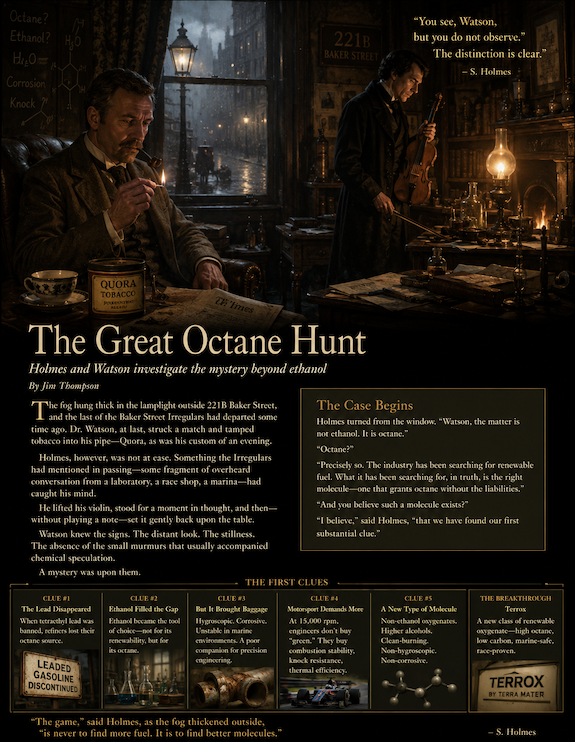
Being an account of a curious inquiry into the true nature of renewable octane.
The fog had settled heavily over Baker Street, softening the glow of the gas lamps into pale amber halos. The last of the Baker Street Irregulars had departed an hour earlier, their muddy boots and excited chatter leaving behind only silence and the faint scent of London’s damp evening.
Dr. Watson, relieved that no client had arrived bleeding, poisoned, or pursued by foreign agents, settled gratefully into his chair. He unfolded The Times, struck a match, and carefully lit his favorite pipe, already packed with a generous charge of Quora tobacco. It promised to be a peaceful evening. Sherlock Holmes had other ideas. He stood motionless at the window, watching the fog drift through the street below. Whatever one of the Irregulars had mentioned in passing—a remark overheard outside a racing garage, a marine workshop, perhaps a chemical laboratory somewhere upon the Continent—had taken hold of his extraordinary mind.
Without speaking, Holmes crossed the room and lifted his violin from its case. Watson waited. Usually the instrument announced the beginning of Holmes’s reflections. Tonight no note came. Holmes held the violin thoughtfully for a long moment before returning it gently to its stand. Watson quietly folded his newspaper. He knew this ritual well. When Holmes played, he was merely thinking. When he could not play, he had discovered a mystery.
“I suppose,” Watson ventured cautiously, “that my memoirs shall have to wait.”
Holmes smiled faintly. “I’m afraid so, my dear Watson.”
He turned from the window. “Tell me. What is the object of modern fuel?”
Watson answered readily. “To propel an engine.”
“No.”
“To reduce emissions?”
“No.”
“To replace petroleum?” Holmes shook his head.
“My dear Watson… those are merely the means.”
He picked up a fuel specification lying upon his desk.
“The world believes it is searching for renewable gasoline.”
“And it is not?”
“No.”
Holmes tapped the paper with a long finger.
“It is searching for octane.”
Watson frowned.
“I confess I do not follow.”
“Gasoline,” Holmes replied, “is merely the carrier. Octane is the quality every engineer is desperately trying to purchase.” Outside, a hansom cab disappeared into the evening mist.
“Consider Formula One. Le Mans. Daytona. Offshore racing. A fishing vessel lying idle through a damp winter in Maine. Their circumstances appear entirely unrelated.”
“They do indeed.”
“And yet every one of them wrestles with precisely the same question.”
“What question?”
“How does one obtain extraordinary combustion without inviting extraordinary trouble?” Watson removed his pipe.
“I presume this concerns ethanol?”
“Ah!” Holmes exclaimed. “There speaks the conventional wisdom.”
“Is it incorrect?”
“Not incorrect. Merely incomplete.” Holmes placed another document beside the first.
“For nearly two decades ethanol has been treated as renewable octane itself.”
“And it is not?”
“It is the first successful renewable octane molecule—but hardly the last.” Holmes paced slowly before the fire.
“Observe, Watson. Ethanol possesses admirable qualities. It raises octane efficiently and lowers the carbon intensity of gasoline. It earned its place honestly.”
“But?”
“It has unfortunate habits.”
“What sort of habits?”
“It is hygroscopic.”
Watson looked puzzled.
“I fear you must translate that into English.”
Holmes smiled.
“It drinks.”
“Drinks?”
“Water from the atmosphere.”
Watson considered this.
“I imagine boat owners would find that… inconvenient.”
“Inconvenient?” Holmes laughed softly. “Imagine leaving your violin outdoors throughout an English winter.”
“I should never dream of it.”
“Quite so. Yet marine engines do precisely that. Moisture enters the fuel. Water separates from gasoline. Corrosion follows. Aluminum carburetors oxidize. Seals deteriorate. Precision injectors resent the chemistry. Idle engines awaken reluctantly after months beside damp harbors. Racing engineers tolerate these shortcomings only because ethanol provides the octane they require.”
“So they accept an imperfect guest for the sake of its virtues.”
“Exactly.”
Holmes stopped pacing.
“Observe the pattern.”
He held up a finger.
“Engineers desired octane.”
A second finger.
“They tolerated ethanol.”
A third.
“They complained of corrosion.”
A fourth.
“They complained of water.”
A fifth.
“They complained of storage.”
“And finally?”
“They complained of emissions.”
Watson nodded slowly.
“They never truly desired ethanol.”
Holmes smiled.
“They desired its virtues without its vices.”
“So the inventor merely listened.”
“No, Watson.”
Holmes’s eyes brightened.
“The inventor solved the correct problem.”
He spread a map of northern Europe across the table.
“Until recently, I believed such a molecule impossible.”
“What changed your mind?”
“The Irregulars.”
Watson looked puzzled.
“I fail to see Baker Street upon that map.”
“You will not. My Baker Street Irregulars no longer confine themselves to Whitechapel. One wanders the paddock at Daytona. Another frequents the marinas of Florida. Several haunt the chemical works of Belgium and the Netherlands. One spends entirely too much time among ethanol plants in Iowa.”
“You have industrialized your intelligence service.”
“Progress, Watson.”
Holmes pointed toward the Scheldt estuary.
“One hears whispers near Ghent. Another reports unusual chemistry at North Sea Port. A third mentions a laboratory anchored in the old counties of Flanders whose chemists have persuaded ordinary bioethanol to become something altogether more… civilized.”
“You make it sound as though they educated the molecule.”
“In a sense, they did.”
Holmes handed Watson another report.
“Through what its creators rather immodestly call their patented 2X technology, ordinary bioethanol undergoes hydroformylation followed by hydrogenation, transforming lower alcohols into higher alcohols. The result remains an oxygenated fuel—but one possessing entirely different manners.”
Watson read silently.
“‘Non-hygroscopic.'”
“Precisely.”
“‘Non-corrosive.'”
“Indeed.”
“‘Octane greater than one hundred and ten.'”
“Enough to satisfy even the most demanding racing engineer.”
Watson continued reading.
“‘Sulfur-free. Cleaner combustion. Reduces lifecycle greenhouse gas emissions by roughly twenty-five percent compared with conventional gasoline. Advanced formulations synthesized from captured carbon promise still greater reductions. Eliminates sulfur emissions while dramatically reducing nitrogen oxides and volatile organic compounds.'”
Holmes nodded.
“You perceive the pattern.”
“It is not merely a renewable fuel.”
“No.”
“It is a redesigned molecule.”
Holmes smiled.
“Engineers, my dear Watson, do not purchase feedstocks.”
“No?”
“They purchase molecular behavior.”
Watson turned another page.
“And who, precisely, has accomplished this?”
Holmes allowed the silence to linger before answering.
“The molecule bears the name Terrox.”
“And its creator?”
“A Belgian enterprise known as Terra Mater BV.”
Watson examined the final pages.
“Remarkable chemistry—but surely years of regulatory obstacles remain.”
“On the contrary.”
Holmes slid one last document across the desk.
“The molecule is already registered with the United States Environmental Protection Agency as a gasoline additive.”
Watson looked up.
“Then this is no laboratory curiosity.”
“Precisely.”
“And now?”
“Now,” Holmes replied, “the chemistry leaves the laboratory.”
He unfolded another memorandum.
“The first commercial quantities are expected to reach the American East Coast marine market during the third quarter of 2026 through a strategic collaboration between Terra Mater and Hyperfuels LLC.”
Watson scanned the figures.
“Current production… one and a half million gallons annually in Belgium.”
“And the ambition?”
Holmes smiled.
“One hundred million gallons each year in the United States.”
Watson gave a low whistle.
“That is no experiment.”
“No.”
“That is an industry.”
The fire crackled softly.
Watson returned the papers.
“So we have found the perfect renewable fuel?”
Holmes looked almost disappointed.
“No, my dear fellow.”
“Then what have we found?”
Holmes lifted his violin once more.
This time he drew the bow across the strings, and a single clear note filled the room before blossoming into a gentle melody.
“We have finally learned the proper question.”
“And what question is that?”
Holmes smiled.
“The future will not belong to those who merely make renewable fuels.”
He drew the bow once more.
“It will belong to those who design the right molecules.”
Watson leaned back and smiled quietly.
The violin, he reflected, had never lied.
Holmes played only when the mystery had yielded its answer.
Outside, the fog rolled silently across Baker Street.
The game, as ever, was afoot.
Category: Top Stories

