








When the Music Stops: An inquiry into thrive traits, survival markers, failure modes in the bioeconomy
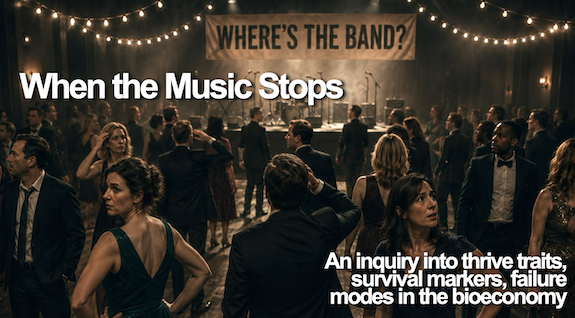
Everybody thinks musical chairs is a game of speed. It isn’t. The winner is not the fastest runner. The winner is the person who can still find a chair when the music stops.
Right now, the music is playing loudly in renewable natural gas and biogas.
Vanguard Renewables recently broke ground on a major anaerobic digestion facility in Minnesota, developed with TotalEnergies and designed to process more than 300 tons of food waste per day alongside dairy manure. OPAL Fuels and GFL Environmental continue advancing landfill gas projects in Alabama and Georgia. Across the Atlantic, St1 Biokraft recently secured a €260 million financing package to support biomethane expansion across the Nordic region. These are steel, concrete, capital, and construction schedules. And yet, behind the announcements, another conversation has begun.
A recent presentation by Ag-Grid Energy‘s Rashi Akki carried a revealing title: Profitability Without Policy: Making Biogas Work in a Post-Incentive World. That title captures an important shift. For years, the biogas industry focused on technology risk. Would anaerobic digestion work? Could food waste and manure be transformed into useful products? Could renewable natural gas compete?
Those questions have largely been answered. It works, biology, chemistry, engineering. Today, the challenge looks different. Projects are confronting shifting tax-credit regimes, volatile LCFS and RIN markets, uncertain financing environments, feedstock variability, operational complexity, and the simple reality that building and operating facilities is harder than modeling them on a spreadsheet.
The question is no longer: Can we build it? Increasingly, the question is: Can it survive reality? That distinction matters.
The new concerns
Anaerobic digestion itself offers an interesting metaphor. The digester is not a machine in the conventional sense. At its heart is a living ecosystem. Diverse microbial communities convert waste into useful products, but only if conditions remain balanced. The system depends on adaptation, resilience, and stability. Shock the ecosystem too severely and performance suffers.
Increasingly, bioeconomy projects appear to face a similar challenge. The technology may work perfectly. The ecosystem surrounding the project may not. What’s at stake is substantial. Agricultural biogas alone represents roughly 5,000 MW of renewable generating potential and approximately 45 terawatt-hours of annual baseload electricity. In an era increasingly concerned with AI data centers, grid reliability, industrial electrification, marine fuels, and low-carbon chemicals, these are no longer niche opportunities.
Which raises a question. Why do some projects continue advancing while others disappear? That question recently sent us back to the Bioeconomy Deployment Observatory. Rather than asking which technologies were succeeding, we asked a different question: What characteristics appear among projects that keep moving?
We used our new digital telescope, The Observatory, which looks intelligently at “galaxies of data”, to review 3,094 deployment records spanning 2019 through 2026 and examine them through the lens of persistence. The findings are not conclusions. They are working hypotheses. But several patterns stood out.
Thriving Traits
The first category might be called Thriving Traits. These are the deeper characteristics that appear repeatedly among persistent projects.
Specificity. Projects that clearly define what they will produce and how much they will produce appear more likely to continue advancing than projects built around broad aspirations.
Demand validation. Projects with identified customers appear more durable than projects that assume demand will emerge later.
Institutional memory. Organizations that repeatedly develop projects appear more resilient than one-time entrants.
Infrastructure attachment. Projects connected to existing industrial systems, ports, refineries, logistics networks, and operating facilities appear more durable than isolated greenfield efforts.
Survival Markers.
The second category is Survival Markers. These are observable signals rather than underlying traits. A named offtaker. A stated production capacity. Construction activity. Multiple years of visible progress. Repeat developers.
One of the most surprising findings was that a named offtaker appeared to be a stronger marker of persistence than disclosed financing. Similarly, a stated production capacity appeared to be a stronger marker than the amount of capital raised. That may tell us something important. Money is necessary. Reality is informative. A customer willing to buy the product. An engineer willing to commit to a production number. A contractor willing to pour concrete. These may tell us more about persistence than a financing announcement alone.
Failure Modes
The third category is Failure Modes. Here, the Observatory became especially interesting because the patterns were not merely statistical. They were practical. Projects built around tax-credit assumptions that later change. Those dependent on environmental-credit values that later weaken. Those who announce ambitions before securing customers. Those who underestimate operational realities.
In biogas, those realities can be surprisingly mundane. Sand used as dairy bedding can damage equipment and reduce performance. Variations in manure handling can affect system economics. Food-waste streams that appear attractive on paper can become operationally complex in practice. This is what fragility looks like. A failed ecosystem.
Perhaps the most surprising finding involved Final Investment Decisions. Conventional wisdom treats FID as the moment a project becomes real. Yet construction-stage projects displayed stronger persistence markers than projects that had simply reached FID. Steel in the ground proved more informative than decisions in the boardroom. At this point, it is worth returning to renewable natural gas. Because the sector may represent one of the most interesting real-time laboratories for persistence in the bioeconomy. Many successful RNG projects possess multiple revenue streams. Waste-management economics alongside fuel production. Defined customers alongside environmental credits. Infrastructure already in place. Operational experience accumulated over years. Flexibility regarding end markets.
In evolutionary terms, these are not optimization traits. They are survival traits. When one market weakens, another remains. When one policy changes, another source of value survives. When conditions shift, the project adapts rather than collapses.
Which brings us back to musical chairs. For twenty years, the bioeconomy has focused primarily on technology risk. Then it focused on economic risk. Increasingly, we may be entering an era defined by fragility risk. Not whether a technology can work. Not whether a project can be profitable. But whether a project possesses enough thriving traits, enough survival markers, and few enough failure modes to keep moving when conditions change.
The Bottom Line
The Observatory’s most striking observation may be the simplest one: Persistence is rare. Of the 3,094 deployment records examined, only 49 were observed more than once. Persistence was the exception requiring explanation, not the norm.
That statistic should be interpreted carefully. The Observatory measures signals, not outcomes. Successful operating plants often become quiet. Failed projects sometimes remain noisy. Visibility and viability are not the same thing. Yet the lesson remains. For decades, the bioeconomy has become increasingly sophisticated at measuring yields, carbon intensity, capital costs, incentives, financing structures, and technology performance. Perhaps the next frontier is measuring persistence itself.
Because eventually the music stops for everyone. And when it does, the question is no longer whether the technology worked. The question is whether there is still a chair waiting when the music ends.
Category: Top Stories

