









Diaper Change: What ZymoChem Teaches Us About Trust and Adoption
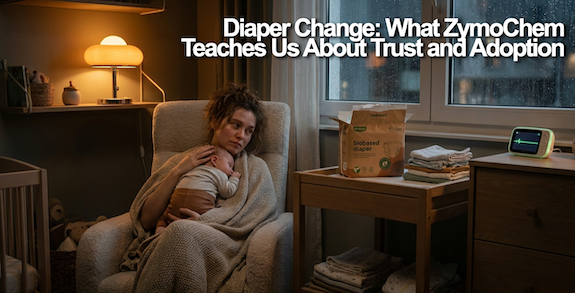
A leaking diaper at two in the morning is not a branding inconvenience. It is system failure.
There is no sustainability consultant standing beside the crib explaining polymer chemistry while exhausted parents strip sheets, search for clean pajamas, restart the washing machine, and try to calm a screaming child before sunrise. Which is why a grocery store diaper aisle may be one of the most unforgiving commercialization environments in the modern economy. Leak protection. Overnight dryness. Price. Done.
And that is precisely why a recent consumer trial from ZymoChem may reveal something important not merely about diapers, but about the future adoption of biobased technologies more broadly.
I want to talk for a few minutes with the people of the bioeconomy — that’s you — about adoption.
Not just with the few who spend their days studying commercialization pathways, consumer psychology, retail behavior, or sustainability marketing — but more particularly with the larger number whose companies, technologies, projects, and payrolls depend upon adoption occurring in the real world. Because there is a difference between a technology functioning and a system accepting it.
ZymoChem, utilizing what it calls “Carbon Conserving” biomanufacturing, recently conducted an In-Home Use Test for diapers using its BAYSE Bio-SAP, a bio-based alternative to the petroleum-derived super absorbent polymers that dominate the global diaper market. The performance results were impressive by any ordinary consumer standard.
An estimated 95.2% to 96.8% of the diapers experienced no leakage events during the trial. Parents rated the diapers highly for absorbency, dryness, softness, and skin comfort. More notably, 52% of respondents actually preferred the BAYSE diapers over the products they normally use. One participant cited “better absorption attributes than my usual product.” Another praised both softness and absorbency performance. That matters because diapers are not aspirational consumer goods. They are household infrastructure.
Parents do not casually experiment with products that can destabilize sleep schedules, laundry loads, childcare routines, daycare logistics, and already strained household economics. Which makes the ZymoChem findings useful not merely as product news, but as a kind of learning laboratory for understanding how adoption itself may now be changing. For years, many sustainability campaigns implicitly asked consumers to begin with moral aspiration. Buy the rougher paper towel. Drive the smaller car. Pay slightly more. Accept slightly less. Save the planet. And, sometimes, that worked, for a while.
But increasingly, the ZymoChem results suggest consumers may now be operating under a different hierarchy entirely. For years, much of the sustainability economy operated on an implicit commercialization sequence: Sustainability narrative → emotional alignment → adoption.
Tell consumers a product is greener, cleaner, more ethical, more circular, and adoption follows. But the ZymoChem trial hints that the topology may increasingly be running in the opposite direction: Functional trust → operational resilience → experiential proof → narrative openness → identity reinforcement. That is a very different model. And the most fascinating finding in the study may not have been absorbency at all.
Initially, parents evaluated the diapers strictly on performance. Before receiving additional information about the materials or sustainability characteristics, approximately 76% of respondents expressed positive purchase interest. Then the researchers explained the technology behind the diapers: bio-based SAP, biodegradable inputs, microplastic-free performance, and renewable carbon sourcing. Purchase interest jumped dramatically, reaching roughly 92%.
The sequence matters. Parents did not begin with ideology. They began with trust. Does it work? Will it hold up? Will this create problems for me? Can I rely on it under stress? Only after the product proved operationally trustworthy did the sustainability story become emotionally additive rather than economically risky.
The scale changes. The psychology does not. A procurement officer evaluating sustainable aviation fuel pathways may operate under the same basic zero-failure logic as a parent standing in the diaper aisle at 6 p.m. Both are being asked to introduce unfamiliar systems into environments where operational failure carries outsized consequences.
Airlines evaluating fuel pathways behave similarly. Lenders financing first-of-kind projects behave similarly. Utilities, manufacturers, industrial buyers, retailers, and infrastructure operators all increasingly prioritize operational trust signals over aspirational narratives.
In that sense, the ZymoChem diaper trial became something precious: a small observational window into how trust propagates through complex adaptive systems.
Inside the controlled environment of the study, the researchers themselves acted as a temporary coordination infrastructure. They translated unfamiliar terminology, explained the science, reduced ambiguity, and helped participants interpret what they were experiencing.
But in a supermarket aisle, that infrastructure disappears. No one is standing beside the shelf explaining polymer chemistry, renewable carbon pathways, biodegradation curves, fermentation-derived absorbency systems, or lifecycle carbon accounting. The package itself must carry the entire coordination burden in seconds. And that may explain why some sustainability messaging increasingly struggles under real-world conditions. One asks consumers to process atmospheric systems, industrial chemistry, manufacturing pathways, and lifecycle accounting. The other says: this product avoids placing plastic particles near your child. Under conditions of cognitive overload, the difference matters.
The modern retail environment is an extraordinarily compressed decision system. Consumers operating under time pressure rarely absorb multi-layered technical narratives in real time. Instead, they rely upon heuristics: trust, familiarity, performance, risk reduction, and social proof. The ZymoChem study also hints at a possible solution.
Perhaps the initial retail task is simple: establish operational trust first. Zero leaks. Soft. Reliable. Microplastic-free.
Then, after the product enters the home and survives contact with reality, the deeper sustainability story can unfold through inserts, QR codes, retailer ecosystems, loyalty programs, and post-purchase education. The study suggests consumers become remarkably receptive to the broader carbon and biotechnology narrative once trust has already been established experientially.
Franklin Roosevelt understood during the Depression that systems under stress cannot be coordinated through abstraction alone. His fireside chats did not avoid complexity, but they translated complexity into ordinary operational language people could use. Banking stability, industrial mobilization, lend-lease — all were explained through familiar examples grounded in trust and lived experience. The goal was not merely persuasion — it was coordinated participation. That may also become the defining commercialization challenge for large parts of the bioeconomy.
For years, many sectors assumed that if the technology worked, adoption would naturally follow. But commercialization is not just chemistry. It is translation. And tomorrow morning, a great many executives in biomanufacturing, advanced materials, sustainable fuels, and consumer products might profitably examine their packaging, presentations, websites, and investor decks with one uncomfortable question in mind:
How much cognitive burden are we placing on people before trust has even been established? The companies that scale may not necessarily be the ones with the most sophisticated technical language, the most elegant fermentation pathways, or even the strongest carbon metrics. They may be the ones that explain themselves clearly enough for participation to occur.
Category: Top Stories

