








Yes, Virginia, There Is a Heartland
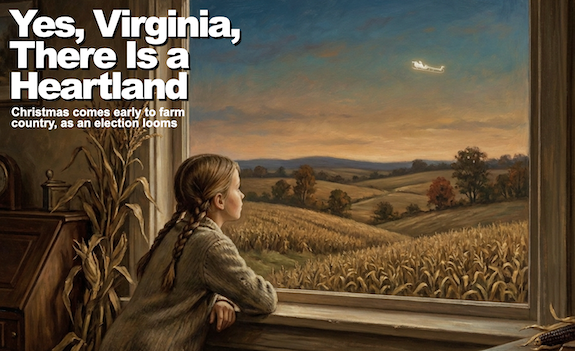
Christmas comes early to farm country, as Washington rediscovers the ancient art of the political Christmas stocking. There’s a little candy, a little hope, and perhaps something substantial beneath the wrapping paper.
Dear Mr. Lane,
Some of my friends say there is no Santa Claus. They say Washington has forgotten the Heartland, that nobody listens to farmers anymore, and that the days when government brought presents to the countryside are long gone.
Papa says that if you see it in the Digest, it’s so.
Please tell me the truth. Is there a Heartland Santa Claus?
Virginia.
Virginia, your little friends are wrong.
They have been affected by the skepticism of a skeptical age. They believe only what they see, and what they see these days across much of the Heartland is not especially encouraging.
Farm margins are under pressure. Equipment, fertilizer, energy, and financing costs have been stubborn companions. Rural industries are struggling to find the capital that turns good ideas into operating plants. The corn grows tall, but the bank balances do not always follow. It is enough to make even the most believing child wonder whether Washington has lost the address.
But yes, Virginia, there is a Heartland Santa Claus.
He exists as certainly as election cycles, agricultural subsidies, and the great American tradition of discovering the immense importance of rural communities just as November approaches.
Ah, how early we hear the jingle-jingle of Bing Crosby singing “White Christmas” this year. The air is turning crisp. Football is on television. Families are gathering. And across Washington, a familiar spirit of seasonal generosity has begun to stir.
Why, Virginia, does Christmas arrive in October? Because the midterm elections are on November 3, and in American political life, Christmas has occasionally been known to arrive a little ahead of schedule. This is not a Republican invention, nor a Democratic one. The old pork barrel has been rolling through American politics for longer than any of us can remember, distributing bridges, highways, dams, airports, agricultural programs, and occasionally a little candy to the children along the way.
There was a time when every congressman knew the way to a constituent’s heart passed through a federal appropriation. The pork barrel was an institution, and its contents were celebrated with brass bands and newspaper photographs. These days the packages often have different labels. Regulatory certainty. Energy security. Rural development. Strategic investment. But the sleigh is much the same.
And this week, Virginia, it is positively overflowing.
The first present: 770 million reasons to believe
Look! Coming down the chimney is EPA Administrator Lee Zeldin, carrying an unusually large package marked Renewable Fuel Standard.
Inside are 770 million Renewable Identification Numbers, or RINs, representing additional renewable fuel demand that EPA proposes to restore following its recent Small Refinery Exemption decisions. It’s a rather handsome present.
For readers unfamiliar with the peculiar machinery of the Renewable Fuel Standard, the idea is straightforward. Federal law requires specified quantities of renewable fuel to enter America’s transportation fuel supply. Refiners demonstrate compliance by blending renewable fuels or acquiring tradable credits, the famous RINs. Small refineries experiencing disproportionate economic hardship can obtain exemptions from those requirements. This provides relief to qualifying refiners, but it can also reduce the market demand supporting ethanol, biodiesel, renewable diesel, and other renewable fuels.
And in August, EPA granted full or partial exemptions to 29 small refineries, covering approximately 1.76 billion RINs. Now comes Administrator Zeldin with a proposal to account for the additional 770 million RIN difference between the exemptions EPA had anticipated and those it actually granted. The agency offers two choices: spread the supplemental obligation across 2026 and 2027, or put the entire amount into 2027. Either way, the proposal calls for 100 percent reallocation of that additional volume.
For the renewable fuels industry, that is meaningful news. The Renewable Fuel Standard provides a demand framework against which agricultural producers, fuel manufacturers, investors, and lenders make decisions. Restoring waived demand can help preserve that framework.
Clean Fuels Alliance America has welcomed the move, with Vice President of Federal Affairs Kurt Kovarik favoring the option that divides the supplemental volume between 2026 and 2027. The reasoning is understandable: a market signal arriving sooner is more useful to companies making production and investment decisions today.
Iowa Senator Chuck Grassley and other farm-state lawmakers have been pressing for full reallocation as well.
And here, Virginia, we should acknowledge something often forgotten in the season of cynical commentary. It matters to the farmer looking for markets for soybeans and corn. It matters to the renewable fuel producer trying to maintain utilization. It matters to the lender trying to decide whether a project has dependable customers. A federal regulatory decision can influence millions of gallons of demand and millions of dollars in commercial decisions, without a single grant check changing hands.
There is, of course, a small matter printed on the gift tag. Proposed rule. Subject to public comment. The present has not quite been delivered. And the obligation being restored is demand that the exemption process itself helped remove. But we needn’t spoil the festivities. The EPA is proposing a consequential adjustment, and the agricultural and renewable fuels communities have good reason to examine it with interest.
Santa has remembered the address.
The second present: All roads lead to Nebraska
And what’s this? More sleigh bells?
This time the sound comes from Nebraska, where Energy Secretary Chris Wright and senior federal officials are expected on Wednesday for a round of visits celebrating American energy, agriculture, and industrial development.
At York, Assistant Secretary of Energy Audrey Robertson is scheduled to visit Green Plains’ biorefinery, where agricultural processing offers a glimpse of the Heartland’s industrial future. The modern biorefinery is increasingly more than a place where corn becomes ethanol. It is a platform for fuels, feed ingredients, chemicals, and other value-added products that can strengthen agricultural markets.
Meanwhile, Secretary Wright is scheduled to visit NioCorp’s Elk Creek Critical Minerals Project, accompanied by senior federal and state leaders. There, the discussion turns from crops to niobium, scandium, titanium, and rare earth elements—materials important to American manufacturing, aerospace, defense, and energy supply chains. Afterward comes a farmer roundtable in Louisville, where the concerns of agricultural producers can receive attention at the highest levels of the Energy Department. One can scarcely imagine a more complete itinerary through the modern Heartland: agriculture, industrial processing, strategic minerals, and energy costs. And there is something encouraging in this broadening recognition of rural America’s importance.
The Heartland is not simply the nation’s breadbasket. It is an immense industrial resource, capable of supplying food, fuels, materials, and manufacturing inputs essential to the national economy.
A Cabinet visit does not finance a plant, and the photographers generally depart before the construction invoices arrive. But attention is not nothing. It can open doors, attract partners, and bring important projects before people capable of moving them forward. Sometimes the first present under the tree is simply the knowledge that somebody important has finally shown up.
The third present: Bring your own wrapping paper
And finally, Virginia, we have something from the Department of Agriculture.
On Tuesday, USDA turned attention to the Rural Energy for America Program, or REAP, through a public webinar explaining the program to potential participants. REAP has long helped agricultural producers and rural small businesses finance renewable energy systems and energy-efficiency improvements. Now, here is something that ought to bring comfort to the countryside.
There is, however, a curious new feature. Under USDA’s revised rules, taking effect October 16, applicants generally must first complete their projects, operate them, and document 12 months of actual energy performance before applying for grant assistance. USDA’s purpose is to replace forecasts with demonstrated results and make awards on the basis of actual energy production or savings. A sensible objective, certainly.
But it introduces an interesting difficulty for the farmer who needs the grant in order to afford the project. To receive the assistance, he may first need to finance the work, build the installation, operate it for a year, and then apply for an award that remains subject to eligibility, competition, and available funds.
It is rather like Santa announcing that henceforth children should purchase their own presents, assemble them, use them successfully for 12 months, and then apply to the North Pole for reimbursement. One admires the fiscal discipline. One wonders about the children.
For a well-capitalized business, reimbursement after proven performance may be quite workable. For a smaller enterprise that needs assistance with initial construction, the arrangement may present a formidable obstacle. USDA argues that the changes will simplify administration and reward measurable outcomes. Critics worry that the requirement to finance projects first will exclude precisely those rural businesses with the greatest need for help. Both considerations deserve attention. A program that rewards successful investment and a program that enables otherwise impossible investment are not quite the same thing. And that difference may prove important when the Christmas decorations come down.
The old pork barrel rolls again
And so, Virginia, we return to the great mystery.
Why has Washington suddenly rediscovered the Heartland? Perhaps because its economic importance has become impossible to overlook. Perhaps because the pressures facing American farmers and rural manufacturers demand attention. Perhaps because three weeks before an election is a particularly convenient moment to remind people that government can do things.
American political history suggests that all these explanations can coexist quite comfortably. The pork barrel was never a purely sinister institution. For all its extravagance, favoritism, and occasional absurdity, it was also one of the ways a large federal republic directed resources toward communities that wanted roads, water systems, agricultural markets, hospitals, schools, and jobs. Some investments were ill-conceived. Some were overdue. Some changed the fortunes of entire regions.
And as the pickings grow lean around kitchen tables across the Heartland, it is difficult to begrudge rural communities a little renewed interest from Washington. There is a sigh in all this, more than a complaint. Wouldn’t it be pleasant if every month were October in an election year? If officials regularly visited the communities whose livelihoods depend on their decisions? If regulatory clarity arrived promptly, financing programs worked predictably, and the American Heartland never had occasion to wonder whether it had been forgotten?
But government has its seasons, just as agriculture does. Planting season. Harvest season. And election season.
The skeptics may insist that the presents are small, the promises uncertain, and the timing suspiciously convenient. They are entitled to their doubts. There is plenty of room for careful examination of every package beneath the tree.
But those who doubt the power of an Administration to move expectations, brighten prospects, and influence the direction of investment might profit from a familiar experiment. Put out a bowl of candy. Hide behind the Christmas tree. And watch what happens when the children discover it.
The candy does not guarantee a prosperous year. It cannot repair every farm balance sheet or finance every new biorefinery. But one needn’t believe in miracles to recognize that even a modest change in the prospects of a hard-pressed community can mean a great deal.
Yes, Virginia, there is a Heartland. And yes, Washington knows where to find it. Especially in October of an election year.
One hopes that, when Christmas actually comes, there will still be something beneath the tree.
Category: Top Stories

