









The New Big Boys of the Bioeconomy: Ballard, Avantium find that scale is more than size, it’s scope
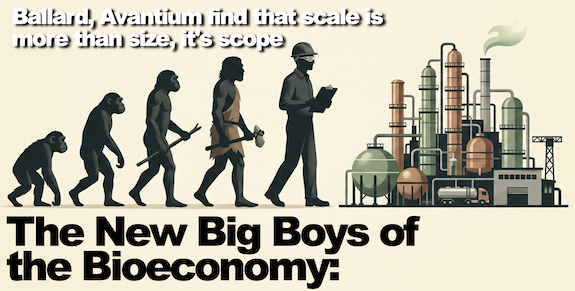
Somewhere between adolescence and maturity, a line is crossed, yet no one hands you a diploma, rings a bell, or hosts a party — we know the moment has arrived because, one morning, everybody has stopped applauding your pilot plant and started asking whether you can deliver 10,000 tonnes on Tuesday.
You’re a Big Boy now.
And with that come responsibilities that never beset the owners of pilot projects, because pilots are constructed to answer the wonderfully bounded question of whether your thing works, while commercial enterprises inherit the sprawling and considerably more expensive problem of whether everything around your thing works, too — whether the feedstock arrives, whether the hydrogen is available, whether the trucks run, whether the material qualifies, whether the customer buys, whether the customer buys again, and whether all these things happen at roughly the same time and roughly the price somebody put into the spreadsheet three years ago.
For some, maturity first appears as a downstream imperative: you have learned how to make the stuff and now must ensure that sufficient demand exists to take it away. For others, it arrives upstream: you have customers for the thing but must ensure that sufficient fuel, feedstock, infrastructure and logistics exist to make the promise good. Eventually, of course, it’s both, at once.
You see, scale isn’t about size. It’s about scope. A bigger reactor is size. A larger fermenter is size. A hundred-million-gallon nameplate is size. Scope is the less photogenic business of taking responsibility for the chain of dependencies that allows all that magnificent stainless steel to earn money.
This week, two old friends of the Digest are in the news, having made strikingly different moves on opposite sides of that invisible line. One looked downstream, one upstream.Avantium and Ballard have crossed the bar: Welcome to the Big Boy Club.
Avantium: The Perimeter Moves Downstream
For Avantium, the story begins with sugar.
Its YXY technology catalytically converts plant-based sugars into furandicarboxylic acid, better known around the renewable-chemicals neighborhood as FDCA, the principal building block for polyethylene furanoate, or PEF — the renewable and recyclable polyester Avantium now markets under the releaf brand.
The chemistry did not arrive yesterday. Avantium built its 15-ton-per-year FDCA pilot plant at Geleen in 2011, using the facility to improve the process, develop the engineering package and, critically, put PEF into the hands of partners who could determine whether the material did something useful after leaving the laboratory. There followed the BASF/Synvina chapter, the eventual return of full ownership of the YXY plants-to-plastics technology to Avantium, and the long march toward the world’s first commercial FDCA plant at Delfzijl.
That’s one way a technology grows up: laboratory, pilot, demonstration, commercial plant, but it is only one dimension of growing up.
Because producing FDCA does not automatically create a market for FDCA, and producing PEF does not mean that a converter knows what to do with PEF. Between a clever molecule and somebody buying a bottle lies an industrial archipelago of polymerization, additives, masterbatches, colors, films, fibers, bottles, converters, brand owners, specifications and qualifications — each perfectly capable of becoming the small missing bridge that prevents the molecule from reaching the customer.
Enter Sukano.
The Swiss company specializes in additive and color masterbatches — concentrated formulations that allow polymer producers and converters to modify performance and processing characteristics for particular applications. Avantium and Sukano have been working together since 2022, when they entered a collaboration and conditional offtake agreement to develop masterbatch solutions for PEF. Sukano’s work has helped open industrial film, fiber and bottle applications and supported PEF scale-up on industrial production lines.
Then, on September 1, the relationship changed again: Sukano signed a capacity reservation agreement for releaf. Sukano isn’t simply reserving some tonnes coming out of Avantium’s first commercial plant. It has secured access to future releaf production volumes from industrial-scale facilities to be built and operated by Avantium’s potential licensing partners.
Avantium isn’t merely finding a customer for the tonnes it expects to make at Delfzijl; it is cultivating the compounders, converters and applications that can create demand for tonnes that haven’t been made yet, in plants that haven’t been built yet, operated by licensees who may themselves still be assembling the business case for building them.
That is a rather different enterprise from proving that YXY works. And it matters particularly because Avantium’s eventual opportunity is larger than one factory in the Netherlands. A licensing business succeeds when somebody else can look at the technology package and conclude that there will be a market waiting when the plant comes on stream. Sukano’s reservation does not guarantee the sale of every future tonne, but it moves one important downstream uncertainty from Who will use this stuff? toward Here’s somebody preparing to use it.
Meanwhile, the perimeter continues to widen elsewhere. Avantium’s Ray Technology targets plant-based monoethylene glycol and monopropylene glycol — plantMEG for polyesters including PEF and PET, plantMPG for applications including de-icing and heat-transfer fluids — while Volta extends the renewable-carbon proposition into electrochemical carbon capture and utilization. That’s downstream adulthood.
Ballard: The Perimeter Moves Upstream
Ballard arrived at the same line from the opposite direction.
At the center of Ballard’s world is the proton-exchange membrane fuel cell, in which hydrogen supplied to the anode is separated into protons and electrons; the electrons travel through an external circuit and do the useful work we call electricity, the protons pass through the membrane, and everything is reunited with oxygen at the cathode to produce water and heat. Stack enough cells together, engineer the system properly, and you have a modular source of electric power suitable for demanding applications ranging from buses and rail to marine and stationary power.
Wonderful. Except, you need hydrogen.
You can make the finest hydrogen fuel cell since Prometheus stole fire, but without hydrogen it is Stephenson’s Rocket without coal, a dreadnought without bunker oil, Apollo 11 without kerosene and liquid oxygen — a triumph of engineering that isn’t going anywhere.
For a component supplier, that can be somebody else’s problem. For a Big Boy, somebody else’s problem has an irritating habit of becoming your problem. So Ballard bought the problem.
On August 28, Ballard closed its acquisition of Britain’s GeoPura Limited, and this wasn’t simply the purchase of another fuel-cell engineer. This was no casual toe-in-the-water joint venture; it was a £275 million balance-sheet restructuring of corporate destiny. Ballard wrote an £82.5 million cash check and diluted its own equity to hand former GeoPura shareholders a 14.1 percent pro-forma stake in the combined enterprise, effectively inviting the molecule guys right into the boardroom.
GeoPura designs, manufactures and operates its Hydrogen Power Unit, or HPU, using Ballard fuel-cell modules at the core to provide clean, low-noise off-grid electricity with “6-9’s” reliability. GeoPura also produces green hydrogen through electrolysis at dedicated facilities and operates the UK’s largest compressed-hydrogen distribution fleet.
Follow the chain:
-
Hydrogen production
-
Hydrogen logistics
-
Hydrogen delivered to the site
-
Hydrogen into an HPU
-
Fuel cell converts hydrogen into electricity
-
Customer gets power
Ballard can now wrap the entire chain into an Energy-as-a-Service proposition rather than merely shipping the customer a fuel-cell module and wishing everyone good luck with the rest. That’s changing the company.
And it changes the addressable problem. GeoPura’s world includes construction sites, events, film sets, healthcare, defense and temporary infrastructure — places where customers don’t necessarily wake up wanting hydrogen, or even a fuel cell. They wake up wanting reliable electricity somewhere the grid cannot conveniently provide it.
Which is one of the oldest lessons in business: customers rarely want your technology nearly as much as you do, they want their problem solved. Avantium has a molecule and is reaching toward the customer. Ballard has a machine and is reaching toward the molecule.
What the Big Boys Know
Look around the industrial landscape and you see the mature operators drawing the same widening circle — not because every company must own every truck, reactor, pipeline and customer relationship, but because industrial scale eventually forces someone to take responsibility for the interfaces between them.
Air Liquide does not content itself with demonstrating an elegant pathway for cracking ammonia back into hydrogen. At the Port of Antwerp-Bruges it has moved that chemistry into a 30-tonne-per-day industrial-scale pilot, bringing proprietary technology together with the operating experience and infrastructure required to contemplate the next jump toward world-scale ammonia cracking.
Topsoe, similarly, isn’t merely offering an ammonia catalyst from the catalog. At ACWA Power’s Yanbu Green Hydrogen Project it is supplying dynamic ammonia technology, engineering, proprietary equipment and catalysts into a development organized around gigawatt-scale green-hydrogen production.
Notice what has happened in both cases. The catalyst remains essential, but now so do engineering, equipment, infrastructure, integration and the ability to make the interfaces behave.
The Ghost at the Birthday Party
The bioeconomy’s graveyard is filled with companies that confused nameplate capacity with commercial viability, paying ruinously expensive tuition for lessons in elementary supply-chain physics.
KiOR remains the most haunting ghost at this particular birthday party.
Its biomass-to-fuels technology attracted enormous attention and enormous capital, and Columbus, Mississippi gave the industry something physically impressive to point toward. But the problems that followed — bottlenecks, mechanical reliability, catalyst performance, costs and ultimately the inability to achieve dependable steady-state commercial production — demonstrated a truth that ought to be engraved somewhere above the entrance to every scale-up committee meeting:
You can scale size faster than you scale scope. A commercial-sized vessel does not create a commercial enterprise. Nor does a nameplate rating, a ribbon cutting, a commissioning announcement or a photograph of executives in hard hats standing beside an extremely large stainless-steel object.
The adolescent question is: Does the technology work? The commercial question is: Does the system work? And the fully industrial question may be harder still: How much of the system are you prepared to take responsibility for when it doesn’t? That’s the line Avantium and Ballard are crossing.
Not because either has suddenly become Air Liquide, or because all the risks of PEF or hydrogen have magically disappeared. They haven’t. The remaining tests are precisely the tests that come with adulthood: economics, dependable production, customer adoption, utilization, margins, repeatability and ultimately positive cash generation. The difference is that the perimeter has moved.
You’re a Big Boy, Now
Somewhere along the long, unforgiving road that stretches from a quiet laboratory in Geleen to the roaring commercial reactors of Delfzijl, or from the sterile bench-test environment of a fuel-cell lab to a heavy-duty hydrogen truck thundering down a rain-slicked British motorway, the perimeter of industrial responsibility quietly and permanently shifts.
It is not that the core technical artifacts lose their magic—the molecule remains essential, the catalyst remains vital, the proton-exchange membrane remains an engineering marvel, and the reactors, electrolyzers, masterbatch formulations, and containerized power units all retain their central places on the schematic diagrams. Rather, it is that the enterprise itself can no longer afford the luxury of asking the world to admire what happens inside its stainless-steel fence line, because commercial survival now demands that leadership concern itself with the unglamorous friction of everything beyond it: the queue at the loading dock, the temperature parameters inside the converter’s factory floor, the logistics of the transport fleet, the site-readiness of the end user, the legal architecture of the licensing agreement, the covenants on the balance sheet, and, ultimately, the unyielding reality of the customer’s cash register.
That shift in perspective isn’t merely a matter of physical expansion or capital expenditure; it is the very definition of industrial adulthood.
Because scale, when stripped of its promotional gloss, has never been a simple measure of physical size—it is, and has always been, an intricate orchestration of operational scope. Avantium looked downstream beyond its own factory gate and began cultivating the broad commercial ecosystem that its future licensed capacity will require to thrive; Ballard reached upstream into the logistical mud to construct the turnkey hydrogen backbone that its end-use customers require to operate today. They chose different directions and deployed vastly different technical toolkits, yet both were navigating the exact same rites of passage toward value-chain maturity.
And somewhere out there in the real world, past the press releases and the ribbon-cuttings, the telephone on the desk is ringing off the hook.
Industrial procurement needs ten thousand metric tonnes delivered by second-shift Tuesday—and because you’re a Big Boy now, you had better pick up the receiver and answer the call.
Category: Top Stories

