








The Magnus Effect: new sensors via NSF, BioMADE look deep inside the system
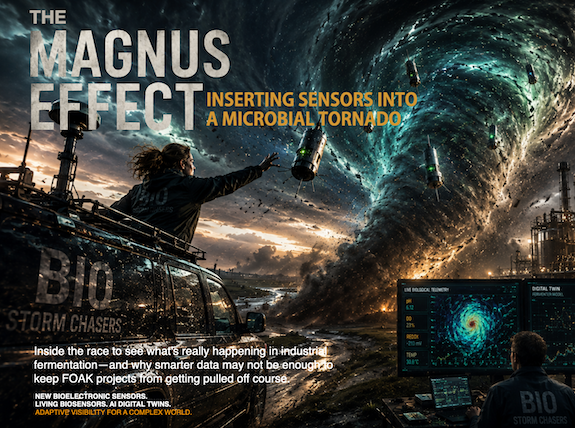
Evolution, at its core, is a tornado.
A stainless-steel tank towers over the pilot floor, warm to the touch, alive with invisible motion. Inside, billions of microbes surge through gradients of sugar, oxygen, heat, stress, and waste, adapting minute by minute to changing conditions no operator can fully see. Tiny asymmetries amplify. Nutrients vanish. Waste accumulates. Metabolisms shift. Local turbulence becomes system behavior.
A team of researchers from Boston University and Capra Biosciences wants to throw sensors directly into the storm. It’s the movie Twister at nano-scale, except the tornado is alive.
Backed by the U.S. Department of Defense and the National Science Foundation through BioMADE, the project proposes wireless networks of free-floating microbial-electronic sensors drifting through industrial fermenters, transmitting real-time data on redox conditions, media composition, intracellular stress, and cell health as the microbial weather shifts around them. The technology itself is fascinating: miniaturized low-power CMOS electrochemical sensor arrays paired with whole-cell biosensors in Yarrowia lipolytica, feeding continuous streams of biological telemetry into AI and machine-learning systems designed to create adaptive digital twins for industrial fermentation.
But the deeper significance may lie elsewhere.
Industrial biotechnology has historically treated fermentation as a recipe problem. Add ingredients, maintain conditions, wait for output. Yet every scale-up engineer knows the uncomfortable truth: a large fermenter is not a larger flask. It is a changing environment with local climates, shifting gradients, hidden turbulence, oxygen deserts, heat pockets, transient stress zones, and constantly evolving biological responses. The fermenter is less a vat than a weather system.
That challenge becomes even greater as industrial biotech moves away from purified laboratory feedstocks and toward heterogeneous real-world carbon streams — agricultural residues, waste biomass, and anaerobic digestate whose chemical profiles shift constantly with geography, weather, seasonality, and upstream industrial conditions. The sensors don’t merely watch the microbes. They translate outside turbulence into a language the fermenter can understand. Real industrial systems rarely behave like rigid machines moving through empty space. They behave more like spinning bodies moving through turbulent media.
In physics, the Magnus effect occurs when a spinning object moving through a fluid drags the surrounding flow unevenly, generating pressure asymmetries that curve its trajectory. A baseball bends. A soccer ball swerves. Tiny rotational differences amplify into visible directional change. Industrial biotechnology often behaves the same way.
The “spin” of a project — operational tempo, financing assumptions, feedstock flexibility, regulatory timing, customer qualification, infrastructure readiness — interacts continuously with the turbulent media surrounding it: policy shifts, commodity markets, logistics constraints, construction delays, energy prices, workforce shortages, and changing investor expectations. Tiny asymmetries compound. Delayed financing intersects with changing feedstock chemistry. Construction schedules collide with policy cycles. Supply-chain friction amplifies biological variability. The project curves.
This is where many First-Of-A-Kind projects encounter trouble. Traditional techno-economic analysis often treats commercialization as a relatively linear pathway from innovation to scale. But FOAK systems are rarely static equations. They are dynamic adaptive structures moving through unstable industrial weather. The project accumulates coordination complexity faster than the system can energetically stabilize and maintain it.
That may help explain one of the enduring paradoxes of industrial biotechnology. The sector has become extraordinarily sophisticated at sensing, sequencing, engineering, modeling, and optimizing biological systems while still struggling, in many cases, to produce large volumes of inexpensive molecules under commodity-scale conditions. Industrial biotech has never lacked intelligence. The unresolved question is whether greater local awareness inside the fermenter can overcome incoherence outside it. The floating sensors inside this BioMADE project may help reduce one critical form of entropy: observational lag. By the time operators detect a process deviation today, the biology may already have shifted. The new approach attempts to collapse the delay between changing biological conditions and adaptive response, moving industrial fermentation closer to a continuously aware system. That matters enormously. Commodity-scale biology likely cannot remain partially blind forever.
Yet local coherence does not automatically create global coherence. A fermenter can become exquisitely self-aware while the surrounding industrial organism — feedstocks, financing, infrastructure, regulation, construction timelines, energy systems, logistics, and customer demand — remains fragmented and asynchronous.
The biology works. The system doesn’t.
Or more precisely: local coherence fails to produce system-wide phase alignment. The long-term promise of projects like this may not lie solely in smarter fermenters, but in creating digital twins capable of synchronizing adaptation across the broader industrial organism itself — linking feedstocks, biology, infrastructure, financing, and operations into continuously aware systems rather than disconnected silos reacting after the fact.
Because persistence does not emerge from intelligence alone. It emerges from timing, flow, damping, coordination, and the ability to maintain coherence while moving through turbulence. That is true of tornadoes, fermenters, FOAK projects — and perhaps industrial civilization itself.
Category: Top Stories

