








The LanzaTech/DTU Deal: The Nimble Evolution of the Bioeconomy’s Wascally Wabbit
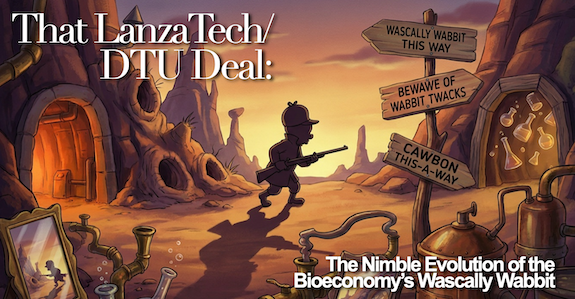
“Got you at last, you wascally wabbit.”
Elmer Fudd leveled the shotgun confidently at the rabbit hole. This time, he was sure. The tunnels had been mapped. The exits blocked. Financial pressure applied. Short sellers deployed. The economy in disarray. Carbon in retreat. The rabbit, surely, had nowhere left to go.
Then two Bugs Bunnys emerged from two separate holes at exactly the same moment.
From behind, they looked entirely different. One Bugs carried SAF in a large flask distilled from industrial carbon gases. The other carried multiple test tubes of low-carbon chemicals derived from CO, CO₂, and methane.
Elmer swung the shotgun wildly between them. Then both rabbits turned and looked at him. Same face. Same calm grin. Same rabbit. Elmer froze. Which Bugs mattered most? Which tunnel led to the real escape route? Which pathway should he pursue? Naturally, by the time Elmer tried to decide, both rabbits were gone.
The trick was a mirror. There were not two Bugs Bunnys at all, but one rabbit moving through multiple pathways faster than Elmer Fudd could resolve which set of wabbit twacks led to the real Bugs.
Industrial biotechnology increasingly works the same way.
This month, in a quieter but not entirely unrelated struggle, LanzaTech and Technical University of Denmark (DTU) announced plans to establish a next-generation C1 biofoundry in Europe.
On May 5, DTU and LanzaTech unveiled a multi-year partnership hosted by BRIGHT — the Novo Nordisk Foundation Biotechnology Research Institute for the Green Transition to engineer microbes capable of converting industrial carbon gases into fuels, chemicals, and materials.
In practice, this means robotic liquid handlers assembling thousands of microbial variants simultaneously. Automated systems perform parallel DNA construction, fermentation assays, and metabolic screening while machine-learning models search the resulting data for pathways capable of converting waste carbon into commercial products.
In older laboratories, researchers pursued one rabbit hole at a time. Biofoundries industrialize the search itself.
At first glance, this sounds like another synthetic biology infrastructure story: robotic workstations, AI-assisted Design-Build-Test-Learn cycles, automated strain engineering, and the usual promises of accelerating the bioeconomy. But the deeper significance of the partnership is not merely technological. It is evolutionary.
For years, LanzaTech was primarily understood as a gas-fermentation company — a specialist organism attempting to prove that industrial waste carbon itself could become feedstock. Working with non-model anaerobic microbes feeding on flammable or toxic gases requires extraordinary coordination between biology, engineering, process control, economics, and patience.
That was already hard enough. But surviving long enough to commercialize a molecule is only one evolutionary hurdle. Surviving long enough to multiply the pathways through which the capability itself can persist is another. The DTU partnership suggests that LanzaTech is attempting a deeper transition: from platform company to distributed infrastructure layer.
Different rabbit holes. Same rabbit. Different products. Same C1 metabolism.
From the outside, the pathways can appear unrelated. Sustainable aviation fuel. Low-carbon chemicals. Licensing agreements. Industrial carbon capture. European biofoundries. But when the system turns around, the same face keeps appearing: a common C1 metabolic architecture coupled to an increasingly distributed industrial learning system. Or, to put it another way: different Bugs, same bugs.
That matters because industrial biotechnology has entered a far harsher phase of selection pressure. The easy capital years are gone. Investors increasingly demand not merely technical brilliance, but repeatability, reliability, and durable pathways to scale.
Synthetic biology has already experienced its share of Elmer Fudd moments — vast expenditures of energy pursuing elusive targets through unstable terrain, often accompanied by a loud noise and an explosion in the hunter’s own face.
Amyris demonstrated that extraordinary metabolic engineering capability does not automatically guarantee commercial persistence. Elegant biology can still collide with hostile economics, scale-up friction, feedstock volatility, regulatory delay, and the simple reality that capital markets often exhaust patience before biology exhausts possibility.
None of this guarantees profitability. Advanced biofoundries can require tens of millions of dollars in capital expenditure before producing meaningful commercial returns. Their economics remain exposed to feedstock pricing, energy costs, policy frameworks such as 45Z, scale-up reliability, and long-cycle market adoption. The rabbit holes may multiply. And Elmer still has ammunition.
What biofoundries attempt to change is not merely the speed of discovery, but the thermodynamics of adaptation itself. At their core, biofoundries create a kind of hall of mirrors for carbon: systems in which the same underlying C1 architecture can be explored across multiple simultaneous commercial pathways, allowing companies to adapt faster than markets, competitors, or financing pressures can fully constrain them.
From a GTESI perspective — the General Theory of Evolutionary Systems & Information — this matters enormously because persistence depends not merely on invention, but on how efficiently systems process disorder, compress learning, and maintain trust under pressure. GTESI describes four major persistence vectors, and biofoundries touch all of them.
First, they improve Entropy Export Delta (EED) — or, in Elmer Fudd terms, how to survive a thousand exploding shotguns without blowing up the rabbit. The multiple rabbit holes function as entropy-export valves. Instead of allowing biological failure to accumulate catastrophically inside a single pathway, the biofoundry rapidly distributes unsuccessful experiments outward while promising pathways continue moving underground.
Second, they reduce Symbolic Compression Divergence (SCD): the dangerous gap between narrative and operational reality. Synthetic biology has historically suffered from stories outrunning factories. Biofoundries help compress ambition into repeatable workflows, statistically robust datasets, and measurable engineering performance.
Third, they lower Inverse Persistence Ratio (IPR): the gap between symbolic excitement and structural memory. Every Design-Build-Test-Learn cycle leaves behind validated workflows, genetic libraries, scale-up data, engineering knowledge, and operational memory that persist even if specific commercial projects fail.
And fourth, they reduce Trust Ritual Friction Index (TRFI): the friction that emerges when biological systems behave inconsistently. Robotic liquid handlers and automated assays remove much of the variability associated with manual experimentation, producing data that investors, regulators, and industrial partners can repeatedly trust.
That may ultimately be the most important evolutionary shift underway. The real value of a biofoundry is not simply that it discovers molecules faster. It is that it lowers institutional uncertainty. The ultimate goal is not merely to make carbon-to-value systems technically possible, but increasingly financeable and bankable.
For Europe, that carries strategic implications well beyond any single fuel or chemical market. Access to advanced C1 biofoundry infrastructure has historically been limited to a relatively small number of heavily capitalized organizations. By establishing this capability at DTU’s BRIGHT institute, Europe is effectively constructing a shared strategic engine for circular, climate-positive manufacturing.
And by embedding within Europe’s emerging carbon-management and industrial-policy framework, LanzaTech is not merely building a laboratory presence. It is embedding its metabolic architecture inside a regulatory environment structurally more aligned with long-duration decarbonization strategies than the increasingly volatile rhythms of short-cycle capital markets.
In effect, Europe becomes not merely another rabbit hole, but a deeper burrow. As CEO Jennifer Holmgren noted, the DTU collaboration allows LanzaTech to consolidate years of gas-fermentation experience while focusing broader commercial efforts on sustainable aviation fuel, carbon utilization, and biorefining deployments. That is the behavior not merely of a startup chasing molecules, but of an organism attempting to multiply the pathways through which its accumulated survival knowledge can persist.
Bugs Bunny rarely survives because he is bigger than Elmer Fudd. He survives because by the time Elmer commits to one rabbit hole, Bugs has already reorganized the landscape. Industrial biotechnology may finally be learning the same trick. Biofoundries may ultimately matter less as robotic laboratories than as institutions of organized industrial memory — systems capable of exploring enough adaptive pathways, fast enough, to survive the extraordinary selection pressures of commercialization.
And in that sense, the deeper significance of the DTU-LanzaTech partnership may not simply be what molecules emerge next. It may be whether the bioeconomy is finally learning how to persist.
Category: Top Stories

