








The Green Meth, Brown Field, Purple Stain & Amber Slash Bioeconomy Revival: What The Compass shows us
At some point, the question changes.
Not: “Is success still possible?” The evidence has already answered that. Not: “Are there opportunities?” The evidence has already answered that too. The question becomes: What do these successes have in common?
That question led to The Compass. Not a report. Not a forecast. Not a collection of best practices. A field guide. Nineteen years of observation. Thousands of deployment signals. Eighty-one findings. Each one connected to real-world examples. Each one connected to organizations that reduced uncertainty, secured supply, created demand, assembled partnerships, crossed the financing valley, or reached commercial operation.
What is it? The Compass contains eighty-one findings across developers, investors, technology providers, feedstock suppliers, fuel buyers, insurers, EPCs and policymakers. Each finding is paired with examples, questions to ask, signals to watch, and actions to consider before ABLC Next. Some findings focus on demand formation. Others on feedstock security. Others on first-of-a-kind risk, financeability, logistics, infrastructure, policy durability, certification, or commercialization. Taken together, they form a field guide to how projects move from concept to construction and from construction to operation. More about the Compass here — it’s a free planning and perspective product for ABLC Next 2026 delegates.
Here is what the companies getting things done are actually doing:
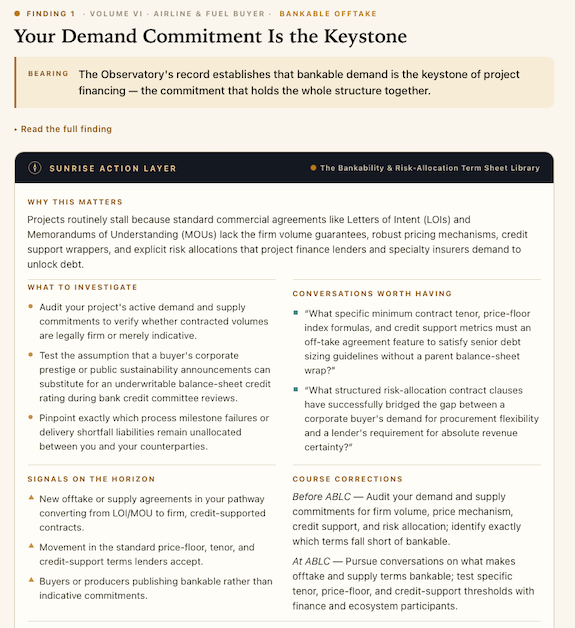
Finding: Offtake Is the Keystone
- Fact: DHL signed a major SAF agreement.
- Fact: Microsoft signed.
- Fact: Google signed.
- Fact: Buyers continue stepping forward before molecules are produced.
- The Outcome: These massive, long-term offtake signatures provide the revenue certainty required to bridge the financing gap and greenlight construction.
Finding: Reference Plants Are the Currency of Proof
- Fact: LanzaTech and Shougang successfully completed an IPO in China.
- Fact: Freedom Pines continues operating.
- Fact: Organizations with operating proof points apply the purple stain advantage, leaving their mark not just on a laboratory slide, but across the deployment record, attracting partners, capital, and customers.
- The Outcome: Securing top-tier validations and operating reference facilities shifts FOAK performance risk to a level that insurers and institutional lenders can confidently underwrite.
Finding: The De-Risked Path
- Fact: Eni applied the brown field advantage, converting existing infrastructure to find new economics.
- Fact: Petrobras expanded licensing and partnership pathways.
- Fact: Existing industrial assets—old steel, old concrete, old permits—continue finding new purposes.
- The Outcome: By utilizing existing industrial infrastructure and established licensed technologies, developers borrow credibility, vastly reducing execution risk and accelerating capital deployment.
Finding: First-of-a-Kind Risk Is the Mountain You Are Actually Climbing
- Fact: Aircapture and Almanac Beer launched the world’s first DAC beer.
- Fact: AKROS Energy inaugurated a pilot plant for salt-based hydrogen storage.
- The Outcome: Bridging the gap between demonstration and commercial scale requires rigorous structural gear; crossing that FOAK risk mountain is the central challenge developers must conquer.
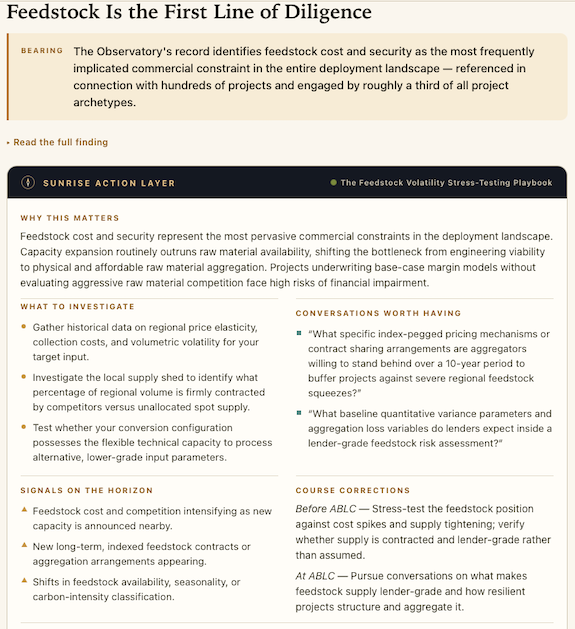
Finding: Feedstock Is the Constraint That Decides Before the Market Does
- Fact: AMAGGI deepened its commitment to feedstock supply.
- Fact: Nufarm extended long-term arrangements.
- Fact: Feedstock aggregation and supply security continue attracting investment.
- The Outcome: Aggressively locking in feedstock through direct equity integration or multi-decade contracts creates a “bankable” supply that easily clears the first line of capital diligence
Finding: Guaranteeability as the Hidden Gate
- Fact: Acwa nears RFNBO certification for its 4.4 GW Saudi hydrogen project.
- Fact: DEKRA was recognized as a certification body for renewable hydrogen under the CertifHy EU scheme.
- Fact: The European Commission approved a $6.95 billion Italian State aid scheme for renewable hydrogen.
- The Outcome: Guaranteeability depends on rigorous certification and state-backed support, shifting the risk profile to a level that third-party guarantors and insurers can confidently accept to open the hidden gate to financing.
Finding: Green Molecules Need Buyers Before They Need Refineries
- Fact: Green meth is not a laboratory curiosity, but an increasingly visible commercial pathway, as projects continue securing demand commitments.
- Fact: SAF developers continue securing demand commitments.
- Fact: Offtake continues arriving before capacity.
- The Outcome: By securing buyers before breaking ground, developers prove that demand formation is a strategic capability that anchors the entire project financing structure.
Finding: Concessional and First-Loss Capital Provide the Geographic Backstop
- Fact: The EIB loaned Eni $580M to convert part of its Burgondi refinery into a biorefinery.
- Fact: The African Development Bank launched a call for proposals for a new green hydrogen program.
- Fact: FMO accelerated deployment in Paraguay with a $94.8 million green fertilizer investment.
- The Outcome: Development finance institutions and public capital provide the essential first-loss capital that de-risks projects, enabling large-scale industrial transitions in regions where private markets hesitate.
Finding: Corporate Offtake as the Anchor for Biomaterials and Biochemicals
- Fact: BioCirc sold 650,000 tons of carbon removals to Microsoft through five BECCS sites.
- Fact: IKEA joined the fold as Seprify raised $15.8 million for cellulose biomaterials.
- Fact: Svante Technologies and Meadow Lake Tribal Council sold Microsoft BECCS CDR credits.
- The Outcome: Major corporations act as anchor offtakers and market-makers, establishing price floors and technical validation that enable project finance for novel biological sites.
Finding: The Logistics Constraint Nobody Owns
- Fact: Air Products advanced a new hydrogen liquefier in Rotterdam.
- Fact: Nordion Energi began construction of a liquefied biogas facility at the Port of Gothenburg.
- Fact: Busan Port Authority committed to building an LNG and methanol bunkering hub by 2032.
- The Outcome: Logistics infrastructure at major ports serves as a collective constraint; these shared projects dictate whether produced fuels can actually reach the global market.
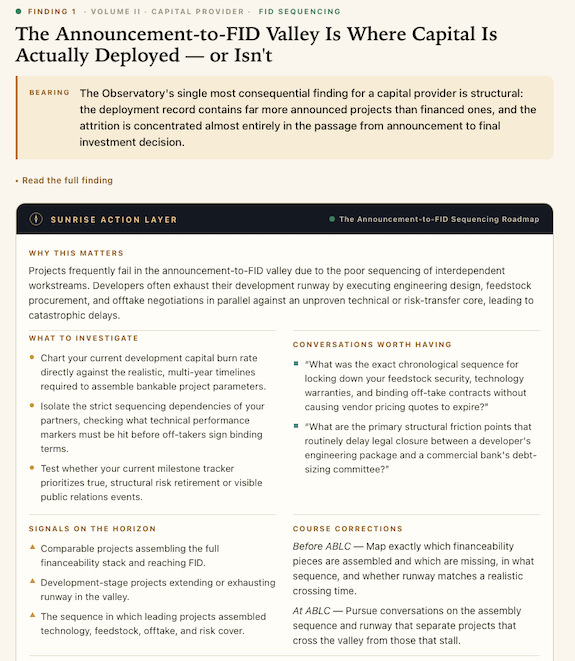
Finding: The Announcement-to-FID Valley
- Fact: Moeve reached a final investment decision to start construction.
- Fact: Multiple projects moved from aspiration to execution.
- Fact: Progress continues to be measured in milestones crossed rather than announcements issued.
- The Outcome: Securing Final Investment Decisions (FID) marks the critical point where capital shifts from speculative to deployed, proving the project has successfully crossed the valley of uncertainty.
Finding: Feedstock Aggregation Turns Abundance Into Supply
- Fact: Forest residues continue finding markets.
- Fact: Woody biomass continues finding markets.
- Fact: Materials once treated as amber slash increasingly appear as strategic feedstocks, with the forest floor becoming part of the industrial system.
- The Outcome: Proactively treating abundant waste as a structural asset allows companies to build the necessary collection networks and infrastructure, turning scattered residues into reliable, contracted supply.
Finding: Feedstock is linked to the Carbon-Intensity Premium
- Fact: Canada granted the Rhode Island Bioenergy Facility a temporary negative CI.
- Fact: BASF and Nutrien teamed up to connect farmers to biorefineries and document CI.
- Fact: Algenesis Labs showed 65% GHG savings for its new polyols.
- The Outcome: Feedstock that can document a “negative CI” or high GHG savings earns a market premium, proving essential for projects seeking maximum tax credits and commercial value.
Finding: Reading the Pipeline: Why Visibility Is Not Momentum
- Fact: KLM and SkyNRG began building the Netherlands’ first standalone SAF facility.
- Fact: Delta Airlines backed away from SAF goals.
- Fact: Shell put a partially-built Rotterdam blue H2 and biofuels project up for sale.
- The Outcome: High visibility in news headlines does not equal actual deployment; confirmable progress—like breaking ground—is the only reliable metric for determining which suppliers will actually deliver.
Different feedstocks. Different technologies. Different geographies. Different business models. The same accumulation of evidence. One organization secures demand. Another secures supply. Another secures financing. Another secures infrastructure. Another secures partnerships. Another secures credibility. The parade continues. The examples in this column represent only a fraction of the evidence. But the pattern is clear.
The first step is recognizing that the route changed. The second step is understanding where the new routes are. The third step is deciding which one is yours. That’s where The Compass begins. To get altitude, you first have to get attitude.
Category: Top Stories

