








The Digest Hallowe’en Special: The Night of the Living Zombie Synbio Start-Ups
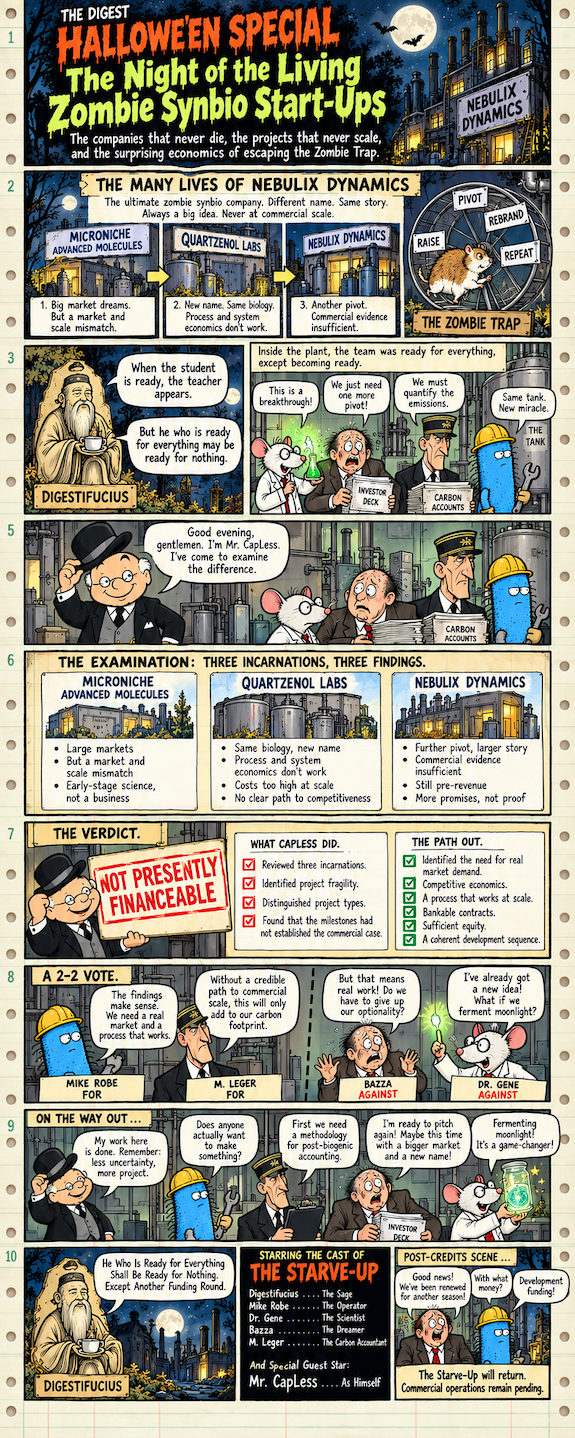
Beyond the Zombie Trap: CapLess Opens Its Winter 2026–27 Cohort
Behind the Halloween satire lies a serious challenge for first-of-a-kind industrial projects: technical progress does not automatically translate into financeability.
Lenders must evaluate far more than whether a technology works. They must consider construction risk, feedstock security, contractual commitments, operating performance, management capability, permitting, completion schedules and the likelihood that all these elements will come together when required. When important uncertainties remain unresolved, lenders may demand higher interest rates, additional guarantees or more restrictive financing terms. Sometimes they decline to finance the project altogether.
This is the problem CapLess was developed to address. Introduced publicly at ABLC Next in San Francisco, CapLess uses the Hudson River Company’s FRAGILITY Framework to examine project vulnerabilities, identify critical dependencies and distinguish between uncertainties that can be reduced and risks that must be accepted, transferred or redesigned. The financial opportunity can be substantial. On an illustrative $500 million loan, reducing an avoidable uncertainty premium by 150–250 basis points can represent tens of millions of dollars in modeled lifetime financing savings, depending on the loan structure and repayment terms.
CapLess is compensated through 10% of realized financing savings, measured against an agreed and independently supported baseline. Its business model is built around improving financing outcomes, not charging conventional advisory retainers. But there is another dimension to uncertainty, and it’s worth returning briefly to our fictional friends at Nebulix Dynamics.
The Human Cost of Uncertainty
Every member of The Starve-Up responds differently to the company’s endless uncertainty.
Mike Robe, our practical fermentation operator, wants to know whether the process works, whether the equipment can deliver, and whether anyone intends to make a product. For Mike, reducing uncertainty means getting back to the satisfaction of doing actual work, with a realistic prospect of success.
M. Leger, our meticulous carbon accountant, wants facts that can withstand scrutiny. Without dependable evidence, every claim becomes another spreadsheet, another disputed assumption, another revision. Reducing uncertainty means replacing endless accounting arguments with numbers that people can trust.
Bazza, our perpetually anxious business-development executive, lives from one prospective partnership to the next. Uncertainty keeps him busy, but it also keeps him frightened. The next telephone call might save the company—or expose that there isn’t much of a business to save. Reducing uncertainty could finally give him something genuinely bankable to sell. Unfortunately, it might also require him to stop selling possibilities and start delivering commitments.
And Dr. Gene, our genetically enhanced laboratory rat, sees uncertainty as an invitation to discover something wonderful. His imagination is essential to innovation. But without commercial discipline, every difficult question becomes the justification for inventing a different molecule. Reducing uncertainty doesn’t mean eliminating scientific imagination. It means giving that imagination a destination.
Even Digestifucius, the ancient observer of the company’s many incarnations, has something at stake. He has spent years watching progress become a cycle of reinvention. Perhaps, one day, somebody will actually learn from his wisdom.
There is a reason the same characters keep reappearing under different corporate names. A company trapped in perpetual development doesn’t merely consume capital. It consumes careers, energy, optimism and time. It can turn inventors into perpetual presenters, operators into custodians of idle equipment, and business-development teams into professional pursuers of the next lifeline. The uncertainty premium is not confined to the lender’s term sheet. It runs through the entire enterprise. And that may be the larger promise of reducing uncertainty: not simply making the money cheaper, but allowing the people involved to stop defending the possibility of a business and begin operating one.
Now Recruiting: Winter 2026–27
The Hudson River Company is now recruiting projects for the CapLess Winter 2026–27 Cohort, limited to 50 projects or $10 billion in aggregate project value, whichever limit is reached first. We welcome projects approaching commercial financing, as well as promising industrial ventures that have made substantial development progress but have struggled to reach financial close. The initial CapLess examination is designed to take approximately 15 minutes, using available project evidence and financing documentation, including an existing term sheet where available.
For financeable projects, the immediate opportunity is to identify and reduce avoidable uncertainty premiums and capture measurable financing savings. For projects that are not yet financeable, the initial task may be to identify the dependencies, evidence gaps or development choices that must change before commercial debt becomes possible. Not every uncertainty can be eliminated. Not every project is presently financeable. And financing savings must ultimately be demonstrated, not merely projected. But identifying which uncertainties matter, what interventions could reduce them, and how those improvements might affect financing terms can be the difference between another development round and a commercially viable project.
Less uncertainty. Lower financing costs. More project.
Winter 2026–27 Cohort inquiries: Hudson River Company / CapLess.
Category: Top Stories

