








The Case of the Missing Hydrogen Economy: A Baker Street inquiry into fuel cells and factories
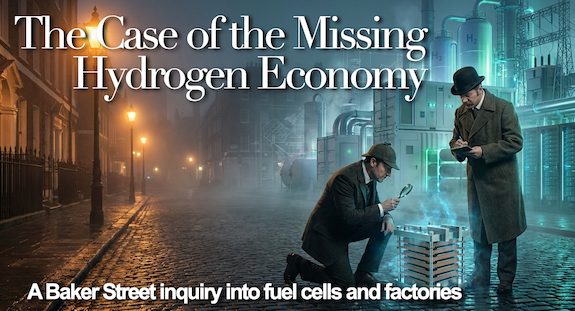
It was upon a damp and windless evening in late autumn that I found Sherlock Holmes stretched languidly upon the settee at Baker Street, his long fingers pressed together beneath his chin while the final embers of the coal fire settled into a crimson glow.
London lay beneath one of those yellow fogs which seem less to descend upon the city than to seep upward from the stones themselves. Beyond the windows, the lamps along Baker Street appeared only as blurred halos suspended in smoke. I had been examining the evening trade circulars, which Holmes professed to despise and yet invariably absorbed before dawn.
“You appear troubled, Watson,” said he at last, without opening his eyes.
“It is these energy fellows again,” I replied, tossing the paper upon the table. “The Hydrogen Economy. The Cellulose Economy. The Glucose Economy. Every decade produces another industrial salvation, and most expire somewhere between the pilot plant and the annual conference.”
Holmes smiled faintly. “You omit algae.”
“Gladly.”
“And methanol.”
“I had hoped to forget it.”
“I have seen the pattern too often, Holmes,” said I. “Elegant systems. Extraordinary diagrams. Vast public subsidies. Then five years later the pilot plant is mothballed, the tax credits vanish, and everyone quietly discovers a new transition.”
Holmes reached for the circular and adjusted the lamp. “Ah,” said he quietly. “Elcogen.”
“You know them?”
“I know patterns, Watson.”
I confess that I regarded the matter skeptically. Fuel cells had long occupied a curious position within industrial society — perpetually promising, technically elegant, yet somehow never quite arriving. Their efficiencies bordered upon the astonishing. Their emissions profiles seemed ideal. Yet while turbines conquered the grid and batteries overtook transportation, fuel cells lingered in demonstration projects, policy papers, and optimistic projections regarding ‘the coming decade.’
“Surely,” said I, “you do not mean to suggest that fuel cells — those perpetual bridesmaids of the energy transition — are suddenly about to inherit the earth?”
“Not suddenly,” replied Holmes. “Necessarily.” He handed me the paper.
At the center of the announcement was Elcogen, the European fuel cell and electrolyser technology developer founded in 2001 with operations centered in Estonia and Finland. The company had announced the launch of its next-generation solid oxide fuel cell and electrolyser stack platform, the elcoStack E3000 G2 — a system designed not merely for laboratory performance, but for scalable industrial deployment. Broader rollout is scheduled for Q2 2026.
“You observe the efficiency figures, Watson,” Holmes remarked.
“Quite naturally.”
“And yet the truly significant clue lies elsewhere.”
“Where?”
“The factory.”
For decades, fuel cell development has suffered from a peculiar contradiction. The underlying electrochemistry often worked extraordinarily well, but the economics of manufacturing did not. Systems were bespoke, expensive, thermally demanding, and difficult to industrialize at scale. In effect, the industry had mastered invention without fully mastering replication.
Elcogen’s approach appears aimed directly at that weakness.
The E3000 G2 platform was redesigned explicitly around manufacturability. Rather than optimizing solely for peak technical performance, the company focused on reducing production complexity, enabling standardized high-volume fabrication, lowering cost per kilowatt, and shortening deployment timelines.
Holmes removed his pipe and pointed toward the specifications. “Observe the temperatures.”
“Six hundred and fifty to seven hundred and fifty degrees,” said I.
“Precisely. Still infernally hot, of course, but no longer ruinously so. Lower the thermal burden and suddenly one may employ less exotic materials, extend operational life, reduce degradation, improve cycling stability, and manufacture economically.”
The thermodynamics themselves remain formidable. In solid oxide fuel cell (SOFC) mode, the platform can utilize hydrogen, natural gas, and various biofuels while delivering electrical efficiencies approaching 75 percent and as high as 90 percent when waste heat is captured and utilized. In reverse solid oxide electrolysis (SOEC) mode, the system can produce green hydrogen at approximately 33 kWh per kilogram.
“Up to ninety percent efficiency when waste heat is utilized,” said I.
Holmes nodded. “Which tells us something rather important.”
“That the engineering is sound?”
“That every wasted joule has become economically intolerable.”
That distinction may suddenly matter far more than it once did. The modern electrical grid is beginning to resemble London rail traffic in a snowstorm: everything electrifying simultaneously, with nowhere near enough infrastructure to support it. At the same time, geopolitical pressures increasingly demand secure, local energy production systems capable of operating resiliently under strained global supply conditions.
Data centers, in particular, have emerged as one of the most power-constrained industries in the global economy. Artificial intelligence systems, cloud computing infrastructure, and advanced semiconductor facilities are generating electricity demand at a pace utilities increasingly struggle to match.
Across multiple regions, operators now face years-long grid connection queues before facilities can even be energized.
“That,” said Holmes quietly, “is the moment at which a technology ceases to be interesting and becomes necessary.”
Fuel-flexible, on-site solid oxide generation offers data center operators something increasingly valuable: the ability to bypass grid bottlenecks altogether. Rather than waiting years for transmission upgrades and utility approvals, distributed fuel cell systems can provide localized, resilient power generation directly at the site itself.
The same logic extends into heavy industry.
Sectors such as steelmaking, ammonia synthesis, refining, marine fuels, and chemicals increasingly require low-carbon molecules rather than electricity alone. Green hydrogen, synthetic fuels, and distributed thermal systems are becoming strategic necessities in sectors where direct electrification remains impractical or economically prohibitive.
Elcogen’s strategy is notable not merely for the technology itself, but for the business architecture surrounding it.
Rather than attempting full vertical integration, the company is pursuing an open ecosystem model, supplying core electrochemical components that third-party system integrators can adapt across multiple industries. The approach lowers barriers to deployment while allowing broader industrial experimentation on top of a standardized platform.
Holmes tapped the circular again.
“Here, Watson. The most revealing passage of all.”
The clue in question concerned ELCO I, Elcogen’s newly expanded 14,000 square meter manufacturing facility in Tallinn, Estonia. The site increases company production capacity from roughly 10 MW to 360 MW, with plans aimed toward eventual multi-gigawatt manufacturing scale.
“You continue to think Elcogen is constructing a factory, Watson.”
“Are they not?”
“No. They are constructing a reproducible method for constructing factories.”
Holmes leaned back and folded his hands.
“There lies the distinction between a successful project and an industry.”
Elcogen intends not only to manufacture the technology itself, but to license both the technology and the manufacturing blueprint internationally, enabling trusted partners to move from licensing agreement to production readiness in as little as fourteen months.
That may ultimately prove the company’s most consequential innovation of all.
For years, the hydrogen economy has often resembled a landscape of isolated pilot projects — technically successful perhaps, yet difficult to replicate economically across broader industrial systems. Manufacturing scale, supply chains, thermal durability, and deployment complexity repeatedly slowed momentum just as enthusiasm appeared ready to crest. The Elcogen announcement suggests an industry increasingly focused not upon proving the science, but upon industrializing the repetition.
Late that evening, Holmes returned once more to his violin while I arranged my notes beside the fire.
I amended them carefully. *Not merely fuel cells.*
*Manufacturable fuel cells.*
Holmes glanced over approvingly. “Better, Watson.”
I continued. *Not merely hydrogen.*
*Distributed industrial resilience.*
Holmes nodded faintly. “You improve.”
At last I wrote: *The fuel cell did not change nearly so much as the world around it.*
Holmes lowered the bow. “There,” said he quietly. “At last, we have the case.”
Outside, the London fog pressed softly against the windows of Baker Street while somewhere far beyond it — in data centers, steel mills, ports, refineries, and crowded electrical grids — the missing hydrogen economy appeared, perhaps for the first time, less like fantasy and more like infrastructure.
Category: Top Stories

