









The Ethanol Bridge, Part 3: Why Brazil Escaped Pain at the Pump This Spring

In the first two installments of this series, we established a compelling chemical and economic reality: the more ethanol blended into a fuel barrel, the less consumers ultimately pay at the pump. This occurs because ethanol is the most affordable large-scale source of high-density octane available to modern refining, as well as an affordable fuel. It delivers both octane and energy simultaneously, yet it routinely clears the market at a profound discount against the petroleum components it replaces.
Which leads to an inevitable, glaring question: if this molecule possesses such a potent capacity to lower consumer fuel costs, why are we not utilizing more of it?
To discover the answer, we must look south to Brazil.
This past spring, as global oil markets fluctuated and sent fuel prices soaring, household budgets around the world were squeezed by a familiar anxiety. Drivers across the globe searched for any conceivable way to stretch a tank of gas just a few miles further. Yet, throughout this period of volatility, Brazilian motorists possessed a structural advantage denied to most Americans: total, seamless choice.
Step up to thousands of retail stations across Brazil, and you will see a mature, dual-fuel ecosystem in daily operation. This is not a specialized demonstration project, nor is it a subsidized, niche alternative; it is an everyday commodity market. When ethanol prices are economically attractive, consumers dynamically shift their volume to ethanol. When gasoline prices drop, they shift back to gasoline. The consumer, armed with real-time information, dictates the terms of the transaction.
This absolute flexibility matters immensely. Consider the basic laws of economics: when two grocery stores on the same block must openly compete for your dollar, prices remain honest. Brazil effectively scaled that exact competitive pressure across an entire national fuel infrastructure.
The architecture of this achievement was not born from an exotic technology, a miracle feedstock, or a stroke of geopolitical luck. It was the product of sustained, deliberate policy.
Beginning decades ago, the Brazilian government established a stable regulatory framework that simultaneously incentivized agricultural production, mandated retail infrastructure development, and required automakers to produce flex-fuel powertrains. Today, more than three-quarters of all new vehicles sold in Brazil are flex-fuel systems capable of switching between fuels seamlessly. Motorists do not require an economist to explain market dynamics; they simply look at the marquee, calculate the value, and exercise their leverage. In doing so, Brazil successfully engineered a permanent macroeconomic release valve against crude oil inflation.
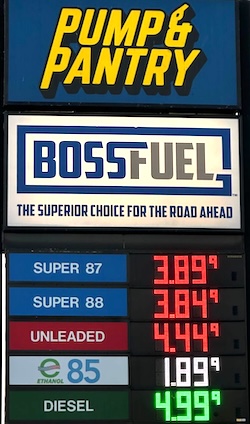 The United States chose a fundamentally different path. Rather than cultivating a comprehensive, high-blend flex-fuel ecosystem, domestic policy increasingly narrowed its long-term focus toward wholesale vehicle electrification. While that strategy possesses its own long-term merits, its immediate consequence is that millions of American families remain entirely dependent on a single, rigid petroleum pathway.
The supreme irony is that the raw hardware for an American release valve already sits quietly in our driveways. Approximately 21 million flex-fuel vehicles are operating on American roads today. Yet, because our system lacks structural alignment, the vast majority of those drivers have no idea their vehicles possess this capability, and many have never even encountered a high-blend E85 pump. This is not a failure of chemistry, nor is it a limitation of technology. It is a failure of system design.
American consumers currently have access to mere fragments of this infrastructure. We have ubiquitous E10, and we enjoy expanding regional access to E15. But we completely lack the regulatory simplicity and widespread consumer access that South American motorists take for granted. In its place, the United States has maintained a dense patchwork of conflicting state rules, restrictive seasonal volatility regulations, and uneven infrastructure investments.
The lesson from Brazil is not fundamentally about the ethanol molecule itself—it is about the transformative power of open market competition. It is about allowing molecules to compete on price and performance, thereby shifting leverage from the oil well back to the consumer.
Building an American Release Valve
Brazil did not stumble into an integrated fuel market by accident; it systematically aligned incentives across the entire value chain. Farmers were guaranteed a predictable market; producers were assured steady commercial demand; retailers received targeted incentives to install blender pumps; and automakers were given clear regulatory reasons to manufacture flex-fuel vehicles. Every participant had a logical, economic reason to sustain the system.
The United States already possesses the foundational elements required to replicate this triumph. The Clean Fuel Production Credit, known structurally as 45Z, represents a historic step toward aligning agricultural practice with fuel policy. By directly rewarding low-carbon intensity scores, 45Z ensures that a farmer’s conservation practices and a producer’s efficiency gains directly enhance the market value of the finished gallon.
Yet, for an ecosystem to function, that value must be allowed to flow unimpeded through the entire supply chain. Production alone is insufficient; it must be coupled with widespread consumption. Retailers require clear, long-term capital incentives to install secondary storage tanks and high-blend dispensing equipment. Automakers require sustained regulatory credit to keep producing flex-fuel internal combustion engines rather than phasing them out entirely. Most critically, the American public must be re-educated to recognize the latent capability already sitting in their driveways.
A molecule cannot lower consumer prices if the infrastructure prevents it from reaching the engine.
For decades, the American public has been conditioned to believe that fuel prices are a sovereign weather event—an inescapable reality that simply happens to them. A refinery goes down in the Gulf, a hurricane disrupts shipping lanes, or a geopolitical conflict erupts overseas, and the price on the corner marquee inevitably spikes. The consumer simply pays the tax of global volatility.
Brazil’s experience proves a far more liberating truth. When you grant consumers meaningful alternative pathways, you grant them direct influence over the macroeconomic outcome. Give them access to lower-cost, domestically produced octanes, and you insulate them from global energy shocks. Give them genuine choice, and you hand them real bargaining power at the pump.
The United States already grows and processes enormous quantities of one of the most affordable, high-performance fuel components on earth. The fundamental question facing American energy policy is not whether the molecule works—it already does. The question is not whether it can lower consumer costs—it already has.
Brazil did not discover a superior law of chemistry; they simply built a superior system. The bargain is already sitting in our fields and biorefineries. The only question remaining is how much of that benefit we will allow American drivers to enjoy.
Category: Top Stories

