








Saff the Mighty Hoop Jumper: What SkyNRG Teaches Us About Getting Steel in the Ground
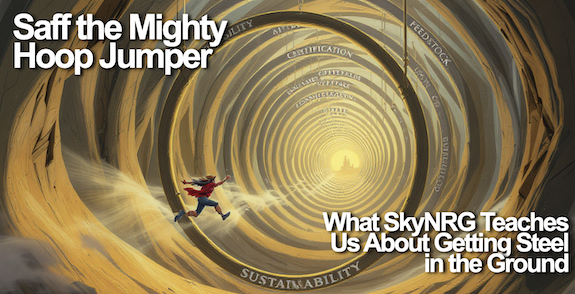
Once upon a time there was a daring and skillful hoop-jumper named Saff. No one could jump hoops like he. He could somersault through flaming hoops, sustainability hoops, carbon-intensity hoops. Children cheered him. Elders admired him. One day the King announced a grand hoop-jumping contest to be held in the Palace Gardens. The villagers were delighted.
“You must enter!” they cried.
Saff hurried home and designed the most magnificent hoops ever seen. They were cleaner, greener, safer, more transparent, more sustainable, and considerably more complicated than ordinary hoops. Then he rode into town to raise the money to build them.
The Banker studied the plans. “Remarkable hoops,” he said. “I shall gladly finance them once you prove that you can jump through them.”
“But I need the hoops in order to prove I can jump through them.”
The Banker nodded sympathetically. “These things happen.”
The Farmer studied the plans. “I shall gladly provide materials for the hoops once the contest is definitely taking place.”
“The contest cannot take place until the hoops are built.”
“Then,” said the Farmer, “we appear to have discovered a sequencing challenge.”
The Airliner studied the plans. “I should be delighted to purchase tickets for the contest once you can guarantee that the performance will cost no more than last year’s contest.”
“There was no contest last year.”
“Excellent,” said the Airliner. “Then you have a benchmark.”
It sounds like a fairy tale. Yet anyone who has spent time around the drive to produce sustainable aviation fuels will recognize it as documentary realism.
This week, SkyNRG and KLM Royal Dutch Airlines officially celebrated the start of construction of DSL-01, a 100,000-tonne-per-year Sustainable Aviation Fuel facility in Delfzijl. Using the HEFA pathway, the plant will convert waste fats, greases, and used cooking oils into SAF and renewable co-products. The headlines focused on the groundbreaking. The deeper story is how long it took to get there.
To some observers, DSL-01 may have felt like a slow train coming. By bioeconomy standards, it was practically an express service. SkyNRG’s quest stretches back to its founding in 2009. Along the way came market development, feedstock sourcing, certification, engineering, environmental reviews, technology selection, investors, lenders, policy support, and enough due diligence to fill a respectable library.
In 2019, SkyNRG was already discussing major SAF projects in Washington State. In the years that followed came partnerships with Microsoft, Alaska Airlines, Boeing, LOT Polish Airlines, VistaJet, and dozens of others. APG invested. Macquarie Asset Management invested. Project Wigeon advanced in the United States. eSAF initiatives emerged in Sweden. Research partnerships appeared in Ireland.
Meanwhile, SkyNRG kept jumping hoops. There was the Sustainability Hoop, culminating in industry-leading RSB certifications. There was the Traceability Hoop, addressed through Book & Claim systems and Project Runway. There was feedstock, engineering, technology, financing. Hoops, hoops, hoops everywhere. Each served a purpose. Each added complexity.
This is where the DSL-01 story becomes larger than SkyNRG.For years we have described commercialization as a technology challenge, a financing challenge, a feedstock challenge, or a policy challenge. Increasingly, it appears to be a sequencing challenge.
The technology provider would like financing before committing resources. The financier would like customers before committing capital. The customer would like fuel before committing volume.The feedstock supplier would like proof of operations before committing supply. The regulator would like studies before issuing approvals. The studies would like engineering data. The engineering team would like financing. The financing would like permits. Everyone is acting rationally.
Collectively, they resemble an M.C. Escher staircase.Each participant is climbing energetically. Progress is visible everywhere. Yet somehow everyone keeps returning to the same landing. Projects rarely die from opposition. More often they drown in conditional support.
The remarkable achievement of DSL-01 is that enough participants eventually replaced conditional support with actual commitment. KLM, a founding member of SkyNRG, did more than cheer from the sidelines. Its long-term offtake commitment helped anchor the economics of the project. The airline became, in effect, the first ticket buyer for Saff’s contest.
The result was historic. DSL-01 is being hailed as the first commercial-scale SAF facility globally to secure non-recourse project financing.
In fairy-tale terms, the Banker finally agreed to finance the hoops.
That breakthrough did not occur in isolation. Technology providers, engineers, investors, policymakers, regulators, feedstock suppliers, and customers all moved into alignment. The Northern Netherlands Alliance contributed a €16 million grant through the European Just Transition Fund, helping a region long associated with natural gas production pivot toward a new energy future. Eventually enough participants decided that waiting for certainty was less attractive than creating it.
The gate opened. The steel arrived. And that may be the most important lesson from Delfzijl. The challenge facing sustainable aviation is no longer proving that SAF can be made.
The challenge is learning how to synchronize the commitments required to build hundreds of facilities instead of dozens. DSL-01 is more than a 100,000-tonne-per-year SAF facility. It is a blueprint for commercially scalable deployment. Every year, projects demonstrate technology, secure customers, attract investors, obtain permits, or assemble feedstocks. Rarely do they accomplish all of those things at the same time. DSL-01 did. The result is not merely another announcement. It is steel in the ground.
Civilization increasingly resembles Saff’s contest.
We have become extraordinarily good at identifying risks, documenting impacts, measuring outcomes, verifying claims, and certifying performance. Every hoop serves a purpose. Yet the accumulation of hoops has become a force in its own right. The next great challenge may not be inventing better hoop-jumpers. It may be designing a world in which the corridor can still be crossed.
Which is perhaps why, late one evening after the groundbreaking celebrations had ended, the Banker, the Farmer, and the Airliner found themselves sitting together and telling old stories.
“Remember Saff?” asked the Farmer.
“The Mighty Hoop Jumper?” said the Banker.
“The very one.”
They laughed. “He spent years trying to obtain financing for those hoops.”
“He certainly did.”
“Whatever became of him?”
The Airliner smiled. “Last I heard, he was trying to obtain a document explaining how to finance hoop-jumping.”
“And did he find it?”
“Oh yes. Everyone knew it was on the other side of the door.”
The Banker laughed. “Let me guess. A Chicken and an Egg were standing in front of it.”
The Farmer nodded.
“After you,” said the Chicken.
“No, after you,” said the Egg.
“After you,” the Chicken insisted.
“No, I couldn’t possibly.
The Airliner shook his head. “Poor Saff.”
They all laughed. Then they fell silent for a moment and looked out toward the construction site. Steel gleamed beneath the floodlights. Permits obtained, financing closed, offtake signed. The hoops had been jumped. The quest, at long last, had succeeded.
The Banker raised his glass.
“Here’s to Saff.”
“To Saff,” said the Farmer.
“To Saff,” said the Airliner.
Or, as we might put it in Digestville: Here’s to SAF. You won a big one this week.
Category: Top Stories

