








Promises in Bloom: The RVO Reset and springtime for the bioeconomy

The roses were already in bloom when the numbers landed.
White House gardeners had done their work—order, symmetry, early spring perfection—but what drifted across the Rose Garden that morning wasn’t fragrance alone. It was something rarer in Washington: relief. Vindication. The unmistakable sense of a season turning.
And then the announcement: the final “Set 2” Renewable Fuel Standard volume requirements for 2026 and 2027. Not a tweak. A reset.
After seasons of regulatory uncertainty and economic headwinds, President Donald Trump and EPA Administrator Lee Zeldin delivered what many across the heartland are calling a historic realignment—one that returns the program to its original intent: putting American farmers first, prioritizing homegrown fuels, and restoring forward motion to a system that had, at times, stalled.
In the twentieth year of the Renewable Fuel Standard, the new rule sets volumes at the highest levels in the program’s history. The EPA estimates more than $10 billion in economic impact for rural America and over 100,000 jobs created across agriculture and manufacturing. But numbers alone don’t tell the story. They move.
The Numbers That Move
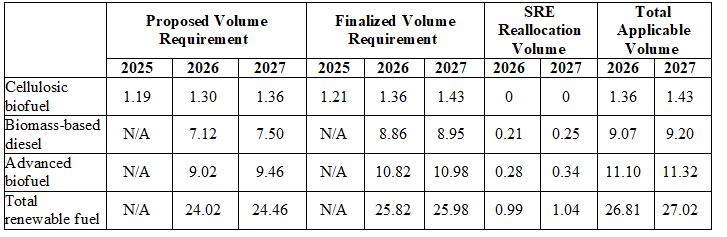
The volumes arrive in full stride.
26.81 billion RINs in 2026. 27.02 billion in 2027. Not incremental growth—acceleration. Biomass-based diesel climbs to 9.07 billion RINs, then 9.20. Advanced biofuels stretch higher, to 11.10 and 11.32. Cellulosic, still the smallest stream, continues its steady advance—1.36 to 1.43. And anchoring it all: 15 billion gallons of conventional biofuel, held firm, a signal of continuity in a system that has not always offered it.
To meet these levels, biodiesel and renewable diesel production must rise more than 60 percent from 2025. The payoff: a projected reduction of roughly 300,000 barrels per day in foreign oil dependence.
This is not inventory. This is motion returning to the system.
From Moment to Memory
Policy moments come and go. Systems remember.
What matters now is whether this day becomes structure—plants restarted, capital returning, feedstocks flowing—or whether it remains what Washington sometimes produces best: a beautiful morning in a garden, remembered mostly for the speech.
Voices in the Garden
The architects of the rule didn’t hesitate. They sounded like people who knew how long the wait had been.
“President Trump promised a Golden Age of American agriculture,” said EPA Administrator Aeldin. “Once again, his administration is delivering.” U.S. Agriculture Secretary Brooke Rollins put numbers to the moment: a projected $3–4 billion increase in net farm income, and $31 billion in value for corn and soybean oil markets tied to biofuels.
Across the industry, the response was immediate. Geoff Cooper of the Renewable Fuels Association pointed to long-sought clarity for producers and markets alike. Emily Skor emphasized the signal of durable commitment. Jed Bower called it certainty at a moment when certainty has been scarce. And for Chuck Grassley, who has carried this issue for decades, the moment carried the weight of memory—policy catching up, at last, with intent.
Three Structural Turns
But the real story isn’t just in the gallons.It’s in three structural turns—quiet revolutions embedded in the rule.
Act I: The SRE Reckoning
A 70 percent reallocation of small refinery exemptions restores nearly a billion RINs annually to the system—ensuring that obligations translate into actual blending, not accounting artifacts.
Act II: The Half-RIN Border
Beginning in 2028, foreign fuels and feedstocks receive half credit. A clear signal: domestic production takes priority, and the runway to scale it begins now.
Act III: Electricity Exits the Stage
Renewable electricity is formally removed from the RFS framework, returning the program to its statutory foundation—liquid and gaseous fuels, as originally intended.
Three moves. Each long debated. Each now decided.
A System Reawakens
Few sectors feel this shift more than biomass-based diesel. After a punishing 2025—plants idled, production down sharply—the new volumes offer something the industry has lacked: a pathway back. Producers are already signaling readiness to bring existing capacity—some 7 billion gallons—back into full use, potentially supplying more than 10 percent of U.S. diesel demand.
For soybean growers, processors, and rural communities, the ripple effects are immediate and tangible. This is what policy looks like when it connects.
Looking to the Horizon
With volumes set, structural questions answered, and the path to 2028 already signaled, attention turns forward.
There are still issues to resolve—regulatory refinements, market expansions, the continued push toward higher blends like E15—but the direction is unmistakable. The system is moving again.
The Garden, in Bloom
The roses were in bloom today. That much was certain.
And for those who had begun to wonder—quietly, privately—whether the season would ever turn, there was something unmistakable in the air: not just fragrance, but arrival. The sense that this day had been coming all along, even when it was hardest to see.
Seize it. Make the most of it. We may never pass this way again, as Seals and Crofts put it. Because spring does not ask permission. It arrives in fullness, in color, in motion—and what is brilliant like this must be met in the moment, or not at all. These are the days that remind us why we build, why we persist, why we stayed when it would have been easier to drift away.
For there is nothing lost that may be found, if sought.
And today, something long sought has come back into view. So let us enjoy it—fully, gratefully, without hesitation. Not as skeptics peering too closely at the gift, but as participants in it, stewards of what comes next. The garden is in bloom. The season has turned. Gather, then—while the light is soft and the air is sweet—
Gather ye rosebuds while ye may.
Category: Top Stories

