








On the Road to Brobdingnag: EcoCeres, Abundia, Cauldron Ferm, and why SAF is still stuck in Lilliput
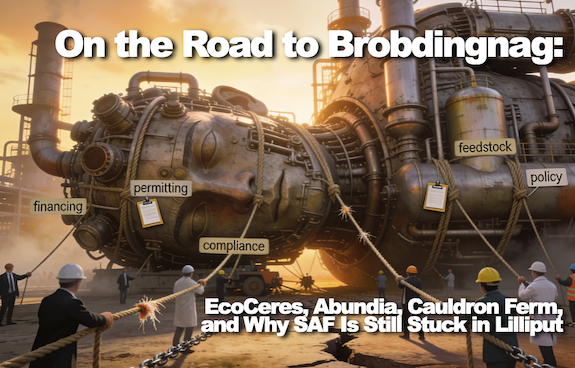
He wakes before the sun, and for a moment everything feels possible. Then he tries to move.
Nothing.
A thousand tiny tensions hold him down—threads across the arms, cords at the ankles, pins in the fabric, stakes in the ground. Individually, they are laughable. Together, they hold. On his chest, committees have formed: one argues about definitions; another about eligibility; a third insists the model is incomplete without a revised framework for compliance. Someone proposes a pilot. Someone else proposes a study of the pilot. A subcommittee is formed to discuss timelines for the study of the study, followed by a review of the mandates governing the mandates.
Gulliver—who is, in fact, a SAF giant in prospect—blinks into the morning light. He does not lack strength. He lacks permission—freedom to operate. Welcome to SAF in 2026. For years, we told ourselves the problem was scale—that our technologies were too small, too fragile, too early. But across sustainable aviation fuel, biomanufacturing, and waste-to-value systems, that excuse is collapsing. The technologies are ready. The capital is interested. The demand is real.
And yet, here we are—tied down by a thousand Lilliputian constraints: policy fragmentation. Feedstock bottlenecks. Financing hesitations. Technology risk, yes—but also counterparty risk, permitting friction, and the quiet, compounding drag of misalignment. Each one small. All of them together, decisive.
These were meant to be the rituals that create trust. Increasingly, they are where trust breaks down—and where systems reveal their underlying strain. This is the scale-up gap—not a canyon of missing science, but a web of accumulated friction. Not failure. Friction. But look closer at the beach. A few companies have stopped arguing with the ropes and started cutting them.
I. Cauldron Ferm: Cutting the CAPEX Ropes
To understand the opportunity in the bioeconomy, one must first understand what is being produced—and why it has struggled to scale. The targets are not abstract: dairy-identical proteins, functional fats, and the broader class of bio-based molecules that underpin everything from food to fuels—including the alcohol intermediates that can flow into sustainable aviation fuel pathways.
We can engineer the microbes. That part works. The bottleneck is manufacturing. The industry has been stuck in a batch mindset—500,000-liter tanks, days of growth, harvesting, then long sterilization cycles before starting again. It is a stuttering, high-CAPEX dance that keeps unit costs stubbornly high. Batch is not a process. It’s a pause button—and every pause is another rope.
For years, the story said breakthrough. The system demanded throughput. Now, for the first time, the two are beginning to align—but not yet at the same scale.
Australia-based Cauldron Ferm is not launching another food brand. It is building the factory layer the industry has been missing. Positioned as a “biomanufacturing-as-a-service” platform, and backed by $13.25 million in Series A2 funding led by Main Sequence Ventures, Cauldron is focused on one thing: removing the structural constraints that keep biology from scaling. Their breakthrough is “Hyper-Fermentation”—a continuous system that eliminates the stop-start inefficiencies of batch production. For decades, continuous fermentation failed due to contamination and genetic drift. Cauldron’s ACE media—a precisely defined nutritional system—and tightly controlled operating protocols solve both, enabling stable production over months, not days.
The result is structural: smaller vessels, lower energy use, reduced water demand, and dramatically improved capital efficiency—cutting unit costs by up to 50% and CAPEX by nearly half. This is what it looks like to cut the high-CAPEX ropes that have held biology down—and to begin building the memory that scale requires.
II. Abundia Global Impact Group: Untying the Knots of Bankability
If Cauldron is cutting technical constraints, Abundia is untying financial ones. Because here is the uncomfortable truth: capital does not fund novelty. It funds certainty.
Abundia Global Impact Group (NYSE American: AGIG), formerly Houston American Energy, is executing a disciplined pivot into waste-to-value fuels—not by inventing new chemistry, but by assembling proven systems into a bankable whole. Their model is integration with intent. Alterra’s continuous pyrolysis converts plastic waste into synthetic crude. BTG Bioliquids’ fast pyrolysis transforms biomass into bio-oil. Topsoe’s HydroFlex technology upgrades both into drop-in renewable diesel and SAF.
The breakthrough is not just the flow sheet—it is the alignment between system and story. Each component is proven, each interface validated, each risk anticipated before it compounds. Abundia has secured territory exclusivity terms with Topsoe, creating a defensible regional moat that extends beyond technology into market position. Combined with independent engineering validation, this removes layers of counterparty and execution risk before they can tighten into knots that stall financing.
But this is not the absence of risk—it is the active management of it. Reliability here is not assumed; it is constructed, step by step. Projects like their 25-acre Innovation Center in Baytown, Texas, are not experiments. They are designed to be financed, scaled, and replicated.
Integration beats invention when capital is keeping score—and Abundia is systematically untying the knots that have held projects back.
III. EcoCeres: Breaking Free at Scale
If Cauldron cuts the factory ropes and Abundia unties financial knots, EcoCeres is what happens when the system begins to rise.
Backed by Bain Capital, this Hong Kong-born renewable fuels producer has moved beyond scale-up into full industrial presence. In early 2026, EcoCeres inaugurated a 420,000-tonne facility in Pasir Gudang, Malaysia, bringing total global capacity to 770,000 tonnes per year—placing it among the world’s largest SAF producers. Critically, EcoCeres avoids the food-versus-fuel dilemma entirely by relying on 100% waste-based feedstocks, anchoring its model in both sustainability and durability. But scale alone is not the endpoint. It is the release—and with it comes new forms of pressure.
Through “Project Spark,” launched with China Southern Airlines, Air China, and others, EcoCeres has built a closed-loop system that collects waste oil, converts it into SAF delivering up to 90% lifecycle greenhouse gas savings versus conventional jet fuel, and returns it directly into aviation fuel systems. Its “Anchor Trace” platform goes further—allocating emissions reductions with precision, Scope 1 to airlines and Scope 3 to corporate customers. In doing so, it enables the conversion of SAF-related green premiums into low-carbon investments jointly borne by multiple stakeholders. This is not just production. It is system-level coordination—carbon, capital, and compliance moving together.
And it signals something fundamental: once you achieve scale, you stop asking for permission—and start setting terms.
The Verdict: The Era of Execution
Step back from the beach, and the pattern is unmistakable.
Across more than 50 national bioeconomy strategies, and with SAF mandates accelerating across the EU, Singapore, and South Korea, the giant is no longer waiting. It is being compelled to move.
Infrastructure is the moat—and the battlefield. The companies that control continuous processing, logistics, and throughput will define the winners. Integration beats invention when capital is keeping score. The fastest path to scale is not the most novel idea, but the most reliable system.
If you can’t trace it, you can’t finance it. Closed-loop accountability is becoming as important as the fuel itself. Scale is not just growth. It is how the system releases pressure—and how that pressure is managed will define what lasts. The advanced renewables industry is no longer waiting for a breakthrough. It is building platforms, solving unit economics, and assembling the infrastructure required to compete at scale.
And the strange thing about Lilliput was never the ropes. It was how long the giant believed they could hold him.
Category: Top Stories

