








It’s Wednesday in America: The Future Still Needs Building
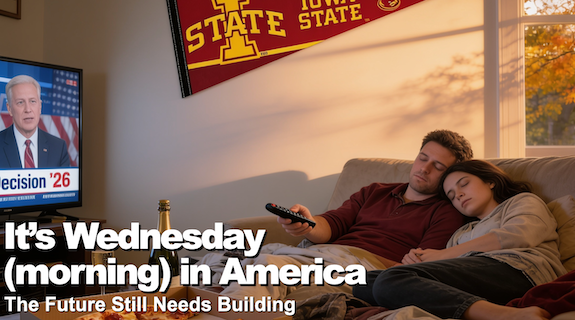
(Scene: A living room in Ankeny, Iowa. The last household in America still watching John King on CNN.)
Click.
“That was terrible.”
“The pizza? I thought it was pretty good.”
“The election.”
“Well, it went pretty well for me. Where’s the rest of the champagne?”
“I’m thinking about emigration.”
Across America, nobody has slept, and nobody can quite remember what John King said about the precincts of Houston or Topeka.
And now it’s Wednesday. The refinery operator still needs affordable hydrogen. The airline still needs sustainable aviation fuel. The farmer still needs a profitable market for agricultural residues. The startup still needs capital. The lender still wants certainty. The engineer who promised commercial operation in 2025 is hoping nobody remembers what year it is.
If your candidate won, congratulations. If your candidate lost, condolences. Either way, now comes the hard part. Welcome to Wednesday (morning) in America.
Elections Change Governments. Builders Change the World.
Politics matters enormously to the circular bioeconomy. Tax credits, agricultural programs, trade policies, permitting reform, carbon regulations, and federal research priorities can make the difference between a promising technology and a commercially viable enterprise.
But political victory is not industrial progress. Winning an election doesn’t guarantee an offtake agreement. Losing one doesn’t repeal the laws of chemistry. And although you can win an election with 50.1 percent of the vote, you cannot build a biorefinery with 50.1 percent of the financing.
For everyone, the question is identical: What do we build next, and how do we get it built? That’s the question behind the new ABLC 2027.
Introducing the New ABLC: 17 Summits, One Connected Future
March 17–19, 2027 | Washington, DC | The Mayflower Hotel
You know ABLC. For years, it’s been the gathering place for the people developing, financing, supplying, and deploying the technologies and markets of the advanced bioeconomy. But the industry has grown too diverse, the opportunities too interconnected, and the stakes too high for the traditional conference model.
So we’re introducing a new architecture: 17 conferences-within-a-conference, seven special events, and six missions.
The idea is simple: bring the real leaders together, in one place, at one time, for real dialogue on real opportunities. Not 17 disconnected tracks, but 17 connected conversations about moving projects forward.
Six Missions That Election Night Couldn’t Accomplish
1. Find the Markets
The world needs lower-carbon alternatives in aviation, marine transport, heavy road freight, chemicals, and materials.But need is not demand, and demand is not a bankable contract.
The Summits:
-
Global SAF Summit
-
Renewable Diesel & DME Summit
-
Sustainable Marine Fuels Summit
-
RNG & Biogas Summit
-
Renewable Chemicals & Materials Summit
Because the world’s most sustainable molecule is meaningless if nobody buys it.
2. Advance the Technologies
Tomorrow’s industrial platforms are emerging right now from laboratories, pilot plants, and engineering departments.
The Summits:
-
Syngas Fermentation Summit
-
Fischer-Tropsch vs. Pyrolysis Summit
-
Carbon Capture & eFuels Summit
The question isn’t simply what works in principle. It’s what works at industrial scale, at a price the market will bear.
3. Build at Scale
We have no shortage of project announcements. We have a shortage of steel in the ground, operating on time, on budget, and at nameplate capacity.
The Summits:
-
The Hottest Projects Summit
-
Regional Deployments Summit
-
Pulp & Paper Co-Location Summit
This is about leveraging existing infrastructure, aligning site partners, and closing the gap between a slide deck and an operating facility.
4. Gain Speed
Time is money, especially when capital is expensive.
The Summits:
-
Feedstocks & Advanced Agriculture Summit
-
Supply Chain Acceleration Summit
The race isn’t always won by the most elegant process. It’s won by the team that locks down the feedstock, logistics, and site rights before capital runs dry.
5. Make Policy Work
Here’s where the election hits home first.
The Summits:
-
ABLC Policy & Regulatory Summit
-
Farm Bill Programs Summit
-
45Z & IRA Tax Credits Summit
What survives? What changes? What new opportunities open? There will be plenty of political commentary in Washington. Our focus is discovering which policies actually translate into bankable assets.
6. Mobilize Capital
Capital is not allergic to the bioeconomy. It is allergic to uncertainty it cannot price.
The Summit:
-
Finance & Investment Summit
The goal isn’t just seeking more money. It’s engineering projects with risks sufficiently understood and reduced that capital is eager to back them.
Where the Summits Meet
A SAF developer might find an innovative feedstock partner at Feedstocks & Advanced Agriculture, a conversion pathway at Syngas Fermentation, a host site at Pulp & Paper Co-Location, statutory clarity at 45Z & IRA Credits, and lead equity at Finance & Investment.
That isn’t five separate conference badges.
That’s one project moving five steps closer to Final Investment Decision.
Complementing the 17 summits are seven special events designed to turn dialogue into action:
-
The Investor & Finance Workshop — exploring capital trends and what makes projects financeable.
-
Industry Horizons Forum — looking beyond today’s markets and technologies.
-
The ABLC Due Diligence Wolfpack — putting ambitious projects under serious scrutiny.
-
The Bio-LPG Challenge — examining a developing market opportunity.
-
The Annual State of the Industry Address — taking stock of where we stand and where we’re headed.
-
ABLC General Session Keynotes — bringing industry leadership and emerging opportunities into focus.
-
Network Like Crazy Sessions — making sure the right people actually meet.
Because sometimes the most valuable five minutes at a conference happen between sessions, when someone with a problem encounters someone with an answer.
The Morning After Is the Morning Before
By the time ABLC convenes in March, the election maps will be in the archives. The new Congress will be at work.The political priorities and constraints will be coming into focus.
The underlying industrial mandate will not change:
-
How do we build durable offtake?
-
How do we scale reliable technology?
-
How do we reduce execution risk so capital flows?
A durable bioeconomy must thrive under administrations it likes and administrations it doesn’t. It must deliver genuine value to customers, dependable returns to investors, economic vitality to rural communities, and energy resilience to the nation.
That doesn’t happen in a single campaign cycle. It happens when builders get to work. So, whether Tuesday night brought champagne or indigestion, the invitation stands. Bring your projects, your balance sheets, your technologies, and your hardest questions. Bring your disagreements, too.Real progress rarely emerges from an echo chamber.
And if you happen to run into someone who voted differently, buy them a slice of pizza. You may disagree about the election. You may even disagree about the pizza. But you might just find yourselves building something together. Tuesday was about who gets to govern. Wednesday is about what we’re going to build.
The election is over. The work isn’t. See you at ABLC 2027.
Category: Top Stories

