








Holy Economics, BioMan! The Double-Premium Trap
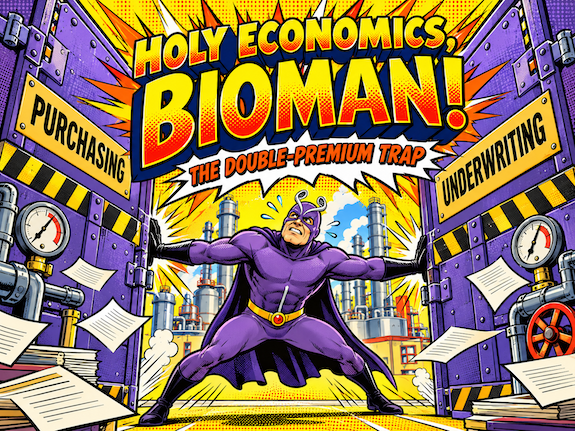
An ABLC Next Preview: How the bioeconomy can escape the cost of being different, the cost of being uncertain, and the temptation to build the hard way.
It was nine o’clock on a perfectly ordinary morning when BioMan—our caped crusader of the bioeconomy—arrived at the refinery gates, clutching a briefcase bursting with renewable miracles.
“Good morning!” he announced, sweeping his cape with theatrical optimism. “I’ve come to save the world!”
The purchasing manager peered over his glasses, unimpressed by the superheroics.
“Splendid,” he murmured. “What, precisely, are you selling?”
“Low-carbon molecules! Domestic feedstocks! Sustainable fuels! Renewable chemistry! Energy security! Rural prosperity!”
“Excellent,” said the purchasing manager, nodding smoothly. “And the price?”
“Well,” BioMan admitted, adjusting his mask, “a modest smidgen more than the conventional product.”
“Ah,” sighed the purchasing manager, turning back to his ledgers. “Come back when it’s a little less.”
By ten o’clock, our hero was standing in the marble sanctuary of high finance. “I need capital,” BioMan declared, “to construct a magnificent facility that will make my product cheaper!”
“Of course,” replied the banker smoothly. “And do you hold long-term, ironclad customer commitments?”
“Not yet. They insist I lower my price first.”
“Understandable. Without those commitments, we must levy a modest premium to cover the sheer, terrifying uncertainty of your existence.”
“But if your capital costs me more, I must charge my customers more!”
“Indeed,” smiled the banker. “And that is precisely what makes it so uncertain.”
By lunchtime, BioMan sat on a curb, staring blankly into the middle distance. He had uncovered a fundamental law of industrial physics: he was expected to pay extra to create his product, only to charge less to sell it. Even kryptonite had never delivered a beatdown quite like this.
When last we saw our valiant protagonist, he was trapped in a bubbling vat of overpriced goo, the refinery gates locked tight, and willing buyers nowhere in sight.
Welcome, friends, to the Double-Premium Trap.
If You Build It, They Will Prevaricate
Back in 2007, the bioeconomy was swept up in a magnificent, soaring vision: a 36-billion-gallon renewable fuel ambition confronting a market then measured at a modest eight billion gallons.
Capital arrived like a tide; scientists invented, engineers designed, and intrepid entrepreneurs built across the landscape. Technologies advanced, entire industries emerged from the lab, and what once seemed impossible became, through sheer force of will, remarkably ordinary.
Nineteen years later, as we prepare to assemble for ABLC Next in San Francisco, our technological mastery is undeniable. Our industrial experience is broader, our operational muscle is stronger, and our understanding of feedstocks, catalysts, organisms, and high-pressure reactors has deepened beyond recognition.
Yet one stubborn, agonizing question echoes across the industry floor: Where are the consequential buyers?
Not the well-meaning executives who admire green molecules from afar. Not the corporate strategists who issue glowing sustainability statements and sign non-binding memoranda of understanding. Not the dignitaries cutting ceremonial ribbons in hardhats.
We are talking about the hard-nosed procurement officers who actually need the volume, sign binding off-take commitments, and provide the contractual foundation required to underwrite billion-dollar debt.
For two decades, our unofficial commercial strategy has borrowed heavily from Field of Dreams: If you build it, they will come.
What twenty years of real-world scar tissue has taught us is rather different: If you build it, they will prevaricate.
They will praise your vision. They will commission exhaustive lifecycle analyses, conduct pilot trials, and issue press releases congratulating you on your noble service to humanity. And then, with practiced serenity, they will ask if you can match the spot price of incumbent fossil fuels.
Which brings us right back to poor BioMan, slumped outside the gatehouse, gazing mournfully at his faded cape.
The Two Locked Doors
The modern bioeconomy stands trapped between two formidable, heavily guarded gates.
The first is the Green Premium, exacted at the purchasing gate. It represents the economic gulf between a novel renewable molecule and its entrenched fossil counterpart—a gap driven by pioneer production costs, immature supply chains, unoptimized logistics, and small unit scale. Environmental stewardship is a noble pursuit, but inside corporate purchasing departments, buyers are rarely promoted for overspending their budget on warm feelings.
The second is the Uncertainty Premium, collected at the underwriting gate. When a commercial project weaves together first-of-a-kind tech, unproven operating durations, volatile feedstock economics, and incomplete off-take agreements, lenders demand heavy compensation for taking the ride. In practice, this manifests as crushing financing spreads—frequently adding hundreds of basis points, and in extreme cases reaching 700 basis points above benchmark rates.
And here the trap springs shut:
-
Costly capital inflates the required selling price.
-
Inflated prices scare off long-term buyers.
-
Missing off-take commitments amplify credit risk.
-
Amplified risk drives capital costs even higher.
Around and around BioMan goes in this economic purgatory, pacing between two locked doors while both gatekeepers insist the other guy must turn the key first.
We have spent twenty years trying to persuade buyers to swallow the Green Premium, and just as long begging lenders to forgive the Uncertainty Premium.
What if we stopped begging? What if, instead of trying to batter down these doors, we simply redesigned the pathway?
Stop Selling Virtue. Start Selling Necessity.
This is the central thesis of our State of the Industry presentation at ABLC Next: The bioeconomy does not have a technology problem—it has an architectural pathway problem.
Consider the perilous blueprint we so often embrace: build a greenfield facility from scratch, forge a novel molecule, qualify it with hesitant customers, build an entirely new distribution network, and then try to persuade the world to pay a premium simply because our carbon atoms have a cleaner pedigree.
While that bespoke approach has its place, every extra interface introduces capital, operating, and market risk. Every unnecessary refining step burns precious cash. Every custom specification makes it harder to drop your product into existing infrastructure.
Meanwhile, sitting right across the highway is an immense, fully amortized industrial engine: refineries, ethanol plants, chemical complexes, pulp mills, pipelines, terminals, and tank farms. And crucial to our survival, these incumbent assets possess the one thing pioneer bio-plants lack: paying customers.
What if the bioeconomy stopped trying to replace the industrial titan, and instead became its most indispensable supplier?
Rather than building a standalone, billion-dollar boutique refinery, supply qualified, drop-in renewable intermediates to the refinery that already exists. Rather than convincing end-consumers to change their habits, supply the molecules that fit seamlessly into existing, high-volume supply chains.
Stop selling delicate, bespoke snowflakes. Standardize the inputs, qualify the intermediates, and make renewable carbon physically available, operationally drop-in, and economically inescapable.
This isn’t about abandoning our climate mission; it is about forging an economic engine powerful enough to carry that mission into the global marketplace. When affordability, reliability, and supply security lead the pitch, carbon reduction transforms from an expensive luxury into an unbeatable competitive advantage.
For BioMan, this is a thunderbolt of clarity: He doesn’t need to construct a brand-new industrial kingdom from scratch—he just needs to become the lifeblood of the one already running.
The Ship, the Ocean, and the Banker
Yet even an elegant industrial pathway can founder if capital commitments are executed out of order.
How many promising ventures have perished because a board authorized long-lead equipment before validating the process, or started site construction before securing firm qualification from key off-takers? The engineering may be brilliant, but the sequence proves fatal.
This sequencing dilemma is precisely what we’ve been tackling at Hudson River Company, analyzing over 300 detailed project dossiers to build our analytical suite: FRAGILITY, SWELL, and CapLess.
-
FRAGILITY inspects the ship itself—stress-testing its physical design, capital structure, technology readiness, contractual spine, and network dependencies.
-
SWELL maps the treacherous ocean—evaluating the fluctuating policy landscapes, volatile commodity markets, and shifting capital environments through which the project must navigate.
-
CapLess asks the ultimate navigational question: Is there a smoother, lower-cost route available?
Can a project resequence its commitments, retrofit a piece of its commercial architecture, or front-load key technical evidence so that uncertainty is stripped away before expensive capital is permanently exposed? And if so, what is that risk reduction worth in cold, hard basis points?
Using the CapLess system, prepared project evidence can be evaluated in under fifteen minutes, generating a targeted course correction, underwriting analysis, and a structured lender package.
In our demonstration case (Bindiwarra Bio), the initial trajectory was flagged as Broken—critical financial liabilities were being incurred long before technical validation existed to justify them. The solution wasn’t magic; it was smart resequencing. By moving key validation steps ahead of irreversible capital spend, the project preserved its runway and opened a viable corridor forward.
The result? A modeled 220-basis-point reduction in the project’s uncertainty spread—dropping from a steep 500 bps reference down to 280 bps.
To be clear: this isn’t a bank guarantee or instant money in the vault. It is a credit-backed pathway contingent on delivering hard evidence and securing lender buy-in. But the macro numbers speak for themselves. Our Fall 2026 cohort includes 29 active projects representing roughly $6.4 billion in total enterprise value. In one single benchmark project, preliminary optimization identified potential debt-service savings approaching $250 million over a 15-year term.
What if the most cost-effective unit operation in your entire engineering package is simply deciding not to build an unnecessary component? What if the single most value-accretive milestone on your Gantt chart is the one you reschedule until the evidence arrives?
BioMan, who spent years believing that saving the planet required bigger steel and taller towers, is suddenly seeing the light.
The Industrial Fire Department
There is one final piece to this puzzle.
For decades, we have valued green molecules almost exclusively by their carbon intensity or their ability to displace fossil fuels. But what if their greatest, most lucrative strategic value lies in market resilience?
What if renewable supply is actually the industrial fire department?
In quiet times, renewable inputs integrate smoothly into standard supply chains, earning their keep on baseline economics. But when geopolitical crises, pipeline outages, or refinery disruptions strike, qualified and agile renewable capacity provides something priceless: immediate, alternative volume right when the market is screaming for it.
In inelastic commodity markets, injecting even a tiny increment of marginal supply can dramatically curb price spikes. Our State of the Industry analysis models a scenario where introducing just two percent additional flexible supply dampens runaway pricing across an entire market segment.
The true value of a fire department isn’t measured by the gallonage of water sprayed on a quiet Tuesday—it’s measured by the catastrophic loss prevented on an extraordinary Wednesday.
That is the ultimate destination for renewable industrial supply: not a boutique charity case, nor a perpetual subsidized experiment, but a vital, resilient, and indispensable pillar of global commerce.
The Road to Indispensability
And so, as the sun begins to set, BioMan marches back to the refinery gate.
The theatrical cape is packed away. His briefcase of general miracles has been replaced with precise product specifications, rigorous qualification data, a de-risked supply architecture, and a compelling plan to make the incumbent facility more profitable and resilient.
He has also revisited the banker—not with a plea for blind faith, but with a sequenced evidence package that resolves credit questions before capital is drawn down.
The purchasing manager reviews the file, taps his pen, and looks up. “Now this,” he says with a smile, “is actually useful.”
The banker scans the underwriting package and nods. “Now we have something real to finance.”
BioMan smiles back. For the first time in his career, he hasn’t asked anyone to pay extra because he’s green. He’s given them an overwhelming reason to sign because he’s essential.
And that, friends, is precisely what we will be tackling at ABLC Next in San Francisco.
-
How to break free from the Double-Premium Trap by choosing integrated, drop-in pathways.
-
How to erase financing uncertainty by aligning evidence ahead of capital risk.
-
And how to transform the bioeconomy from a heroic promise into an indispensable industrial advantage.
In 2007, you offered the world a vision. In 2026, let’s deliver the advantage.
Tune in tomorrow—same Bio-Time, same Bio-Channel!
Category: Top Stories

