








E15 and the Farm Bill: a Gettysburg and Vicksburg story
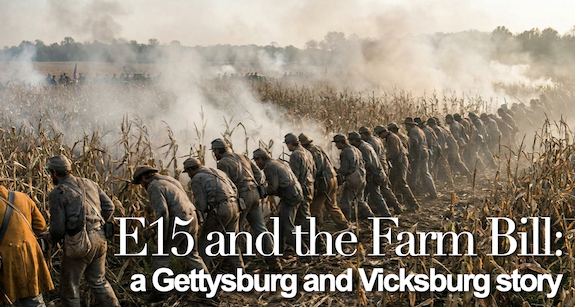
The guns had been firing for two hours when the order finally came.
Across the open fields west of Gettysburg, Pickett’s men stepped out from the tree line and began the long walk toward Cemetery Ridge. Nearly a mile under direct fire. The sort of assignment historians later describe as desperate because they already know how it ended. About the same time, farther west, Grant was attempting something equally improbable at Vicksburg. Gunboats running the batteries at night. Months of failed canal schemes, drowned horses, mud, disease, editorials explaining why the whole enterprise was doomed, and generals quarreling over maps while the river kept doing what rivers do.
One battle was immediate and violent. The other was logistics, endurance, and the long struggle to control supply lines. In July 1863, the Union needed both.
Which brings us, improbably enough, to E15 and the 2026 Farm Bill.
Because this week on Capitol Hill, rural energy advocates found themselves fighting on two fronts at once: the loud, highly visible struggle over year-round E15, and the slower, grinding campaign to move a long-stalled Farm Bill through Congress after years of delay, stalemate, and political trench warfare. One fight was about moving the line. The other was about controlling the river.
And like most Washington campaigns, neither side consists of cartoon villains twirling mustaches beneath the Capitol dome. Oil-state lawmakers, representing refiners already squeezed by compliance costs and narrowing margins, were never likely to stand quietly by while E15 advanced toward year-round permanence. One suspects many of them felt rather like Pickett’s men stepping out from the tree line at Gettysburg: perhaps doubtful of success, but not especially free to decline the assignment.
Meanwhile, supporters of the Farm Bill have spent the better part of four years in something resembling Grant’s Vicksburg campaign — repeated failures, procedural dead ends, changing strategies, uneasy coalitions, and the persistent belief that somehow, eventually, the river had to be opened.
Now, at last, both battles appear to be reaching decisive phases at the same moment.
The House narrowly passed the “Farm, Food, and National Security Act of 2026” by a 224-200 vote, the farthest a Farm Bill has advanced since the 2018 legislation. Yet even that fragile victory nearly collapsed amid a fierce internal fight over year-round E15 authorization. For rural energy advocates, the stakes extend far beyond ethanol blends alone.
The Farm Bill’s Energy and Rural Development titles quietly shape much of the physical architecture of the American bioeconomy. Sustainable aviation fuel (SAF) enters more firmly into the definition of advanced biofuels, while the bill directs the Secretary of Agriculture to establish a department-wide SAF strategy. Biorefinery assistance programs receive renewed backing. The Rural Energy for America Program (REAP) expands into waste-energy recovery. Federal biobased procurement standards move toward modernization, while national labeling terminology for plant-based and biobased products edges closer to uniformity.
None of these provisions arrive with the dramatic flourish of a floor fight over summer gasoline blends. But then Vicksburg never possessed the romance of Gettysburg either, despite controlling the Mississippi and ultimately splitting the Confederacy in two. The E15 battle, by contrast, has all the noise and smoke one expects from close-range political combat.
Beneath the rhetoric lies the long-running problem refiners call the “blend wall.” Americans consume less gasoline per capita than they once did, while federal Renewable Fuel Standard quotas continue pushing larger volumes of ethanol into the fuel pool. To comply, refiners either blend more biofuels or purchase compliance credits, costs critics estimate now approach $20 billion annually across the system. Large integrated refiners can often absorb the burden more easily. Smaller operators, especially in parts of the Midwest and Rust Belt, argue the mandates hit them with the force of artillery fire directed at already thin margins.
Most gasoline sold in the United States already contains roughly 10 percent ethanol. E15 raises the blend to 15 percent, and supporters have long sought year-round authorization rather than seasonal waivers and regulatory uncertainty. Refiners and oil-state lawmakers counter that compliance burdens, infrastructure constraints, and fuel-market distortions continue to impose heavy costs, especially on smaller operators already working with thin margins.
The Wall Street Journal, never known for sentimental attachment to ethanol mandates, promptly denounced the latest maneuvering as “An Ethanol Extortion Play,” arguing that the proposal would merely redistribute economic pain from one sector to another. Corn-state lawmakers and ethanol advocates, meanwhile, view the matter through an entirely different lens: rural market access, energy resilience, and the mounting financial pressure on farm economies already battered by retaliatory tariffs, narrowing margins, and volatile export markets. Critics, including the Wall Street Journal editorial board, see the E15 push as a form of political compensation for those trade-war disruptions — an attempt to redirect economic pain rather than resolve.
Inside every field position, the arguments sound perfectly rational.
Refiners see compliance burdens. Corn growers see market survival. Environmental groups see emissions tradeoffs. Lawmakers see regional economies and voting blocs. Editorial writers see market distortions and political horse-trading. But pull back far enough and the fight begins to look less like a dispute over fuel chemistry than a larger struggle over resilience, supply chains, strategic flexibility, and who absorbs the costs of transition.
Some of those costs appear in refinery balance sheets and farm ledgers. Others arrive more quietly, a few cents at a time at the fuel pump or another season of uncertainty for growers trying to decide what to plant into unstable export markets. There is, underneath the E15 debate, a curious “gasoline is” problem. Americans still talk about gasoline as though it were a singular and settled thing, the way people once said “the United States are.” But modern gasoline is already a negotiated blend of molecules, oxygenates, octane strategies, refinery economics, seasonal formulations, geopolitical assumptions, and regulatory compromises. Pull back even farther and the argument stops being about one fuel versus another entirely. It becomes an argument about what kind of energy system the country believes it is actually operating.
That question has only grown sharper in recent weeks. The Strait of Hormuz crisis has quietly altered the geometry of the discussion. Not long ago, much of the American energy conversation rested on assumptions of durable abundance and permanently cheap domestic supply. But chokepoints have a way of reminding markets that volume and resilience are not the same thing. Logistics still matter. Shipping lanes still matter. Flexibility still matters.
Congress, much like Civil War generals, often discovers that the map and the terrain are two different things entirely. That reality shaped this week’s procedural warfare in the House. Republican leadership initially attempted to attach year-round E15 authorization directly to the Farm Bill, only to trigger an immediate rebellion from oil-state lawmakers. Leadership ultimately struck a compromise: decouple the measures, hold a separate standalone E15 vote on May 13, and in the meantime effectively lash the wagons together by delaying transmission of the Farm Bill to the Senate until the E15 vote occurs.
Classic Washington horse-trading, certainly. But also evidence of something deeper: a recognition that these fights, once treated as separate regional disputes, increasingly belong to the same interconnected system.
Which brings us back to Gettysburg and Vicksburg.
History remembers Gettysburg because it was dramatic. Pickett’s Charge supplied the unforgettable imagery. But Vicksburg mattered because it determined movement, logistics, and long-term strategic position. One battle captured the imagination. The other controlled the river. Gettysburg seized the headlines. Vicksburg changed the map.
The American bioeconomy may be entering a similar phase. E15 is the visible fight on the ridge line. The Farm Bill is the slower struggle over infrastructure, financing, energy systems, rural adaptation, and industrial continuity. Rural energy advocates rarely succeed simply by holding position. In long campaigns, survival usually belongs to the side that recognizes the terrain has already changed.
Whether Congress ultimately delivers two victories, one victory, or a complete shutout remains uncertain. The Senate’s 60-vote threshold looms over both efforts, and Washington campaigns have a way of collapsing just when success appears closest at hand. Still, there are moments when separate battles suddenly reveal themselves as parts of the same campaign.
This may be one of them. And if history is any guide, rural energy advocates would probably settle for controlling the river.
Category: Top Stories

