








Commercialization Has Recurring Topology: How Acelen’s $3 Billion SAF Bet Reveals the Hidden Grammar of Deployment
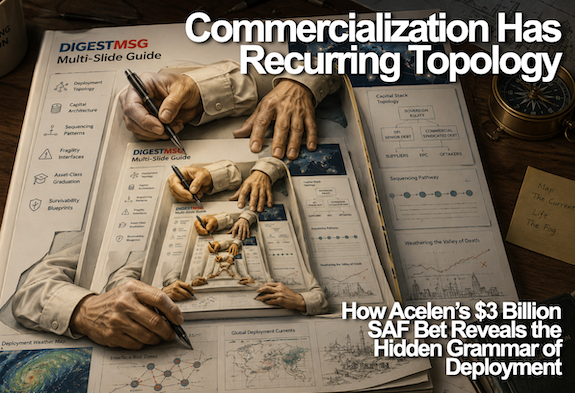
For years, biorefinery commercialization has often been discussed as if it were a linear process: develop the technology, raise the capital, build the plant, scale the market.
But after reviewing tens of thousands of deployment stories across fuels, chemicals, carbon, SAF, hydrogen, biomaterials and infrastructure systems, a different picture begins to emerge. Commercialization behaves less like a pipeline and more like weather. Projects move through shifting conditions: financing weather, policy weather, infrastructure weather, permitting weather, utility weather, feedstock weather, offtake weather. Some structures repeatedly stabilize under stress. Others repeatedly fracture at the same points.
And across that sea of uncertainty, patterns begin to recur. The fog lifts. Not completely. But enough to begin charting the currents.
A $3B Brazilian SAF project illuminates far beyond its shores
That feeling returned this week as news arrived that Acelen Renováveis — controlled by the Emirati sovereign wealth fund Mubadala — will invest $3 billion in a Brazilian biorefinery producing sustainable aviation fuel and renewable diesel in São Francisco do Conde, in the state of Bahia. The initial financing tranche, reportedly led by HSBC and the International Finance Corporation, signals something larger than another refinery announcement or another SAF press release.
It suggests that parts of the bioeconomy may be beginning to cross an invisible boundary: from venture-scale technology speculation toward infrastructure-scale underwriting. That distinction matters. For years, many commercialization narratives implicitly treated deployment as if success flowed naturally from technical validation. Demonstrate the chemistry. Secure a demonstration plant. Raise the next round. Scale the market. But real industrial deployment rarely behaves that cleanly.
Across the archive, recurring patterns begin to emerge. Financing gaps repeatedly appear between demonstration and infrastructure scale. Projects secure grants but fail during sequencing. Others reach construction yet stall before commissioning because refinancing structures were never fully stabilized. Some attract strategic equity but never achieve senior debt participation. Others succeed not because the technology is inherently superior, but because the institutional choreography aligns in the right order.
Sequencing increasingly appears to be the operative discipline.
- Grant timing.
- Permitting timing.
- Lender timing.
- Utility timing.
- Offtake timing.
- Construction timing.
- Policy timing.
Commercialization often behaves less like invention than orchestration.
That is part of what makes the Mubadala/Acelen structure so significant. The story is not simply that SAF works. The industry already knows that renewable diesel and SAF pathways can function technically. The deeper signal is that sovereign capital, development finance institutions, and commercial lenders are beginning to behave differently around selected bioeconomy assets. The underwriting logic itself may be changing.
Increasingly, large institutional actors appear willing to finance not merely technologies, but recognizable survivability architectures: repeatable capital stacks, long-duration revenue structures, sovereign-backed sequencing frameworks, infrastructure-grade debt tenors, and deployment systems that resemble industrial infrastructure more than venture experimentation. In other words, capital itself may be becoming topology-aware. That awareness did not emerge from a single project. It emerged from repetition.
Across hundreds of deployment stories, certain structures recur with striking regularity. Sovereign anchor equity lowers perceived country risk. DFI participation transfers confidence into commercial syndication. Long-dated offtake agreements begin functioning less as sales contracts than as quasi-credit instruments. Repeatable SPV structures reduce lender uncertainty. Multi-institution consortium architectures distribute fragility across larger systems.
At the same time, the archive reveals recurring failure signatures. Announcement-to-disbursement lag. Sequencing collapse despite technically successful systems. FID announcements without fully stabilized commercial debt. Post-commissioning refinancing stress. Offtake-bankability mismatch.
Commercialization appears to possess finite grammar.
The new Multi Slide Guides
That may ultimately become one of the most important discoveries emerging from the next generation of Digest Multi-Slide Guides. The first generation largely mapped sectors, companies, molecules, markets and technologies. The next generation increasingly maps recurring deployment structures themselves: financing architectures, fragility signatures, lender-entry thresholds, sequencing laws and survivability patterns. Not merely who announced what. But why certain structures repeatedly survive while others repeatedly fail. You can see the first one of the next generation: The Digest’s 2026 Multi-Slide Guide to Sovereign-Backed Concessional Finance for Bioeconomy May 2026 How sovereign wealth funds, DFIs, and infrastructure lenders are reshaping deployment-era SAF finance, right here.
And fittingly, this latest signal arrives in Bahia, where old industrial and agricultural histories have long overlapped. In June, São Francisco do Conde prepares for São João celebrations — the Arraiá do Banza — where forró rhythms spill through the streets and quadrilhas fill the night air. This is part of the old Bahian Recôncavo, where sugarcane shaped the region centuries before petrochemicals arrived along the coast.
Now, in an unexpected way, those histories begin converging again. A city long associated with refining and industrial infrastructure may once again find itself connected to biological carbon flows, agricultural systems and fuel production — not as a nostalgic return to the past, but as part of an emerging global infrastructure system linking Gulf sovereign wealth, multilateral finance, Brazilian agriculture, aviation decarbonization and industrial-scale energy transition. The bioeconomy may be entering a phase in which the most important breakthroughs are no longer purely scientific.
They are increasingly institutional. Financial. Sequencing-driven. Infrastructural. The Mubadala/Acelen structure matters because it suggests the map itself may be changing.And across the sea of uncertainty, the fog is beginning to lift.
Category: Top Stories

