








Brian Westlake and the Great Quibbler: Why Avantium, Itaconix, Michelin and Axens are on the march
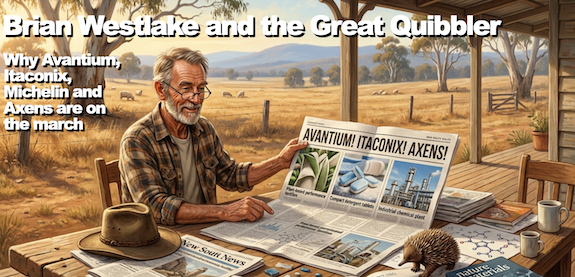
“G’day, Brian.”
“Hmmm.”
“I’ve brought tea.”
“Put it down quietly.”
“What were you reading?”
“The future.”
Only then did I notice where I was.
It was one of those crisp Australian winter mornings that persuade you walls are an optional extra. Dr. Brian Westlake’s cabin stood somewhere on the Lachlan River. Or perhaps the Little River. Brian has always maintained that if you can actually find Bindiwarra on a map, you’ve gone to the wrong place.
His sprawling verandah overlooked a paddock the colour of old khaki. Every flat surface had disappeared beneath journals, engineering drawings, polymer samples, coffee mugs, molecular sketches and what I sincerely hoped was an unusually shaped potato rather than another echidna.
Brian lowered the journal he was reading and peered over the top of his spectacles. I looked down at the papers spread across the table.
“Avantium. Itaconix. Michelin and Axens?” I inquired.
“Mmm. Three first-rate stories. Not that I read them first in the Digest. He snorted. “Never was so much been written, for so many, on so little.” He regarded me with the expression normally reserved for people who wash Land Rovers with imaginary water, for sustainability’s sake. He lined the three stories neatly beside one another.
“How many does it take?”
“How many what?”
“Companies.” He insisted.
“I’ve only just sat down.”
Brian shook his head.
“Jim, when three independent companies arrive at the same answer without consulting the same consultant, pay attention.”
“Why three?”
“Because by then you’re no longer looking at three companies.”
“What are you looking at?”
“A great thing in the making.”
“Like Rome and its Three Hills.”
“Seven hills.”
Brian looked at me with genuine disappointment. “Jim, you’ll never amount to much while you’re still serving as the Great Quibbler.” He took a sip of tea.
“In Australia one bloke, he’s alone. Two blokes, now he’s got a mate. Three blokes, now you’ve got a town, where’s the pub?”
“So what’s the town this month?” I asked.
“Chemicals.”
He pushed the first article toward me.
“First bloke’s a tailor.”
“Avantium?”
“They’ve taken releaf® PEF out of the laboratory and into the wardrobe. Casa da Malha knitted the fabric. Lacatoni’s already showing the sportswear at Milano Unica in Milan.”
“So that’s commercial.”
“That’s confidence. Nobody debuts laboratory curiosities on a fashion runway. They debut products.”
He slid the second article across the table.
“Second bloke runs the washhouse.”
“Itaconix. Over a thousand of the things are already making tablets around the world. Itaconix built the plant-based chemistry. Smaller tablet. Faster dissolving. No plastic. The machinery’s been waiting for chemistry like this.”
“So the greener product also performs better.”
Brian smiled. “Now you’re paying attention.”
The third article followed.
“And this fellow?”
“The brickmaker.”
“Michelin?”
“Michelin and Axens.”
“I thought Michelin made tires.”
“Some of the best people do.” He tapped the production-plant diagram.
“Thing is, Jim, they’ve been chasing this since 2008. They were already using expensive little batches of 5-HMF by 2016, wherever they could justify the cost. Now they’ve finally found the scale. Three thousand tonnes a year with Axens starting in 2027.”
“What does 5-HMF actually do?”
“It starts replacing things we’d rather stop using. Formaldehyde, for one. Better resins. Better adhesives.” He paused. “And better PEF.”
“The same polymer Avantium’s using?”
“The very one.”
I looked back at the three articles. “So these aren’t really separate stories.”
Brian nodded. “Now you’re seeing it. For thirty years the chemical industry believed sustainability and performance were pulling in opposite directions.”
“Wasn’t that true?”
“It was conventional wisdom.”
“Which isn’t the same thing.”
“Exactly.”
I thought for a moment. “But these are still relatively small businesses.”
Brian chuckled. “That’s what they say about holding an echidna.”
“What do they say?”
“Don’t look at the size, Jim. Look at the spines.” He folded the three announcements together. “People keep measuring these companies in tonnes per year.”
“Shouldn’t they?”
Brian stared across the paddock. “It’s like Cow pats.”
“Cow pats?”
“Doesn’t take stepping in many to change the way you walk.”
The silence lingered.
“So what’s really changing?”
Brian looked toward the river. “People think revolutions begin with enormous factories. They begin when infrastructure quietly starts noticing a better idea.”
He tapped the Itaconix story. “The presses were already there.” Then the Michelin–Axens announcement. “So was the engineering.” Then Avantium. “And the markets have been waiting for better molecules.” He looked back at me. “They begin when clever people stop apologizing.”
“Apologizing?”
“For making something greener.” He tapped the stories. “This lot aren’t apologizing.”
I gathered up the three papers. “So sustainability and performance…aren’t two horses pulling against one another after all.”
“They’ve finally discovered they’re hitched to the one horse. Give him his head and he’ll go a Phar Lap.”
As I drove away from Bindiwarra—or wherever Bindiwarra really is—it struck me that Brian hadn’t been talking about three companies at all. He’d been talking about one assumption.
For years, the chemical industry believed it had to choose between lowering carbon and improving performance. This month’s announcements from Avantium, Itaconix, and Michelin–Axens suggest something far more profound. Across three different corners of the value chain—advanced materials, consumer products and platform chemistry—the same conclusion has quietly emerged.
The next generation of chemistry isn’t succeeding because it’s sustainable. It’s succeeding because it is. And once you’ve seen that pattern, like Brian’s third stain on an old work shirt, you’ll never scrub it out.
Category: Top Stories

