








Amyris and the Biology of Industrial Organization
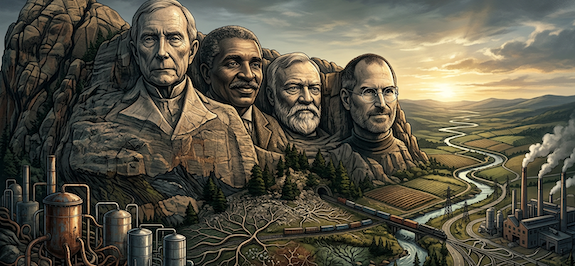
What Rockefeller, Sherman, the Oregon Trail, and the architecture of life can teach us about building industrial systems that create value, adapt, and persist
Amyris has spent much of its existence teaching microorganisms to make remarkable molecules. Along the way, it may have demonstrated something even more remarkable: how industrial systems survive the transformation, and sometimes the failure, of the organizations that contain them. Its shareholders have changed. Its ambitions have changed. Its commercial relationships have evolved. Its original business model proved unsustainable. Yet something recognizably Amyris persisted through bankruptcy, reorganization, and now the proposed acquisition of Oobli, the sweet protein pioneer.
How? Perhaps the answer has been lying in biology all along.
For twenty years, industrial biotechnology has concentrated enormous talent, capital, and scientific imagination on the challenge of making things. Better organisms, higher titers, improved yields, larger fermenters, more efficient pathways from inexpensive substrates to valuable molecules. It’s an extraordinary achievement, this ability to persuade living systems to manufacture substances that once required petroleum, exotic plants, or expensive chemical synthesis. But as industrial biotechnology goes big, a different question is becoming urgent. Not simply how to organize biology to make molecules, but how to organize an industry to make those molecules useful. And here we may discover that biology has been teaching the same lesson for billions of years.
The molecule and the receptor
Consider a sweet protein. Oobli has developed proteins capable of producing sweetness hundreds or even thousands of times more intensely than sugar, measured by weight. Unlike sugar, these molecules are digested as proteins. Their attraction lies in the possibility of delivering the sensory experience of sweetness without delivering sugar’s metabolic load.
But imagine one of these remarkable proteins sitting in a laboratory vial. It has the molecular structure needed to activate the human sweet-taste receptor. It is chemically complete, scientifically impressive, and potentially valuable. Yet it is not making anything taste sweet. For sweetness to occur, the molecule must reach the appropriate receptor, interact with it successfully, initiate cellular signaling, and ultimately contribute to an experience in the human brain. The molecule supplies a capability. The larger biological system converts that capability into a useful effect.
Now imagine replacing sugar with that protein in a chocolate bar. Sugar does considerably more than activate sweetness receptors. It contributes bulk, structure, texture, preservation, and processing characteristics. Remove it, and the formulator may face an expensive collection of new problems. The spectacular sweetness of the replacement molecule may be of little commercial value if restoring sugar’s other functions costs a fortune.
The question is no longer how cheaply we can produce a kilogram of sweet protein. It is how economically we can deliver the desired experience in a finished product. That requires an industrial system extending far beyond the fermentation vessel: downstream processing, purification, formulation, qualification, packaging, distribution, marketing, and reliable customer supply. The sweet protein must find its receptor. The industrial product must find its customer. In both cases, the destination and the means of reaching it are inseparable from the value of the molecule. And that takes us to the first principle of what we might call BIO: the Biology of Industrial Organization.
The organism is not the end of biological organization
Life is a remarkable hierarchy of organized capabilities.
Molecules interact to form structures and perform functions within cells. Cells specialize and cooperate within tissues. Tissues form organs, organs work together within bodies, and bodies participate in families, communities, populations, and ecosystems. At every level, new capabilities become possible because components interact in ways that no component could accomplish alone. A muscle cell can contract, but cannot run a marathon. A neuron can transmit signals, but cannot compose a symphony. An individual bacterium can perform astonishing chemistry, but a microbial community may accomplish transformations beyond the capacity of any one of its members.
And the hierarchy does not stop at the body. Consider the human organism. We are magnificent examples of biological integration, but spectacularly incapable of sustaining ourselves independently. We cannot photosynthesize. We cannot fix atmospheric nitrogen. We depend on plants, microorganisms, other animals, and intricate ecological relationships for the resources that sustain our lives. Inside the body, tight integration is essential. Outside the body, interdependence is equally essential. A human being need not become a tree, a nitrogen-fixing bacterium, a honeybee, and a wheat plant in order to flourish. It needs to participate in systems through which their capabilities become available. The biological achievement is not merely the creation of more complex organisms. It is also the creation of more complex relationships among organisms.
This is an important distinction for industrial biotechnology, because we have sometimes confused the growth of an individual enterprise with the development of the industrial system around it. A company needs an economic identity. It needs a distinctive capability, something valuable to contribute, and a sustainable means of participating in the value that contribution creates. It may own a technology, a manufacturing process, a formulation capability, intellectual property, or access to important customers. But it need not own every other capability required to turn its contribution into a commercial product.
Indeed, trying to make one organization perform every function may eventually become less efficient than allowing specialized enterprises to cooperate. Biology has not chosen one universal arrangement. The body offers the advantages of integration. The ecosystem offers the advantages of distributed specialization. Both produce extraordinary complexity, but they accomplish different things. Industrial organization faces the same choice.
The fermentation of enterprise
Fermentation itself offers an illuminating metaphor.
We take a biological system, supply suitable substrates, establish productive conditions, and encourage a sequence of transformations that produces something valuable. The result depends on much more than the raw materials. Temperature, nutrients, oxygen transfer, metabolic pathways, process stability, and the interactions among countless molecular and cellular processes determine what emerges.
Now think of an industrial enterprise. People arrive with knowledge, experience, ambition, and ideas. Capital provides resources. Technology supplies possibilities. Organizations create conditions in which people collaborate, experiment, learn, specialize, and sometimes accomplish things none could have achieved independently. The enterprise becomes a vessel for transforming human capability into productive economic activity.
Of course, people are not passive substrates, nor is a company literally a fermenter. The interesting parallel is that the result depends on the organization of productive relationships, not simply on the inventory of components. A collection of brilliant scientists is not necessarily a successful industrial business. A magnificent production plant is not necessarily a commercially viable enterprise. And an extraordinary molecule is not necessarily an ingredient.
Something must organize the transformations that connect possibility to usefulness. Here, too, there are different stages. A fermentation process that performs wonderfully in a laboratory may fail at industrial scale. A successful fermentation broth may prove ruinously expensive to purify. A purified product may be difficult to formulate. A successful formulation may fail to obtain reliable distribution or repeat customer orders. Each stage demands different capabilities, and often different partners. The industry needs to learn how to change its organization as the task changes.
The Oregon Trail that never was
Americans remember the Oregon Trail as a line on a map, running from Independence, Missouri, to Oregon City. We imagine covered wagons crossing the prairie, mountains rising in the distance, and a determined company of pioneers pressing westward toward a shared destination. But the real journey was considerably more complicated.
Few emigrants began their lives in Independence. They arrived from farms and communities scattered across the eastern United States, sometimes traveling great distances before reaching the Missouri frontier. Independence was one gathering point among several, a place to assemble provisions, find companions, acquire wagons, and prepare for the journey ahead. Nor did Oregon City necessarily mark the end. Families dispersed throughout the Willamette Valley and beyond, seeking farms, settlements, businesses, and opportunities. In my own family’s story, the journey continued into what is now Lane County. Along the way, the nature of the undertaking changed repeatedly.
One day the problem was keeping wagons moving across the prairie. Another day it was crossing a swollen river. At a difficult crossing, the talents of a wagon builder might suddenly matter less than those of someone who understood ferries, rafts, river currents, and the behavior of heavily loaded vehicles in water. The people who helped a family reach Missouri were not necessarily the people who could guide it across the mountains or help establish a productive farm in Oregon. There were wagonmasters, merchants, blacksmiths, ferrymen, guides, traders, and people whose knowledge of the country preceded the emigrants’ arrival by generations. There were temporary alliances, disagreements, separations, new companions, and changing routes.
What we remember as one great journey was actually a gathering of journeys, undertaken by people whose needs and capabilities changed continually. Industrial biotechnology is not so different. The scientific founders who discover an extraordinary molecule may not be the people best equipped to finance a factory. The engineer who can scale fermentation may not know how to formulate the resulting ingredient. The formulator may have little interest in owning the manufacturing plant. The global distributor may want dependable supply rather than ownership of the microorganism. Even the capital changes. Venture investors capable of recognizing scientific potential bring different experience from industrial growth investors, lenders, or restructuring specialists. A company may require all of them over its lifetime, but not necessarily at the same time.
This is not a failure of the original founders or investors. It is a consequence of the changing journey. A wagon is a wonderful invention. But when the trail reaches a river, one may need a boat.
Rockefeller’s answer
In the 1870s, John D. Rockefeller confronted a rapidly expanding petroleum industry whose extraordinary productive potential was constrained by disorder, unreliable transportation, uneven refining practices, and fierce competition. Oil wells were appearing across Pennsylvania and elsewhere. Refiners converted crude petroleum into kerosene and other products. Railroads moved materials between producers, refiners, and markets. Merchants brought finished products to customers. Rockefeller recognized that these were not merely separate businesses. They were interdependent components of an emerging industrial system. His achievement was to organize them.
By consolidating refineries, coordinating transportation, investing in infrastructure, improving operating practices, and building increasingly integrated distribution capabilities, Standard Oil developed an industrial organization of extraordinary scale and efficiency. There was an immense Rockefeller insight here: the economic value of petroleum depended not simply on the oil itself, but on the reliable organization of everything required to make petroleum products useful and available. The molecule was never enough. Delivery mattered.
Yet Rockefeller made a second choice. He pursued the benefits of industrial coordination largely through concentration of ownership and control. The distinction is crucial. Effective coordination can create immense value. But it does not necessarily follow that every participant must be owned by the same enterprise. Standard Oil’s consolidation also relied on restrictive arrangements and practices that helped it acquire extraordinary market power. What began as an effort to improve industrial organization became a struggle over who would control access to the benefits of that organization.
In 1890, Congress enacted the Sherman Antitrust Act. In 1911, the Supreme Court ordered Standard Oil dissolved. And then something remarkable happened. The industrial system continued.
Sherman and the release of the system
The dissolution of Standard Oil did not cause the petroleum industry to forget how to refine oil. Its pipelines did not suddenly become useless. Its engineers did not lose their knowledge. Its customers did not cease needing fuel, lubricants, and petroleum products. The unified corporate structure was divided, but the industrial capabilities persisted under new arrangements of ownership and control. Even Rockefeller himself became substantially wealthier as the value of his holdings in the successor companies increased in the years following the breakup.
We should not mistake this for proof that breaking up companies always creates prosperity. The successor companies remained substantial enterprises, many continued to pursue integration, and the petroleum industry experienced repeated cycles of consolidation and competition. But the historical lesson is unmistakable. The productive system was not identical to the corporation that had assembled it.
Rockefeller demonstrated the advantages of organizing industrial capabilities. Sherman supplied a countervailing principle: that the benefits of organization need not justify permanent monopolization of the system. Perhaps the most consequential industrial question is not whether concentration or distribution is inherently superior. It is which capabilities should be concentrated, which should remain independent, and how the relationships among them can be organized so that the entire system becomes more productive. An enterprise must retain a meaningful economic role, but it need not own the whole chain. Indeed, the chain may become more valuable when its participants are free to specialize, compete, innovate, and form new relationships. That requires more than merely dividing ownership. Standards, contracts, trustworthy interfaces, dependable performance, and fair opportunities for participation must make cooperation possible. And it requires the capacity to reorganize when conditions change.
Amyris and the catastrophe
Which brings us back to Amyris. The company began with remarkable scientific ambitions, developed valuable technologies, acquired manufacturing capabilities, established commercial relationships, and attracted successive generations of investors. Its history includes fermentation-derived farnesene, fragrances, specialty chemicals, and the Reb M sweetener technology that Ingredion now commercializes. Over time, Amyris attempted to combine an expanding collection of scientific, manufacturing, consumer-brand, and commercial activities. Its technology was impressive. Its ambition was enormous. Its financial structure eventually became unsustainable.
In August 2023, Amyris filed for Chapter 11 bankruptcy protection. When its reorganization became effective in May 2024, the old common equity was cancelled, and the business emerged with a substantially different economic structure and strategic focus. For the shareholders whose claims were extinguished, this was not some elegant biological transformation. It was a financial catastrophe.
Yet the technology did not disappear. The manufacturing knowledge did not evaporate. The patents, experience, capabilities, and many commercial relationships remained economically useful. Amyris did not literally die and reappear as an unrelated company. Its legal and operational continuity survived restructuring. But the economic organism was profoundly changed.
There is a useful parallel in natural history. Sixty-six million years ago, an asteroid struck the Earth, bringing the dominance of the great non-avian dinosaurs to an end. But not all dinosaurs disappeared. Birds survived, carrying their evolutionary inheritance into a profoundly changed world.
The dominant form disappeared in a catastrophe. The capacity to evolve persisted.
Amyris’s bankruptcy was not an asteroid strike, and corporate restructuring is not biological evolution. But the analogy illuminates the difference between preserving an organizational form and preserving the productive capabilities that form makes possible. Amyris’s financial structure could fail while much of the industrial capability accumulated within it remained valuable. The enterprise that emerged from restructuring was not simply the old company made smaller. It had to discover a different economic proposition, one based more heavily on B2B technology, manufacturing, and relationships with customers and partners.
And now it proposes to acquire Oobli, whose co-founder Jason Ryder once worked at Amyris. The industrial knowledge circulated. The people pursued different journeys. The technologies developed in separate organizations. Now some of those journeys are converging again. The surviving industrial system still had a use for an Amyris, although not necessarily the Amyris that existed before.
The changing seasons of industrial organization
Consider ice forming on a river.
As conditions change, water molecules organize into a solid structure. Later, as temperatures rise, the ice breaks apart. The water flows again, forming different relationships with its surroundings. Under suitable conditions, ice may form once more. The water persists through changing arrangements. Industrial organization has something of this character.
When technologies are immature, capital is scarce, and coordination is difficult, bringing activities together inside one enterprise may be the most effective way to make progress. An integrated organization can establish standards, share information, align investments, and overcome the difficulties of coordinating independent participants. As technology matures, capabilities become more widely available. Specialized firms emerge. Suppliers learn to meet common specifications. Customers become better informed. Entirely new combinations become possible. The old concentration may become less necessary. A distributed system may be capable of delivering the same functions more efficiently, or may discover applications the integrated enterprise never imagined. Then conditions change again. A technological breakthrough, supply-chain crisis, new regulation, or shift in market demand may favor new concentrations.
The metaphor is imperfect, of course. Water molecules do not negotiate supply agreements, and industrial transitions can permanently destroy productive capacity. There is no law requiring industries to alternate predictably between integration and fragmentation. But the image reminds us that the organization of capabilities is not a permanent destination. The system can persist while its structures change. And in some circumstances, it may persist precisely because those structures are capable of changing.
What does persistence require?
This is where the problem of industrial organization becomes more than a question of efficiency.
An extraordinarily specialized organism may perform wonderfully under the conditions for which it is adapted. But if those conditions change, the very features that made it successful may become liabilities. A more modular system, composed of smaller units capable of forming new combinations, may possess different advantages. Some components may fail while others continue functioning. New participants can enter. Old relationships can be replaced. Knowledge and capabilities can survive the loss of particular organizations. But we must not confuse smallness with resilience, or size with fragility. Large integrated structures can be exceptionally robust, especially when they incorporate redundancy and adaptive capabilities. Distributed networks can be vulnerable when critical dependencies fail.
The deeper question concerns the architecture of persistence. How much coordination is necessary? How much independence is beneficial? Which functions must remain tightly integrated, and which can become more adaptable through specialization and exchange? And what must survive when a particular enterprise cannot? An industrial system may preserve technical knowledge while losing financial capital. It may retain manufacturing capability while changing ownership. It may preserve commercial relationships while replacing products and technologies. Its original shareholders may disappear. Its founders may move on. Its technologies may be licensed, sold, improved, or incorporated into other enterprises. Persistence at the level of the industrial system does not guarantee persistence for every participant.
That is why the system must offer participants a reason to contribute. The people and enterprises providing useful capabilities need sustainable economic claims on the value they help create. A system in which everyone contributes but only one participant captures the rewards is unlikely to remain healthy, innovative, or competitive without some coercive source of control. Nor can a system function if nobody takes responsibility for the difficult work of coordination.
The industrial organizer therefore faces a challenge more sophisticated than simply building the biggest company or owning the largest manufacturing plant. The task is to create relationships that increase productive value, preserve incentives to participate, and remain adaptable as technologies, markets, and participants change. In that sense, the next Rockefeller may be less interested in owning the entire industry than in understanding how to make the entire industry work.
The biology of industrial organization
Perhaps the great irony of industrial biotechnology is that we have spent so much energy mastering biological organization inside the cell while sometimes neglecting the biology of organization outside it. We understand the importance of metabolic pathways, cellular regulation, specialized functions, communication, and carefully controlled operating conditions. We know that a fermentation process succeeds not because one molecule is extraordinary, but because an entire collection of processes works together.
Yet when we turn to industrial commercialization, we sometimes return to the belief that the essential task is simply to produce the molecule at sufficient scale. What might this industry look like several decades from now, when it has moved beyond its equivalent of petroleum’s 1870s, and into something resembling the world after the dissolution of Standard Oil in 1911 and the breakup of Ma Bell in 1984?
Perhaps we will see great industrial biotechnology enterprises continually forming, dividing, exchanging capabilities, and forming again. Manufacturing networks may assemble around one family of molecules and reorganize around another. Formulators may become the organizing centers of entire markets. Technologies developed within one company may migrate into a dozen others. Capital, talent, intellectual property, manufacturing capacity, and customer relationships may circulate through an industrial ecosystem whose productive capabilities grow even as its individual organizations change. Some enterprises will become giants, and some giants will discover advantages in becoming smaller. Others will combine, separate, or find entirely new roles as the needs of the system change. The industrial landscape may come to resemble less a collection of permanent corporate empires than an evolving ecology of specialized organisms, each possessing something valuable, none required to possess everything. That would not be the abandonment of industrial organization. It might be its maturation.
Biology has been demonstrating something similar for billions of years. Living systems grow, specialize, cooperate, compete, reproduce, and reorganize. They preserve useful information and capabilities even as individual organisms perish. Their structures are never permanent, and their persistence depends on continual exchanges of energy, materials, and information with the world around them.
Entropy is always at work. No organism, no corporation, no civilization can preserve its organization indefinitely without paying the costs of maintenance, repair, and renewal. And the larger and more intricate the arrangement, the more consequential its dependencies may become. The answer is not to build an organism so immense that it can contain the entire world, nor a corporation so comprehensive that it can perform every industrial function. It is to create living systems, and industrial systems, capable of continually renewing the relationships through which they create value.
Perhaps the great industrial enterprises of tomorrow will be remembered less for how much they owned than for how much they made possible. Their achievement will be measured not only in the molecules they produced, but in the capabilities they released into the world, the enterprises they enabled, and the new combinations that continued long after their original corporate forms had passed away. The organism is not the end of biological organization. The corporation is not the end of industrial organization: The dominant form disappears. The capacity to evolve persists.
And perhaps the highest achievement of industrial organization is not to build something that will never change, but to build something that can never be finished changing.
Category: Thought Leadership, Top Stories

