








ABLC Next 2026: From Alignment to Emergence
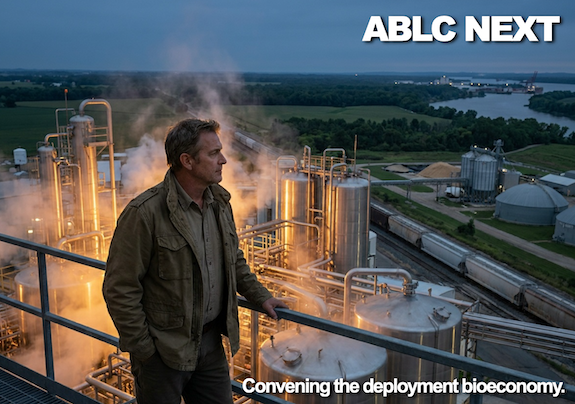
There comes a moment in every industrial transition when the question changes. The early questions are familiar enough. Does it work? Can it scale? Is there a market? Is financing available? Can the feedstocks be secured? Can policy support hold? Can the engineering survive contact with reality?
But eventually the question changes from whether the future can happen to how systems align to make it happen repeatedly. That is where the bioeconomy stands now.
Not in the age of isolated breakthroughs. In the age of synchronized systems. And that is the idea behind ABLC Next 2026, which arrives October 21–23 at the Hotel Nikko in San Francisco. This year’s program is organized not simply around technologies or markets, but around phases of deployment:
ALIGNMENT → IGNITION → EMERGENCE
Because the future does not emerge from isolated inventions alone. It emerges when engineering, capital, policy, operations, infrastructure, feedstocks and timing come into position simultaneously.
For years, many industry events have treated the bioeconomy as a single conversation. But anyone who has actually built facilities, commissioned systems, raised project finance, survived feedstock disruptions or navigated scale-up knows that the rules change dramatically at every phase. The needs of a laboratory are not the needs of a pilot plant. The needs of a pilot system are not the needs of demonstration. The needs of demonstration are not the needs of commercial deployment. And the needs of commercial deployment are not the needs of frontier exploration.ABLC Next is designed around those transitions.
Wednesday: Alignment
The opening day focuses on the systems that must come into position before deployment can accelerate. Markets. Molecules. Feedstocks. SAF. Marine fuels. Supply chains. The industries, incentives and materials entering phase together.
This is the alignment layer of the bioeconomy — where demand signals, infrastructure, regulatory frameworks and production systems begin synchronizing. And increasingly, that synchronization is becoming regional as well as technological.
San Francisco is not simply hosting the event. It increasingly sits inside a growing West Coast deployment corridor linking California’s LCFS-driven market pull, Pacific logistics infrastructure, National Lab ecosystems, emerging SAF initiatives, engineering talent and Washington State’s accelerating aviation fuel initiatives. This isn’t theoretical.
ABLC Next is designed to bring together the architects of deployment alignment itself — the engineers, financiers, operators, policy strategists, project developers, feedstock systems leaders and commercialization teams attempting to synchronize the next industrial buildout.
Because projects rarely fail from a single flaw. More often, they fail from mistimed systems. A technology may be ready before policy. A market may emerge before infrastructure. Capital may appear before engineering certainty. Feedstocks may scale before logistics. Alignment matters because deployment is fundamentally an orchestration problem.
Thursday: Ignition
Thursday moves into activation. Capital meets engineering. Technologies meet deployment. And increasingly, the central industrial question is no longer whether First of a Kind systems can function. It is whether Nth of a Kind deployment can become repeatable, financeable and durable. That transition — from FOAK to NOAK — may define the next decade of the bioeconomy.
The day’s programming centers on bench-to-pilot systems, pilot-to-demonstration scale-up, commercial integration, finance, engineering execution and project delivery. This is where the bioeconomy leaves the safety of diagrams and enters the difficult terrain of commissioning reality. Scale-up is not merely enlargement. A system that functions beautifully in glassware may fail in steel. A process that works continuously for 72 hours may fail over 18 months. An elegant model may collapse under maintenance schedules, operator constraints, corrosion, impurities, integration lag or financing delays. Because eventually every elegant process diagram becomes a field problem.
Pumps cavitate. Catalysts foul. Heat balances drift. Utilities arrive late. Contractors collide. Feedstocks vary. Commissioning schedules slip. Valves leak. Control systems misbehave. And operating reality begins rewriting assumptions. That is why pilot systems are not merely small factories. They are learning systems.
That is why ABLC Next increasingly focuses on deployment systems rather than isolated technologies. The future belongs not simply to discovery, but to integration. This year’s summit structure reflects that reality directly.
The Bench to Pilot Summit
From laboratory insight to engineered pilot systems — instrumentation, integration, process control and scale-up readiness. This is the world where ideas first encounter operational discipline. Not simply whether chemistry works, but whether systems can repeat, stabilize, instrument, control and survive.
The Pilot to Demonstration Summit
Engineering the leap from proof to deployment. This may be the hardest transition in the entire industrial stack. This is the terrain where promising FOAK systems either begin evolving toward repeatable deployment — or discover the hidden realities that prevent it. Pilot systems can demonstrate possibility. Demonstration systems must demonstrate survivability. At this stage, integration becomes everything: Heat integration. Mass balance. Utilities. Materials handling. Financing structures. Construction sequencing. Operational resilience. Supply assurance.Commissioning strategy.
This is the valley where many promising technologies either become industries — or disappear.
The Commercial Scale Summit
Mastering the build and commissioning. Commercial deployment is where timelines, contractors, permitting, operations, logistics, financing and execution all collide simultaneously. And increasingly, the industry’s central challenge is not invention. It is reliable deployment. The bioeconomy is moving from a period defined by technological proof toward a period defined by systems execution. That is a different skillset.
Friday: Emergence
Friday turns toward the frontier. National Labs. Emerging ventures. Activate Fellows. IndieBio companies. Frontier technologies. The ABLC Due Diligence Wolfpack. This is where the 2030 horizon first becomes visible. Not simply through presentations, but through scrutiny, challenge, testing and operational debate. Where next-generation systems are tested, challenged and refined under real-world scrutiny.
Emergence matters because the future rarely arrives fully formed. It appears first as fragments:
— a process improvement
— a novel catalyst
— a financing innovation
— a systems integration breakthrough
— a new feedstock pathway
— an overlooked infrastructure advantage
The role of the ecosystem is not merely to observe these fragments. It is to create conditions under which they can synchronize into deployment.
The New Deployment Era
For much of the past twenty years, the bioeconomy operated under a scarcity model. Scarcity of capital. Scarcity of infrastructure. Scarcity of deployment experience. Scarcity of operational examples. Today, many of those constraints remain — but the industry is also entering a new phase.
There are now commercial SAF facilities. Operational renewable diesel systems. Biomanufacturing platforms. Gasification deployments. Carbon management systems. National Lab infrastructure. Pilot ecosystems. Project finance frameworks. Deployment experience.
The challenge is no longer simply proving that the future is possible. The challenge is coordinating systems rapidly enough to achieve durable scale.
That is why ABLC Next increasingly centers on integration. Not because integration is fashionable. Because integration is now the central industrial problem. The future does not emerge from isolated breakthroughs. It emerges from synchronized systems. And that synchronization — across engineering, policy, capital, infrastructure and deployment — is ultimately what ABLC Next is designed to accelerate.
ABLC Next 2026 takes place October 21–23 at the Hotel Nikko in San Francisco. More about the event here.
Category: Top Stories

