









You Have to Know Before You Go: 45Z and the New Geology of the Bioeconomy
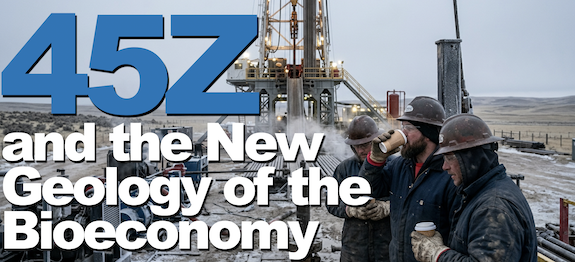
Bowman Draw, Converse County, Wyoming. April 21, 2026.
It is 32 degrees Fahrenheit, more or less, and blowing.
Nobody at the Rocky Road well pad needs a thermometer to establish this. The coffee is doing the measuring. A few men stand around Pete Martin Drilling’s rig with paper cups wrapped in gloved hands, partly for the caffeine and mostly because anything warm is worth holding onto. Raise the cup and the Wyoming wind finds the little strip of wrist between glove and jacket. Put it down and the coffee starts losing its argument with April. Nobody complains. It’s early spring in Converse County. Diesels idle. Steel waits in the rack. Breath appears and disappears.
Somewhere beyond the pad are cattle, sagebrush, shallow gulches and a great deal of Wyoming in which nothing appears to be happening. Here, something is. Pete Martin Drilling has a job today.
Rocky Road Federal 3572-2032 3NH.
The name is almost jaunty. The numbers aren’t. Wyoming’s records will eventually put total depth at 12,217 feet. But first you have to get through the first inch. Somebody gives the word. Machinery takes the load. Steel begins to turn.
The bit strikes dirt. Is it pay dirt? There was a time when oilmen had a wonderfully reckless way of answering that question. They drilled. Wildcatting. Pick your ground. Raise the derrick. Put your money down. Make a hole. See what comes back. A century of expensive dry holes has taken some of the romance out of that.
Long before the Pete Martin crew arrived at Rocky Road, people had been trying to know what the bit would find. Nearby production. Formation thickness. Depth. Pressure. Well logs. Decline curves. Completion designs. Reservoir models. Two Rocky Road wells had already been spudded twelve days earlier.
Nobody is guessing in Wyoming anymore. The uncertainty doesn’t disappear. Twelve thousand feet of geology retains the right to make fools of everyone standing above it. The drill bit gets the final vote. But these days, you have to know before you go—as much as it is possible to know.And here comes the slightly sheepish part for those of us who have spent a generation building an industry to replace petroleum.
The bioeconomy is becoming a wildcatter. Because Section 45Z is teaching renewable fuels the same lesson that a century of expensive dry holes taught the oil business:
What you produce matters. But what lies underneath determines what it’s worth. For petroleum, the hidden formation is geology. For the bioeconomy, it is carbon intensity.
A gallon of ethanol looks like another gallon of ethanol. Jet fuel doesn’t arrive at the wing wearing a little tag explaining where its carbon came from. A bushel of corn gives no outward indication of its fertilizer regime, tillage history or soil-carbon practices. And manure remains, reassuringly, manure. Yet underneath each lies a hidden formation of farming practices, fertilizer, methane, process heat, electricity, transportation, carbon capture and conversion efficiency.
Those differences used to belong mostly in sustainability reports. Under Section 45Z, they belong on the income statement. And this month, Washington handed the bioeconomy a much better set of well logs.
Washington Logs the Formation
On September 8, the IRS released Notice 2026-53, providing the emissions-rate table for transportation fuels produced during 2026 and additional guidance on the treatment of manure-derived fuels and regenerative agricultural practices.
At almost the same moment, the September revision of 45ZCF-GREET supplied important technical additions of its own: new RNG pathways for food scraps, corn stover, grain stillage and mixed high-moisture organic wastes; integration of the feedstock carbon-intensity calculator for qualifying agricultural practices; and dairy- and swine-manure pathways reflecting the statutory changes Congress made for fuel produced after 2025.
Congress had already changed the economics underneath all this. For post-2025 production, qualifying feedstocks generally must be grown or produced in the United States, Mexico or Canada. Indirect land-use-change emissions come out of the calculation. And negative emissions rates are generally prohibited. Then Congress leaves one very large barn door open.
Animal manure.
Transportation fuels derived from manure can still receive negative emissions rates, reflecting the methane avoided when manure that otherwise would generate emissions is captured and converted into useful fuel. Dairy and swine pathways are in the current framework. Work continues on beef and poultry manure.
This isn’t a clerical distinction. It’s an economic formation. A dairy digester capable of demonstrating substantial avoided methane isn’t simply making the same molecule by another route. It can occupy an entirely different place on the 45Z value curve. For years, the bioeconomy talked about carbon intensity as though CI were a report card. Increasingly, it looks more like reservoir quality.
Carbon Intensity Is the Well Log
This is where 45Z departs from much of the history of American biofuel policy. Traditional volumetric incentives asked a relatively straightforward question: How much qualifying fuel did you make? Section 45Z asks something more demanding. What kind of gallon did you make?
The credit begins with lifecycle greenhouse-gas emissions associated with producing and using the fuel. Depending upon the pathway, that means looking backward through the molecule into feedstock production and sourcing, gathering and transportation; into electricity, process fuels and hydrogen at the production facility; and forward through transportation, storage and ultimate use.
The physical gallon can’t tell you any of this. The well log can.
USDA’s regenerative-agriculture framework and the 45Z feedstock carbon-intensity calculator provide pathways for qualifying farm-level practices to enter that lifecycle calculation. Transition relief for certain 2025 and 2026 nutrient-budget requirements gives producers time to bring documentation and operations into alignment with the emerging regime.
That means decisions made hundreds of miles from a refinery can migrate all the way through the carbon calculation to the economics of the finished fuel. Fertilizer application is no longer simply an agronomic input. Methane management isn’t merely environmental compliance. Carbon capture isn’t simply a sustainability project. They can become characteristics of the economic reservoir.
And suddenly one of the bioeconomy’s most valuable instruments isn’t merely the fermenter, digester or hydrotreater. It’s the data.
The Barn Door Exception
Nowhere is the transformation more dramatic than manure. Congress generally prohibited negative emissions rates for post-2025 fuel pathways. But animal manure received an exception. There is a physical reason for that asymmetry. Capture manure-derived methane that otherwise would have entered the atmosphere and the lifecycle calculation can recognize an avoided emission—not merely a cleaner production process.
That creates a remarkable inversion of ordinary commodity economics. For most commodities, the raw material has positive value and processing adds value to it. Manure can begin as a disposal problem. Avoided methane can turn that liability into carbon value. Conversion can turn it into transportation fuel. And Section 45Z can make the carbon characteristics of the pathway worth economically more than an observer looking only at the underlying molecule would ever suspect.
In oil language, somebody discovered a very interesting formation underneath the barnyard. But there is an important warning here. A manure project does not become valuable because somebody writes manure on a spreadsheet. Prior manure-management practice matters. Baseline matters. Documentation matters. Verification matters. Once again: You have to know before you go.
From Well Log to Bank Statement
If this were merely an exercise in sophisticated lifecycle accounting, Section 45Z would remain the province of policy specialists.
The more interesting development is that somebody is buying the output.
Gevo offers one of the clearest demonstrations.
Its North Dakota operation contracted sales totaling $52 million of 2025 Section 45Z production tax credits, following an initial roughly $22 million transaction and another approximately $30 million sale. For 2026, Gevo has been targeting more than $70 million in Section 45Z monetization.
Look closely at where that value comes from. Low-carbon ethanol. RNG. That is the wildcatting analogy becoming financial. Improve the formation, improve the economics. And that can create a feedback loop. C arbor capture > CI > credit value > cash > more carbon capture.
This isn’t theoretical carbon arbitrage anymore. It’s operating cash flow. OPAL Fuels has offered another sign of maturation by establishing a framework capable of monetizing up to $100 million in Section 45Z credits over multiple years. One transaction proves that a credit can be sold. A repeatable monetization architecture begins to suggest something larger. A market.
The Banker Test
Engineers like better models because they produce better answers. Bankers like them for another reason. They make disagreement smaller. A lender doesn’t finance a $500 million plant because GREET contains elegant lifecycle mathematics. The lender finances when the developer, independent engineer, tax adviser, insurer, lender and eventual credit purchaser can examine the same project and reach sufficiently similar conclusions about what its performance is worth.
That’s the quiet infrastructure underneath project finance. What the evolving 45Z architecture does is improve the instrument with which one important source of project value can be measured.
The September 45ZCF-GREET revision puts more pathways into the model. Agricultural practice guidance pushes measurement farther upstream. Notice 2026-53 supplies the emissions-rate table and additional rules for translating those measurements into the credit.
The New Carbon Yield
There is a temptation to describe Section 45Z simply as the successor to earlier biofuel tax incentives. That undersells what is happening. The profound shift is from identity toward performance. The economic question becomes progressively less:
Are you ethanol? Renewable diesel? SAF? RNG?
And increasingly:
What did it take to make this unit of transportation fuel, and what lifecycle emissions rate can you demonstrate?
At its heart, the Section 45Z calculation is beautifully simple. The statutory benchmark is 50 kilograms of CO₂-equivalent per MMBtu. Move your lifecycle emissions rate farther below that benchmark and the emissions factor rises. In simplified form:
Credit value = applicable credit amount × emissions factor
and
Emissions factor = (50 − lifecycle emissions rate) / 50
That means carbon improvement isn’t ornamental. It has a yield. Suppose two otherwise comparable fuel producers qualify for the same applicable credit amount. One produces at an emissions rate of 25. Its emissions factor is 0.5. Drive that rate toward zero and the factor approaches 1.0. You haven’t made twice as much fuel. You’ve made the carbon performance of the same gallon dramatically more valuable.
And where a qualifying manure pathway reaches a negative emissions rate, the economics can move still farther.
This creates a race not merely to manufacture more gallons.
It creates a race to improve the carbon yield of every gallon produced. Improvements occurring far upstream can travel through lifecycle accounting into the economics of fuel produced far downstream. That is why the real revolution may ultimately happen outside the refinery fence. Section 45Z turns the farm into part of the energy system. It turns carbon accounting into production infrastructure. And it turns information into something surprisingly close to a feedstock.
You Have to Know Before You Go
Back at Bowman Draw, none of the modeling guarantees that Rocky Road will be a great well. That’s why Pete Martin Drilling still had to turn the bit. The formation ultimately gets the final vote. But nobody sensible concludes from the existence of uncertainty that geology isn’t worth studying. Quite the opposite.
The millions of dollars committed once steel starts turning are precisely why people want every credible piece of information they can obtain before it does.
That may be the most useful lesson petroleum has left for the industry trying to replace it. The bioeconomy spent a generation asking America to believe that cleaner molecules could be made. Section 45Z asks something harder. Measure. Trace. Differentiate. Finance. .
A century ago, the wildcatter’s great question was simple: Is there something valuable underneath this ground?
The modern bioeconomy is beginning to ask much the same question about every bushel, every lagoon and every gallon. The answer isn’t found by looking at the surface. Show us the log.
Category: Top Stories

