








Algae Projects Utilizing Carbon Dioxide – Foster Photosynthesis And Carbon Sequestration
By Sam A. Rushing, Advanced Cryogenics, Ltd.— www.carbondioxideconsultants.com
Special to The Digest
For the average citizen, Algae is often viewed as a problematic growth, sometimes found in backyard swimming pools and in-home fish tanks. These environments are constantly trying to eliminate and prevent algae formation. On the other hand, algae today in greenhouse gas emissions reduction efforts and biofuel production via algae growth are significant; where algae support environmental improvement (via CO2 sequestration) and supports biofuels, which should be among the most acute demands of our time. Coincidentally, with restrictions on fossil fuels in the Middle East; this is ever more critical than before.
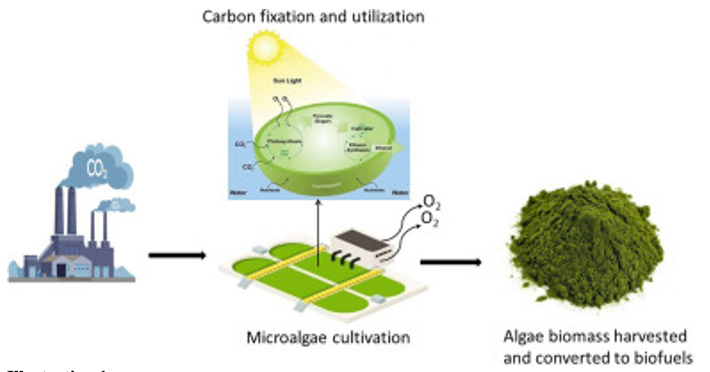
In addition to ethanol projects today, the electric utility sector has tested the injection of hot flue gas from coal and gas fired power plants, with the potential for carbon sequestration. Certain blue-green algae can grow in an environment with hot flue gas from such power or chemical projects. Via photosynthesis, carbon dioxide and water are basic requirements for algae growth, and oxygen plus water vapor are by-products from this process. The algae also can absorb SOx and NOx; two compounds which cause acid rain. The algae process from power, combustion, and other chemical projects including ethanol are therefore a means of sequestering carbon, plus, in some cases, other environmentally harmful agents, with an energy source feedstock in the form of algae generated; which could be used for both ethanol and biodiesel projects.
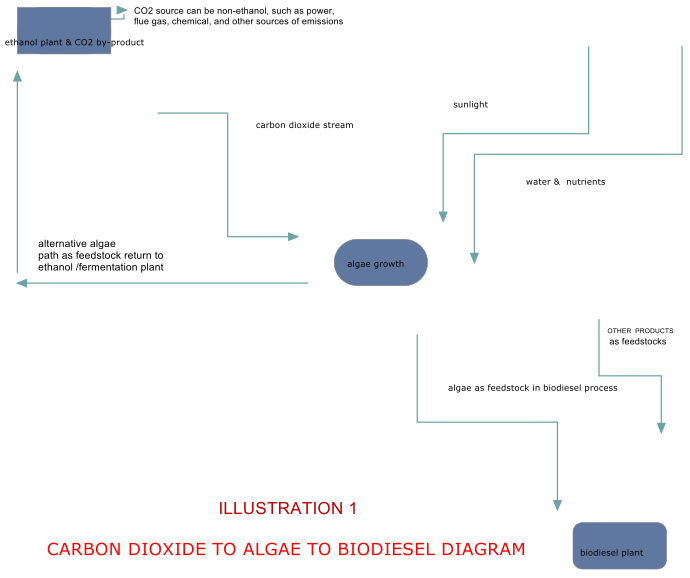
As for ethanol and biodiesel, when a full loop or cycle is considered, whereby ethanol yields CO2 as a by-product, and this CO2 is then used in algae growth, from this point, algae can be used in the manufacture of biodiesel and/or a feedstock for fermentation as ethanol; conceivably a cycle is then generated; that being a cycle using CO2 from ethanol and other CO2 sources for production of algae; and this algae returning as a feedstock for ethanol or as a feedstock in biodiesel projects. The algae growth is a CO2 sink, or form of sequestering carbon; thus, it is extremely important today, as would be generating a viable, highly efficient form of plant oil from algae. Algae could be considered the most viable oil source available, growing more rapidly than any other material. Please see illustration 1 for the CO2 an algae sourcing concepts for biodiesel and ethanol production. As a rule of thumb, approximately one ton of carbon dioxide would be removed (from otherwise airborne emissions) via the growth of two tons of algae.
CARBON DIOXIDE – GROSS YIELD, MARKETS, AND ETHANOL
Merchant Carbon dioxide is well known as a soft drink carbonation agent, a cryogenic fluid, and an industrial gas consumed in foundries, to name a few. Globally, there is an estimated 25 million tons of total CO2 emissions daily absorbed by the oceans, leaving a gross 50 million tons in excess, beyond the ocean’s ability to take on this gas as a natural process, again this is on a daily schedule, all produced from industrial and biological processes. This is primarily power plant, flue gas & chemical by-product; to follow with a wide range of other processes daily. This total 50 million tons of carbon dioxide in excess each day is growing at an astronomical rate, from an emissions perspective.
Next is the question of growing energy demand. The U.S. has a dire need to become green energy independent, as well as other continents and countries throughout the globe. Even in markets which are oil rich, CO2 sinks must be established which are of a viable nature, v. those which are not true sequestration methods, such as enhanced oil recovery (EOR), and class VI wells. Therefore, using CO2 from ethanol sources as an ingredient for algae growth, is an excellent CO2 sink, since algae oil can then be used to produce biodiesel. Some 40% of the U.S. merchant CO2 is sourced from ethanol v. other sources in the United States. The U.S. Midwest is today well satisfied with merchant CO2 from ethanol, assuming all current CO2 from ethanol sources continue. Other regions of the US and various global markets are also candidates for CO2 from ethanol; that being for merchant use. As for algae use, all regions are wide open when ethanol and CO2 emitting sources exist.
The ethanol markets in the US and Brazil essentially equal each other in terms of volume, however, corn-based ethanol sources run year-round v. those sourced from sugar cane, as found in Brazil. The problem with the sources in Brazil, if dedicating these sources to the algae production, a chemical process, or the merchant markets, yield a void period due to the timing associated with sugarcane crops as well as the lack of a viable means for storage of sugarcane v. corn.
At one time, and in error, corn gained a negative reputation in terms of creating food shortages and high food prices; which is not correct; evermore in today’s world. Since most of the corn is dedicated to markets other than ethanol, those concerned about grain use as a feedstock sometimes sought alternate feedstocks, such as algae. Ethanol is one of today’s hopes to become green energy independent in the U.S., and elsewhere; and the drive in some markets to increase the gasoline blend to E-15, only makes sense.
BIODIESEL GROWTH, FEEDSTOCK YIELD & PROJECTS
Algae have basic requirements for growth, including CO2, water, nutrients, and sunlight. CO2 is a major by-product of ethanol production. Algae can serve as a feedstock for biodiesel and ethanol. The discussion surrounding this article surrounds the biodiesel sector, where on the front end, CO2 is one ingredient for growth of algae; and algae is then discussed as perhaps the ultimate source of plant-based oil for biodiesel. It is also well known that algae can flourish in otherwise hostile growing environments, including non-arable land, or in dirty water. When algae flourishes, it is unmatched by any terrestrial feedstock known. Algae can double in mass several times daily. In the United States, Iowa and Texas have traditionally been the largest producers of biodiesel; with a total of 11 plants or so; with a newfound interest in SAF. Of course, B100 as 100% biodiesel is more expensive than diesel; so the most common form of biodiesel is 20% by volume, or B20 more commonly known. With respect to estimating the number of U.S. gallons of biodiesel produced from a variety of feedstock materials, algae is often considered the highest in efficiency when compared to a variety of other materials, for example, table 1 below has estimates which are defined in terms of gallons of biodiesel per acre (gpa).
Table 1 – feedstock yield from acreage of crop source
CROP YIELD – gpa
Algae 1,800 to 15,000
Tallow, Chinese 503 to 970
Palm Oil 508
Coconut 230
Rapeseed 102
Soy 59.2 to 98.6
Peanut 90
Sunflower 82
The DOE has estimated that algae fuel can yield up to 30 times more energy per acre than land crops such as soybean. A growing consensus suggests that biodiesel produced from algae is the only feasible solution today for replacement in full of petro-diesel products. No other feedstock has the oil yield sufficient in volume to produce such large volumes of oil. To illustrate this point, in order to produce sufficient oil for biodiesel from crops such as soy or palm, all growing regions for all of today’s crops would have to produce simply soy (for example) to yield sufficient biodiesel for full replacement v. producing a mix of biofuel the ideal algae strains and food dedicated products. Given the high oil yield from algae, from 10 to 45 million acres would be sufficient, as land, pond, or ocean space, to grow enough algae to replace the total petro- diesel fuel in the United States today. This is </= 3.8% of the total amount of acreage used in the United States today for grazing and farming; that being about 1.19 billion acres. In the end, one could conclude that the vast superior biodiesel feedstock material for the large-scale replacement of petro-diesel is clearly algae. To produce large scale quantities of algae for such massive biodiesel projects, it is essential to have sustainable high oil producing strains of algae, often micro algae, on a large-scale basis; followed by the ability to adequately extract the oil from algae on such a scale. To follow, of course, there would need to be capabilities to convert algae oil into biodiesel. The first two steps are essentially specific to algae; and the final step is typical of all biodiesel processes related to all plant-based oils. The challenges of greatest need are defining & refining the most viable strains of algae strains and developing / maintaining the most effective and optimal cultivation methods. Furthermore, there is the potential of added opportunity for SAF.
With respect to converting vegetable, plant, and algae oil into biodiesel is largely defined as transesterfication. Since algae can grow under severe conditions, a wide range of temperatures, pH, and salinity; such facilities can exist in places which are fully unsuitable for conventional agriculture. Again, key technical challenges are the right strains of algae with the highest oil content (oil or lipid content from algae can be converted into diesel or jet fuels by conventional oil refineries); also harvesting efficiently such algae is the other challenge with this feedstock.
SUMMARY
As described in this article, algae are the most efficient means of producing a unique agricultural crop with a high vegetable oil content v. petroleum product; as well as oils from other well known and tested food crops, such as palm oil and soy crops. Moreover, algae do not take from foodstuffs, as would be what the press, the oil companies, and certain lawmakers have historically claimed as one of the reasons for high food prices when using corn in ethanol production. Food prices today, being sky high, are driven by high energy prices, and today, ExxonMobil’s $8.8 billion, the first quarter of 2026; given this, why does anyone believe corn in ethanol is the reason for the food pricing crisis today? High food prices are primarily driven by energy costs; and all of those who are attempting to foster the oil industry sometimes blame ethanol. On the other hand, ethanol has been a major saving grace as an alternative fuel option today, and will be tomorrow, considering the global hydrocarbon decline, oil & gas are finite and are declining rapidly. The best hope is a full range of feedstocks for ethanol, including the traditional corn, wheat, rice, and other grains used throughout history; however, today, and tomorrow, we can further balance this supply equation with the development of viable cellulostic technologies, as well as a growing use of algae as a feedstock in the production of biofuels.
When considering the loop obtained when producing ethanol and the CO2 by-product feeding some of the essential processes whereby via photosynthesis the basic elements including light, CO2, water and nutrients yield fast growing strains of algae. Algae can grow at geometric rates; many times, beyond the alternate forms of plant-based oil derivatives, which in turn can be used as a feedstock material for ethanol as part of the loop back to ethanol; or perhaps more importantly a feedstock agent in the form of oils for biodiesel & SAF production. In the end, algae can grow in a wide variety of climates, in a wide range of terrain, and yield the most plentiful form of plant oil feedstock for biofuels. This is an extraordinary opportunity for replacement of diesel and jet fuels from biodiesel plants; and from ethanol plants, the ethanol – gasoline mix can use algae as a supplement or common feedstock. These oil replacement agents are the key to long-term self-sufficiency and energy management for the future; and algae can be the key.
About the author: As a very diverse CO2 consultant, Sam A. Rushing, of Advanced Cryogenics Ltd. is a chemist with 30 years in the CO2 industry, in both merchant and consultant roles. A full range of services are available from technical to market and business services. Call or send an e-mail to 305 852 2597; [email protected] ; www.carbondioxideconsultants.com
Category: Thought Leadership

