









Circularity Fuels and the Odyssey of the Test-Bed
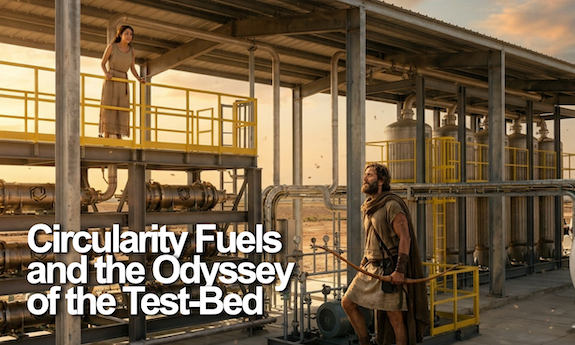
In Book 23 of The Odyssey, a stranger stands before Penelope claiming to be her husband. Others have made claims before.
“I have been shuddering all the time through fear that someone might come here and deceive me with a lying story,” she says, “for there are many very wicked people going about.”
Twenty years have taught her caution. So she devises a test. “Move our marriage bed,” she tells a servant.
Odysseus erupts. The bed cannot be moved. One of its posts was carved from a living olive tree. The roots still run beneath the house. The room itself was built around it. Anyone who truly built the bed would know that. Anyone who did not would fail instantly. Only then does Penelope believe. Not because she heard another story: because she received proof.
The sustainable aviation fuel industry may be approaching a similar moment.
For years, airlines, investors, regulators, and fuel buyers have listened to an endless procession of suitors. Each arrived bearing charts, projections, pathways, and promises. Many claimed they could transform aviation. Many claimed they could produce sustainable aviation fuel economically, at scale, from abundant feedstocks. Many claimed commercial deployment was just over the horizon.
The industry has become fluent in stories. What it craves now is evidence. Which is why a dairy farm outside Madera, California may prove more important than many conference stages, investor decks, and policy announcements combined. There, over the past six months, Circularity Fuels has been conducting a test of its own. Not with laboratory gases, idealized feedstocks, or a demonstration that lasts an afternoon. With real dairy biogas, operating conditions, and continuous production.
And that distinction matters. Because the destination has never been the problem. The aviation sector consumes roughly 300 million tonnes of jet fuel annually. Sustainable aviation fuel remains one of the few practical pathways for reducing emissions from long-distance flight. Airlines want it. Regulators want it. Governments want it. Investors want it.
The destination is clear. Like Ithaca, it always has been there. The challenge has been surviving the voyage.
Between here and there stand the modern equivalents of Scylla and Charybdis: feedstock constraints on one side, crushing economics on the other. Between them lie policy uncertainty, infrastructure costs, technology risk, certification requirements, financing gaps, and the graveyard of promising ideas that never survived contact with reality. Many voyages have begun. Far fewer have reached shore.
Circularity Fuels believes it has found a route through the straits. The company’s premise begins with one of the most overlooked resources in the modern energy economy. America’s livestock operations generate nearly a trillion pounds of manure every year. As organic material decomposes, it produces methane-rich biogas. Yet fewer than six percent of large livestock operations actively capture and monetize this resource.
Historically, the economics have been challenging. Converting biogas into valuable products often required expensive cleanup systems, pipeline connections, and large centralized infrastructure. For many operators, flaring methane proved easier than monetizing it.
Circularity’s approach turns that logic on its head. Rather than treating carbon dioxide as a contaminant that must be removed, the company designed a system intended to use it. At the heart of the process is the company’s electrified Ouro reactor, which converts both methane and carbon dioxide into synthesis gas. During the recent pilot, the company reports methane conversion exceeding 98 percent and carbon dioxide conversion exceeding 90 percent.
That synthesis gas then enters Circularity’s Aion Fischer-Tropsch reactor, where hydrogen and carbon monoxide are transformed into long-chain hydrocarbons suitable for refining into sustainable aviation fuel. The chemistry is sophisticated. The significance is simple. The system worked continuously for six months using raw biogas from a working dairy operation housing more than 5,000 cattle.
That is the olive tree. Not the chemistry, projections or renderings. The operation. For anyone in the wide world can describe a pathway. The question investors, airlines, and project developers eventually ask is the same question Penelope asked. How do we know? Circularity’s answer is not a theory. It is six months of operating data.
The implications are substantial. Because dairy methane represents one of the lowest-cost and most carbon-intensive waste streams available, converting it into aviation fuel creates a remarkable environmental equation. Instead of allowing methane to escape into the atmosphere, the process captures and converts it into a transportation fuel compatible with today’s aircraft. According to company modeling, the resulting fuel achieves an extraordinarily low carbon intensity score, reflecting the climate benefit of preventing methane emissions before they occur.
The economics may be equally important. The company believes its modular architecture can reduce capital costs dramatically compared to many large-scale SAF projects now under development. By bringing conversion technology to the feedstock rather than transporting feedstocks to distant facilities, Circularity hopes to unlock value from resources that have long remained stranded.
There is still a long way to go. Commercial deployment remains ahead. Certification remains ahead. Financing remains ahead. Scale-up remains ahead. The suitors are not yet gone. But something important may have changed.
For years, sustainable aviation fuel has largely been a conversation about destinations. Net-zero aviation. Decarbonized flight. Energy security. Carbon reduction. Circularity Fuels has shifted the conversation back to the voyage itself.
Can the feedstock be processed? Can the chemistry operate continuously? Can the economics work? Can the system survive reality?
Those are the questions that determine whether a technology reaches Ithaca. In The Odyssey, Penelope finally recognizes Odysseus because of the proof. The same principle applies throughout the bioeconomy. Announcements are stories. Operating assets are olive trees. And on a dairy farm in California’s Central Valley, Circularity Fuels may have planted one.
Penelope, of course, would still ask to see the bed. That may be the deepest lesson of Homer’s story. Skepticism is not cynicism. It is memory.
Twenty years of stories had taught Penelope what every investor, lender, airline, and project developer eventually learns: The claim is not the thing. The proof is the thing.
Category: Top Stories

