








When the bioeconomy slows, why do we always convict technology?
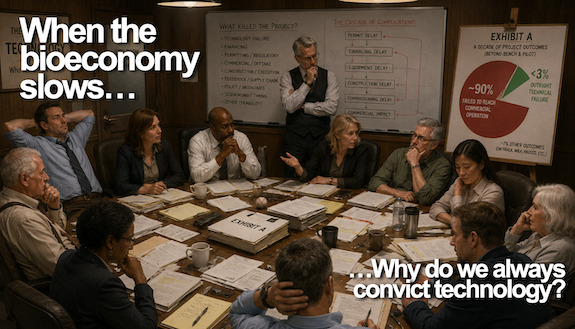
The jury had been deliberating for hours. The case seemed straightforward enough. A commercial bioeconomy project lay dead. Not every project, certainly. Some had survived and even thrived. But enough had stalled, disappeared, or failed to reach operation that a consensus had emerged regarding the culprit.
Technology.
The foreman looked around the room. “All those in favor?” Eleven hands rose. One remained down. The room groaned.
“Really?” asked one juror. The dissenter shrugged.
“I’m not saying Technology is innocent.”
“Then what are you think happened?”
The juror leaned back in his chair. “I think we should look at the evidence before we convict.” That was, after all, why juries exist. The prosecution’s case was familiar. Projects scale beautifully on paper and struggle in reality. Pilot plants behave differently than commercial facilities. Feedstocks vary. Equipment performs unexpectedly. Biology refuses to follow PowerPoint schedules. Every veteran of the advanced bioeconomy could recite examples from memory.
The foreman nodded. “Seems obvious enough.”
“Maybe,” said the dissenter. “Let’s call our first witness.”
The courtroom door opened. Nobody entered. The foreman frowned. “Where’s the witness?”
“The witness,” said the dissenter, “is the record.”
A clerk entered carrying a stack of files. He dropped them on the table with a thud. “Exhibit A.” The room stared. Project announcements. Groundbreakings. Financings. Permits. Commissionings. Delays. Cancellations. A decade of evidence. The jurors began sorting through the files.
One project had functioning technology but failed to secure financing. Another secured financing but became trapped in permitting delays. A third completed permitting but struggled with construction execution. A fourth completed construction but encountered commercial challenges. A fifth found itself waiting for infrastructure that existed only on somebody else’s schedule. Technology appeared in every case. But increasingly, it seemed unable to explain every outcome.
One juror pointed toward the stack. “The numbers aren’t perfect,” he said. “But they’re difficult to ignore.”
He flipped through several pages. “Industry veterans increasingly estimate that outright technical failure beyond the bench and pilot stages may account for less than three percent of project outcomes.”
The room fell silent.
He continued. “Yet roughly nine out of ten proposed projects fail to reach successful commercial operation.” The foreman frowned. “If those figures are even approximately right…” The juror nodded.
“Technology can’t be the whole story.” The room called for another vote. Six hands rose. Six remained down. The certainty that had filled the room at the beginning of the trial had begun to evaporate. The jury requested additional evidence.
What emerged from conversations across the industry was not a picture of technological collapse but something more complicated. Airlines continue pursuing lower-carbon fuels. Major brands continue seeking lower-carbon materials. Corporate net-zero commitments remain largely intact. Feedstocks continue improving. Scientific capabilities continue advancing. The long-term demand signals that helped launch the modern bioeconomy have not disappeared. Yet anyone walking the corridors of recent industry gatherings encounters a different conversation.
Developers speak of financing delays. Investors describe caution. Operators discuss execution challenges. Many point to shifting government loan programs, changing incentive structures, prolonged approval timelines, and unpredictable capital availability. The mood is not defeat. It is hesitation.
The challenge is not whether people still want the future. The challenge is how to reach it. One developer described spending years learning that building a successful technology company and building a successful industrial project are not remotely the same thing. Another observed that the industry does not suffer from a shortage of ideas. It suffers from a shortage of coordination.
The foreman called for another vote. This time only one hand rose. Technology still had a defender. A seasoned juror who had spent enough years around industrial projects to distrust fashionable explanations. “Let’s not get carried away,” he warned. “Technology still matters.”
Heads nodded. Of course it does. No commercial facility survives if the technology doesn’t work. No investor ignores technical risk. No operator forgets the realities of scale-up. Technology remained part of the story. The question before the jury was whether it was the entire story.
The final evidence arrived. A permit delayed financing. Financing delayed equipment orders. Equipment delays pushed construction schedules. Construction delays complicated commissioning. Commissioning delays threatened commercial agreements. Commercial delays increased carrying costs. Capital became more expensive. A project that looked healthy six months earlier suddenly found itself struggling to survive. The jurors stared at the evidence.
Different technologies. Different feedstocks. Different geographies. Different products. Yet the pattern appeared again and again. The victim had not suffered a single fatal wound. The victim had suffered complications.
Sequencing problems. Financing friction. Permitting delays. Commercial misalignment. Construction challenges. Deployment fragility.The foreman rose.
“Has the jury reached a verdict?”
“We have.”
He unfolded the paper. “We find that Technology contributed to certain project failures.”
A pause. “We do not find Technology solely responsible for the majority of project deaths.”
The room remained silent.
“We find substantial evidence that the primary causes of project mortality are deployment fragility, coordination failures, financing delays, permitting friction, commercial misalignment, and execution risk.”
Another pause.
“We further find that if technical failure beyond pilot scale remains rare, while roughly nine out of ten proposed projects fail to reach successful commercial operation, then the industry’s greatest risks increasingly lie outside the laboratory.” The foreman looked around the room.
“The victim did not die from a single wound.”
He lowered the paper. “The victim died from complications.”
For years, much of the industry’s attention has focused on proving that technologies work. Increasingly, the challenge is proving that projects work. The distinction matters. Technologies scale through science. Industries scale through coordination.
Encouragingly, the industry is beginning to respond. New initiatives such as the ASTM-CSA binational standards addressing Biomass Supply Chain Risk and regional manufacturing readiness are designed to bring greater consistency and transparency to deployment risk. Their purpose is not to improve chemistry or biology. Their purpose is to improve confidence, financeability, and execution.
In other words, to address the complications. Outside the jury room, the future continues waiting. Airlines still need fuel. Manufacturers still need materials. Farmers still need markets. Communities still need jobs. Technology sat quietly as the room emptied. It had not been acquitted. It rarely is.
But for the first time in years, it was no longer carrying the entire blame. The case against Technology may be weaker than many assumed. The case for mastering deployment has never been stronger.
Category: Top Stories

