











Speed, Baby, Speed: How Washington State’s Cascadia Accelerator Turned a Launch into Lift
Editor’s Note: This is part III of a four-part series on the Cascadia Sustainable Aviation Accelerator and opportunities in the Pacific Northwest. Part I is here: Notes from Peanut Butter Lake: Why SAF Is Moving Slower Than It Should — and What Cascadia Teaches Us About Real Take-Off. Part II is here: Beat Crude with Altitude: Why Cascadia Needs a Place Where SAF Risk Can Clear
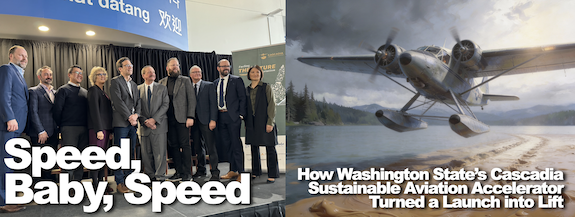
The reason everyone gathered at Paine Field last week was clear: to launch the Cascadia Sustainable Aviation Accelerator.
More than 175 people filled Boeing’s Future of Flight building in Everett—senior state and county leaders, airline and aircraft executives, project developers, financiers, labor leadership, and top academic researchers—there to formally stand up a regional engine designed to do one thing exceptionally well: turn sustainable aviation fuel ambition into commercial velocity.
“This is a once-in-a-generation opportunity,” said Governor Bob Ferguson. “Sustainable aviation fuel isn’t optional for this industry. It is literally the future—and Washington is uniquely positioned to lead.”
The launch is backed by $20 million in initial capital—$10 million from the State of Washington, matched dollar-for-dollar by philanthropy—with an explicit ambition to scale toward one billion gallons of sustainable aviation fuel (SAF) production over time.
And then, during the launch, something happened that made the room lean forward.
SkyNRG announced that Project Wigeon—a commercial-scale SAF facility planned for Eastern Washington—had secured its key environmental approvals and was moving into engineering. Fifty million gallons per year. Renewable natural gas feedstocks. Operations targeted for 2030.
SkyNRG wasn’t why people came.
But the announcement confirmed why they were there.
As Earth Finance managing director Tim Zenk put it plainly from the stage, without years of coordinated work to build Cascadia’s accelerator, this project would not exist—and we would not be in this room today. The announcement didn’t hijack the launch. It validated it.
That is what acceleration looks like.
Near the coffee station sat a scale model of the Saturn V. One look at it and caffeine felt redundant. The message was implicit: this is a place that remembers what it takes to move from audacity to execution—and has done it before.
A Coalition That Shows Up
The Cascadia Sustainable Aviation Accelerator didn’t appear overnight. Senator Marco Liias, who has worked on SAF policy for more than a decade, framed the moment plainly.
“Some of us have been sitting in workgroups on sustainable aviation fuel for ten years just to get to today,” Liias said. “This launch didn’t happen by accident. It happened because people stayed at the table.”
That persistence was on display when Governor Ferguson paused the program to honor Dave Somers, naming him Washingtonian of the Day live from the stage for his role as a catalyst.
“This region has been building airplanes for more than fifty years,” Somers said. “If sustainable aviation fuel is the future of flight, this is exactly where that future should be built.”
The Drag Problem
For years, the SAF story has been a study in drag.
Despite molecular brilliance and urgent climate necessity, sustainable aviation fuel has often felt like a seaplane trying to take off from a lake of peanut butter. The thrust is there. The demand is real. But velocity has been missing. Drag costs time. Time costs money. Money costs interest. Interest erodes return on investment. And when ROI collapses, adoption stalls.
After four cycles—ethanol, biodiesel, renewable natural gas, and now SAF—it’s time to ask a harder question: what if the constraint isn’t feedstocks, chemistry, or even price?
Markets don’t price distance. They price time under uncertainty.
Why Cascadia Exists
Cascadia was launched to attack that problem directly.
Its mission isn’t to invent new molecules. It’s to collapse timelines—to reduce the compounding delays that quietly kill projects long before the first gallon is produced.
Scaling SAF requires crossing multiple thresholds at once: ASTM certification (the global fuel safety standard), state environmental review under SEPA (Washington’s gold-standard environmental policy), engine testing, carbon accounting, permitting, and infrastructure build-out. None of these hurdles is fatal on its own. Together, they destroy velocity.
Cascadia exists to build scaffolding around producers—policy, finance, infrastructure, workforce, and research—so projects don’t have to survive a decade-long game of Half Dome Economics, where one slip sends capital over the edge.
“This is a systems problem,” said Betsy Cantwell, president of Washington State University. “Universities can’t solve it alone. Industry can’t solve it alone. Government can’t solve it alone. Regional efforts like this are how hard problems actually get solved.”
Proof, on Day One
That’s why the SkyNRG announcement landed with such force.
Project Wigeon cleared review by the Washington State Department of Ecology and Walla Walla County, confirming compliance with land use, water protection, air quality, and transportation standards. With permitting secured, the project now moves into engineering—the phase where steel replaces slides.
“This milestone allows us to move forward the right way,” said John Plaza. “It demonstrates that you can meet Washington’s rigorous environmental standards while building real projects that deliver clean fuel, economic opportunity, and long-term community benefits.”
The facility will use renewable natural gas from landfills, wastewater facilities, and agricultural operations, delivered through existing infrastructure. Once operational, the fuel can reduce lifecycle greenhouse gas emissions by up to 85 percent compared to conventional jet fuel—while materially reducing soot and particulate matter.
Representative Mia Gregerson, who represents communities near Sea-Tac Airport, put a human frame around those numbers. In neighborhoods downwind of runways, she said, residents can die nearly a decade earlier due to chronic exposure to air particulates. One reason SAF matters is that when it burns, the reduction in soot and particulates is visible to the naked eye—not just to a carbon calculator.
Leaders from IAM 751 emphasized another dimension: scaling SAF is also about ensuring that the next century of aviation manufacturing and energy production remains rooted in family-wage jobs.
This wasn’t a promise. It was progress.
Why Washington, Why Now
Washington’s aerospace sector supports roughly 200,000 jobs and generates more than $70 billion in annual economic impact. For leaders in the room, SAF isn’t a climate accessory—it’s an industrial necessity.
Inside the glass-walled Future of Flight building, leaders talked about fuels and timelines—while just across the street, Boeing teams were assembling aircraft that will fly for decades. The message was quiet but unmistakable: this is a place where ambition eventually turns into hardware.
As President Cantwell noted, while federal agencies can set policy, only regional efforts can actually build physical supply chains. That’s why the rest of the world is watching Cascadia—not as a local experiment, but as a blueprint for decarbonizing hard-to-abate sectors globally.
Lift
The Cascadia Sustainable Aviation Accelerator is not a guarantee of success. But its launch—validated immediately by a real, permitted project—marks a shift from activity to velocity. At Paine Field, it felt like the brakes were finally off.
Speed, Baby, Speed.
Category: Top Stories

