











Notes from Peanut Butter Lake: Why SAF Is Moving Slower Than It Should — and What Cascadia Teaches Us About Real Take-Off
Editor’s Note: This is part I of a four-part series on the Cascadia Sustainable Aviation Accelerator and opportunities in the Pacific Northwest. Part II is here:Beat Crude with Altitude: Why Cascadia Needs a Place Where SAF Risk Can Clear. Part III is here: Speed, Baby, Speed: How Washington State’s Cascadia Accelerator Turned a Launch into Lift
This August, one of the fastest and loudest races on earth returns to Seattle: the Seafair Unlimited Hydroplane races on Lake Washington. Boats pushing 200 miles per hour, engines delivering 3,000 horsepower create rooster tails, rising 30 feet in the air. 400,000 spectators roar with excitement.
It is speed, power, and precision—the visible result of enormous investment and relentless engineering.
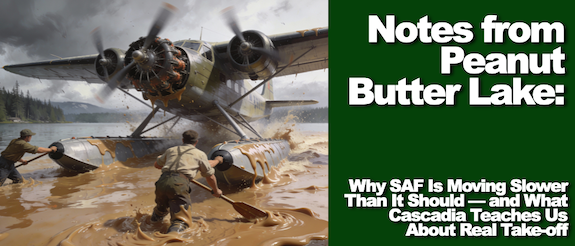
Now imagine running that same race, same boats, same crews, same engines. But the course has been moved from Lake Washington to a lake filled entirely with peanut butter.
The engines still scream. The pilots still fight the wheel. The crews work just as hard. But the boats barely move. The wake oozes instead of roars. The crowd fidgets. The race feels slow — not because the machines are weak, but because the medium itself resists motion.
That’s sort of how SAF progress feels today, in a peanut shell. Not failing, underpowered or unpopular. It’s pushing through something far thicker and more viscous than anyone expected.
Every energy transition requires systems-level solutions, and historical shifts—like coal to petroleum—took decades of market disruption to achieve the scale of legacy alternatives. Today, aviation accounts for 3% of global carbon emissions, and since hydrogen (if ever) and electric aircraft remain decades from wide-scale deployment, SAF is the only drop-in solution available to decarbonize flight over the next 40 to 70 years.
Systemic Friction on “Peanut Butter Lake”
If the bioeconomy has a region that has earned the right to be impatient, it is Cascadia. Across Washington, Oregon, and British Columbia, the pieces required to scale SAF are already being connected. Yet, the “peanut butter” remains in the form of systemic challenges. The current jet fuel market favors high-volume, lowest-cost, index-based pricing from proven suppliers, giving legacy oil refiners generations of market advantage.
New producers face daunting hurdles: SAF refining is capital-intensive, with new projects often exceeding $1 billion. Furthermore, the SAF certification process requires higher standards than fossil fuels, and current blend limits of 50% require a fossil component, limiting offtake potential at strategic airports. Airlines, operating on low margins, are often unable to absorb “green premiums,” and the market suffers from a lack of durable federal policy and limited access to pipelines for new producers. Right now, each bioeconomy project is still being evaluated as a bespoke experiment, which is deadly for scale.
The Cascadia Architecture: Systems-Level Solutions
The Cascadia Sustainable Aviation Accelerator (CSAA) and its partner, the Cascadia Sustainable Aviation Institute (CSAI), were created specifically to thin this “peanut butter” by de-risking the entire SAF value chain simultaneously. By coordinating the unglamorous work of standardization and trust-building, these organizations ensure private capital can move with confidence across infrastructure, offtake, and execution risks.
Through a shared services model, the coalition provides targeted support to help producers overcome market barriers:
• Offtake Optimization: Structures multi-modal partnerships for renewable diesel, naphtha, and SAF to improve project economics across the heavy-duty transportation sector.
• Policy Advocacy: Harmonizes Clean Fuel Standards across the West Coast to create a stable and predictable credit market.
• Supply Chain Development: Coordinates the construction of blending terminals and expands distribution infrastructure to move fuel from production sites to wingtips cost-effectively.
• Shared R&D Infrastructure: Provides leased modular production facilities and “digital twins”—computer models of biorefineries used to adjust fuel formulas—to lower R&D costs for new producers.
Importantly, this kind of clearing is no longer hypothetical. A recent first-of-its-kind integration between the SAFc Registry, Chooose, and Alaska Airlines demonstrates how interoperable, transparent systems can standardize SAF transactions across buyers and sellers. By making environmental attributes trackable, auditable, and transferable, the partnership shows how confidence can be engineered — not assumed — and how bankable demand can be created without reinventing the market for every project.
The Cascadia Advantage: Why This Region?
The Pacific Northwest is uniquely positioned to lead this transition because of its institutional density and unrivaled natural assets. The region possesses more than 50 million acres of managed forest and timberlands, providing a steady source of woody biomass alongside significant municipal solid waste from urban corridors.
Beyond raw materials, the region hosts a world-class aerospace hub. Key international air hubs like SEA (Seattle), PDX (Portland), and YVR (Vancouver) provide ready-built distribution networks, while Paine Field serves as a center for advanced aerospace manufacturing. Research leadership is provided by the Pacific Northwest National Laboratory (PNNL), which leads fuel certification, and Washington State University (WSU), home to the FAA’s ASCENT research center. This is complemented by a cheap, clean energy grid and the emergence of green hydrogen hubs, which are critical for next-generation e-SAF.
The Economic and Human Imperative
The transition to SAF is not just a climate necessity; it is a catalytic investment opportunity. Achieving one billion gallons of local production would deliver a 14X ROI, generating over $500 billion in total economic impact from a $38 billion investment.
This shift also addresses environmental and economic justice. Communities adjacent to airports currently face a significantly higher risk of asthma hospitalization due to jet fuel combustion. SAF improves air quality by cutting particulate matter, soot, and NOx by 20% to 70%. Furthermore, a regional SAF ecosystem provides high-quality jobs for Tribal Nations and rural communities involved in feedstock cultivation and refining, turning the bioeconomy into a engine for regional prosperity.
These are the same communities currently rowing hardest in peanut butter — and the ones who stand to gain the most if Cascadia builds a circular, regional model where value settles closer to where risk is borne.
One more mile
Much has been done, much is in progress., Yet, I think we can go one step farther, one step faster, than even the laudable CSAA has so far discussed. We need to go one more mile, one last mile, to go the distance. Coalitions like CSAA are exceptionally good at reducing known risks inside projects. They convene stakeholders, align incentives, pilot solutions, and advocate for policy. That work is essential — and Cascadia is leading it.
But markets don’t scale when projects look promising. Markets scale when risk has somewhere to go. The missing layer isn’t another accelerator, grant program, or white paper. It’s the layer that turns “this should work” into “this is bankable.” The place where:
- contracts mean the same thing across projects
- disputes don’t become existential
- insurers know how to price uncertainty
- lenders don’t have to reinvent diligence every time
Right now, each bioeconomy project is still being evaluated as a bespoke experiment. That’s fine for innovation. It’s deadly for scale. Every system moves at the speed of its slowest uncertainty.
Why We Keep Building the Wrong Things
Ray Kurzweil recently noted a strange human paradox: we dramatically over-weight short-term pain and under-weight long-term loss. We remember crises vividly. We forget slow improvement almost entirely. We romanticize golden pasts and panic about near-term disruptions, even as long-term trajectories improve. That bias shows up everywhere — including the bioeconomy.
We’re very good at funding things we can see:
- reactors
- refineries
- feedstock yield
- conversion efficiency
We’re much worse at building things that feel abstract:
- standards
- clearing
- shared definitions of risk
- places where failure doesn’t kill learning
So we row harder. We build better boats. And we wonder why the race still feels slow.
A Brief Detour into AI (and Why It Matters Here)
Here’s Lane’s AI Paradox: the more successful AI becomes at scraping human-generated knowledge, the less incentive there is to produce high-quality human knowledge in the first place. Eventually, the system risks feeding on its own outputs — hallucination on steroids.
The bioeconomy faces a similar trap. If regions keep exporting value to distant clearing centers — financial, legal, insurance, narrative — they shouldn’t be surprised when local capacity erodes. You can’t extract faster than you regenerate and expect the system to persist.
Think of the SAF transition like building a high-speed rail system. You can have the fastest train in the world (the technology), but if the tracks (infrastructure) aren’t laid, the stations (policy) aren’t built, and the ticketing system (market confidence) doesn’t work across borders, the train stays in the station. The CSAA isn’t just trying to build a better train; it is laying the tracks and building the stations so the entire system can finally leave the platform.
The $6 Box of Corn Flakes Problem
A sixteen-ounce box of Corn Flakes sells today for about six dollars. Inside that box is roughly ten cents’ worth of corn at the farm gate. That gap is not a scandal. It’s a system.
Start with the farmer. From that dime of corn value, subtract seed costs, fertilizer, chemicals, fuel, machinery depreciation, land rent or mortgage, insurance, and financing. What remains locally is measured in fractions of pennies—often not enough to support a bank branch, a grocery store, or a hardware store in the grower’s town.
Where does the other $5.90 go?It flows outward, step by step, to clearing centers: processors, brand owners, logistics providers, insurers, financiers, advertisers, lawyers, exchanges, and retailers. Each layer adds real value—but almost none of it stays where the corn is grown. The farmer produces the molecule. The system prices the uncertainty.
The same risk now faces Cascadia’s bioeconomy. More than 50 million acres of managed forest and timberland across Washington, Oregon, and British Columbia are poised to supply the feedstocks for sustainable aviation fuel. Without local clearing capacity — standardized contracts, bankable offtake structures, interoperable credit systems — those forests risk becoming the aviation equivalent of ten-cent corn. The molecules will leave the region. The value will not stay.
This is why rural towns hollow out even as productivity rises. The problem isn’t that corn is cheap. It’s that value migrates to where uncertainty is resolved, not where crops are harvested.
Until regions build their own clearing functions, they will keep exporting value—one six-dollar box at a time.
Peanut Butter, Not Headwinds
None of this is a failure story. Cascadia isn’t rowing in the wrong direction. It’s rowing in the wrong medium.
The bioeconomy isn’t slow because people lack will, talent, or technology. It’s slow because we haven’t yet built the places where risk can land, be translated, and move on.
Imagine Seafair again — same boats, same pilots — but this time, the lake is water.
In Part Two, we’ll look at how regions have solved this problem before — not by extracting more, but by inventing places where risk could safely land. From the emergence of maritime insurance in 17th-century London to the standardization of electricity markets in the early 20th century, every industrial leap followed the same pattern. Cascadia may be closer to that moment than it realizes.
Category: Top Stories

