











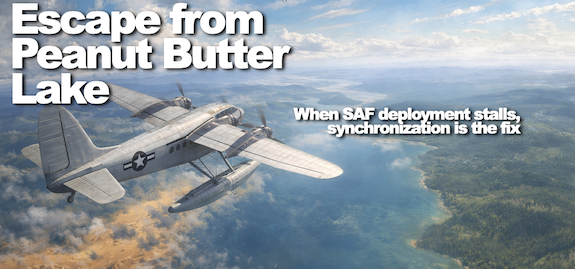
Escape from Peanut Butter Lake: When SAF deployment stalls, synchronization is the fix
Last week at Paine Field, something important happened.
More than 175 people gathered inside Boeing’s Future of Flight building to launch the Cascadia Sustainable Aviation Accelerator—not as a ribbon-cutting exercise, but as a declaration of intent: to turn sustainable aviation fuel ambition into commercial velocity. The room was full of people who have been pushing SAF uphill for years—developers, financiers, airline executives, labor leaders, policymakers, and researchers—many of whom have lived through more false starts than breakthroughs.
Then, during the launch, the room leaned forward.
SkyNRG announced that Project Wigeon, a commercial-scale SAF facility planned for Eastern Washington, had secured its key environmental approvals and was moving into engineering. Fifty million gallons per year. Renewable natural gas feedstocks. Operations targeted for 2030. The announcement didn’t hijack the event. It validated it.
As Earth Finance’s Tim Zenk put it plainly from the stage, without years of coordinated work to build Cascadia’s accelerator, this project would not exist—and we would not be in this room today. That is what acceleration looks like: not promises, but steel replacing slides.
Near the coffee station sat a scale model of the Saturn V. One look at it and caffeine felt redundant. The message was implicit: this is a place that remembers what it takes to move from audacity to execution—and has done it before. And yet, for all the momentum in the room, the deeper question lingered quietly beneath the applause. Why has sustainable aviation fuel, despite real demand, extraordinary chemistry, and years of policy support, so often felt like a seaplane trying to take off from a lake of peanut butter? Why has thrust been present—but velocity elusive?
The usual answers are familiar: feedstocks are too expensive, technologies too immature, policy too brittle, carbon prices too low. None of those explanations are wrong. But they are incomplete. Markets don’t price distance. They price time under uncertainty.
This lens comes from what we call GTESI—the General Theory of Evolutionary Systems and Information—a framework developed to understand how complex systems evolve not by optimizing speed or price alone, but by collapsing uncertainty through shared learning, trust, and coordination. To understand why SAF has struggled—and why Cascadia matters—we need to talk not just about speed, but about synchronization.
Why SAF Stalls—and Why Synchronization, Not Speed, Is the Fix
In the final days of Operation Market Garden in 1944, British paratroopers clung to the north end of the Arnhem Bridge, surrounded and running out of time. Brigadier Roy Urquhart, cut off from his command and unable to influence events, later reflected that the operation didn’t fail because anyone panicked or underperformed.
It failed because no one had the authority—or the mechanism—to align time itself. To Urquhart, time meant minutes to reach the bridge and days to hold it. To Allied Air Command, it meant seconds of exposure over German anti-aircraft guns. To XXX Corps, it meant bottlenecks, blown bridges, and resistance along a narrow road. To staff planners, it meant when the next window of opportunity might open if this one closed. To German commanders, it meant the timing of demolition charges.
Every clock was locally correct. Collectively, they were incompatible. Sustainable aviation fuel faces the same problem today—not a shortage of ambition or capability, but a failure to synchronize decision-making across fundamentally different clocks.
The Diagnosis We Keep Missing
SAF critics and supporters alike tend to recite a familiar list of obstacles: feedstocks are too expensive, technologies too immature, policy too unstable, carbon prices too low. None of that is wrong. But taken together, these explanations are incomplete.
They describe symptoms, not structure. In SAF, those clocks are easy to name:
– Feedstocks move on commodity and harvest time
– Technologies move on learning and iteration time
– Capital moves on diligence and risk-resolution time
– Airlines move on compliance and fleet-planning time
– Policy moves on rulemaking and election time
– Communities move on trust and lived-impact time
Each clock is rational. Each is locally optimized. The failure comes when we assume they will align simply because the objective is urgent.
That assumption—shared time by intent alone—is what stalls SAF projects that appear aligned on paper. No one is irrational. No one is acting in bad faith. But uncertainty does not collapse at the same speed for everyone, so commitments arrive out of sequence—or not at all. Most SAF projects don’t fail spectacularly. They arrive too late.
What GTESI Adds to Supply and Demand
Classical supply-and-demand economics is locally correct. But it treats key variables—like demand intercepts and price responsiveness—as constants. In reality, those “constants” are projections of something deeper: how much uncertainty the system has resolved, and how quickly. The General Theory of Evolutionary Systems and Information offers us necessary refinement to address SAF. In GTESI terms, demand has two hidden drivers:
• Willingness to engage: who shows up and stays in the market at all
• Willingness to respond: how effectively price signals convert into coordinated action
Participation raises the floor. Coordination steepens the slope. This matters because participation is not sentiment—it is information efficiency. Markets do work every day. Engineers learn. Developers adapt. Investors diligence. Operators solve problems. That effort is real energy. But when the resulting learning is locked in NDAs, buried in bespoke contracts, or lost when a startup fails, it becomes effectively inaccessible. Like information inside a black hole, it may exist—but it cannot reduce uncertainty for anyone else.
From a system perspective, that is inefficiency. Efficiency is not output per unit input. It is uncertainty collapsed per unit effort. Participation is the conduit.
Why Price Alone Can’t Fix This
If all SAF producers are price-takers, the only tools standing between the public and odious fuels are prohibitions and carbon prices—both policy instruments, both politically fragile, and both poor at coordinating learning.
Carbon pricing works best when pathways are mature and uncertainty is already low. In SAF, the opposite is true. The deeper the carbon reduction, the earlier the technology, the higher the fog. Policy neutrality unintentionally rewards established pathways while leaving emerging ones stranded in the valley of death. The result is a familiar trap:
• cheap feedstocks pair with immature technology
• mature technology pairs with expensive feedstocks
• risk shifts form, but never disappears
• learning remains privatized
• and every project is treated as FOAK
We row harder. We build better boats. And we wonder why the lake still feels like peanut butter.
Participation Is the Missing Variable
This is where Cascadia’s work—and the next step beyond it—becomes decisive. Participation is not charity. It is not virtue. It is system design. When learning is accessible—through standards, shared definitions, durable registries, and visible commitments—the same amount of effort collapses more uncertainty. Distances shrink. Risk premia fall. Prices regain power.
This is why Alaska Airlines’ passenger SAF program matters more than it looks. When tens of thousands of passengers opt into SAF through miles rather than mandates, they’re not just offsetting emissions—they’re signaling belonging, helping turn a new fuel into a shared practice rather than a policy abstraction. That raises demand intercepts without waiting for perfect price parity.
Rethinking Risk: Guarantees for Learning
Loan guarantees are meant to absorb first-of-a-kind risk. In practice, they struggle. Optics make agencies risk-averse. One failure haunts a program. Moral hazard creeps in at both ends—small firms walk away, large firms offload bad projects. The problem isn’t guarantees. It’s mispriced learning. The correct trade is simple:
Public risk should only be exchanged for public learning.
Or more plainly:
The price of a loan guarantee is structured transparency. The price of opacity is bearing your own risk.
Not data dumps. Not disclosure theater. Transparency tuned to learning. Reference projects should publish what others need to know to reduce uncertainty—performance ranges, failure modes, timelines, cost drivers—without surrendering proprietary advantage. In return, the system learns. Future projects need less support. Guarantees become self-extinguishing rather than permanent. Risk doesn’t disappear. It migrates to where it can teach.
Why Cascadia Is Uniquely Positioned
This brings us back to Cascadia—and to what Part III showed so clearly. Cascadia is not short on ambition, talent, or molecules. It is already building velocity. What remains is synchronization.
The Cascadia Sustainable Aviation Accelerator is doing the hard project-level work: aligning policy, finance, infrastructure, feedstocks, and technology so steel can replace slides. That is necessary. Just as importantly, it offers a place where community concerns—air quality, jobs, land use, and local impact—are addressed early and visibly, so trust is built on shared timelines rather than after-the-fact mitigation. What comes next is complementary: a place where risk can clear, learning can persist, and clocks can be aligned. Call it a Cascadia Commission if you like—not as an authority, but as infrastructure. A neutral venue for standards, arbitration, market memory, and interoperability. A trust anchor.
Think less regulator, more clearinghouse. Regions that build clearing keep margin, memory, and momentum. Regions that don’t become suppliers—ten-cent corn feeding six-dollar cereal boxes priced elsewhere. With more than 50 million acres of managed forest, Cascadia already does the hard physical work. The question is whether it also keeps the informational value—whether learning settles back into the communities carrying operational and environmental risk.
Synchronization Is the Fix
Operation Market Garden didn’t fail because anyone moved too slowly. It failed because no one synchronized clocks across fundamentally different frames of reference.
SAF will not scale because we push harder on price alone. It will scale when participation rises, learning circulates, and uncertainty collapses fast enough for price to matter. That is what Cascadia is quietly inventing—not just a fuel pathway, but a market structure.
A practical first step is already within reach. Cascadia participants could agree on a simple structured-transparency protocol for first-of-a-kind SAF projects: shared reporting of timelines, performance ranges, failure modes, and verification milestones—enough to collapse uncertainty for the next project, without forcing disclosure of proprietary process details. In return, those projects gain faster permitting, clearer financing pathways, and reduced first-mover friction.
The choice now is whether Cascadia merely produces the fuels of the future—or invents the place where those fuels learn how to trade. History tends to remember the latter.
Category: Top Stories

