











CO2 Sequestration, Values & Markets
By Sam A. Rushing, President – Advanced Cryogenics, Ltd. – www.CO2consultant.us
Special to The Digest
The merchant CO2 industry is estimated to be around 22 million metric tons in size, otherwise stated in consumption terms; and the US accounts for about 40% of this value. The food and beverage industry is some 70% in developed countries; of which the majority is food related as a refrigerant. The balance is a wide range of often very interesting industrial applications; of which there has been a development of many green applications for the product. The global atmospheric CO2 content in 2015 was averaging 402 ppm; and in 2024 it grew to around 424 ppm; with the period 2023 – 2024 accelerating ever rapidly. Some of this we can attribute to natural factors, such as volcanoes for example; however CO2 content growing in the atmosphere from industrial emissions is a logical reason for much of this growth. Therefore, this growth since the industrial revolution is generally precipitated by carbon emissions from industrial processes and internal combustion engines, as major sources of CO2 emissions.
Sequestration
The Summit Energy pipeline has been slated to receive CO2 by-product from up to 57 ethanol plants in the 5-state Midwest region is one excellent solution to help tame the CO2 beast; along with smaller ventures, such as the Tallgrass pipeline carrying CO2 from places such as Nebraska and Iowa, and sequestering into Wyoming. With respect to Summit, numerous challenges lie ahead, starting with several states resisting or banning eminent domain, including South Dakota. Further Many legal challenges are underway, along with public opposition – surrounding safety, environmental impact, and the use of eminent domain. There is also regularity uncertainty, such as permit denials, and challenges with complex and shifting regulatory landscapes in multiple states. Therefore, the estimated pipeline completion has been pushed back up to about 2027; and may modify sequestration destinations and pipeline routing – not to mention public hearings in several states with pending permits continuing. Given all of this, Summit may never be completed as originally thought.
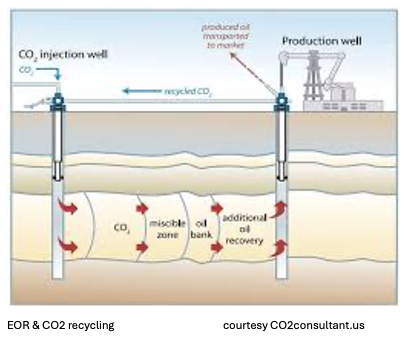
To Sequester or sell into the merchant market is one challenge, if the ethanol or other industrial CO2 emitting operation is not already attached to a CO2 plant in some form. Further to this subject, when considering 45Q tax credits, the broad definition for such credits represent $85/metric ton, from industrial and power generation facilities, generally defined as secure geological storage; similar to what the pipelines are doing, or trying to do. The $85/metric ton value would also apply to other sequestration destinations such as advanced fuels, chemicals and building materials. One such destination would be methanol production. The value for sequestering from DAC ( direct air capture) , is valued at $180/metric ton; however, this process is an outlier, given its place in the CO2 sourcing industry, and is virtually unaffordable in most markets. Then another form of geological sequestration, essentially a recycling of CO2, is EOR (enhanced oil recovery). Recycling in this process is essentially sweeping oil from the small cracks and crevices in the well, as an ongoing process, generally running for many years – and sometimes decades; and adding more CO2 as the process continues. Such CO2 is ultimately sequestered. I had one such EOR project in West Texas recently from a restarted ethanol plant, 500 TPD of CO2 going to EOR; such is an excellent example of this application.
CO2 values
As to the tax credit values, typically this would be $85/metric ton, as stated before, assuming the project adheres to specific requirements surrounding prevailing wage and apprenticeship requirements; separate of DAC ventures. As to the merchant markets, in order of magnitude terms, they currently have an average selling price of around $100/short ton; and regional US markets vary widely, from under $100 to over $300/ton for delivered product. Costs of production, depending upon on existing assets or newer installation, given differences in scale, can run from $30 to $80/ton; then distribution costs can run in the low $30/ton range on average. Given the above ranges, it is easy to see how under the right conditions, significant profit margins can be achieved within the merchant market. All of which should be examined carefully to develop the best plan for given projects.
CO2 markets and unique developments
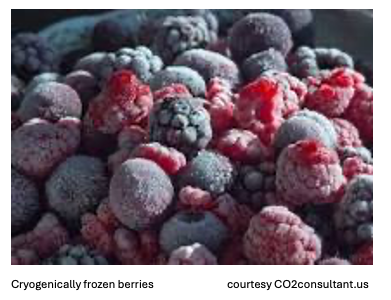
Back to the summary of the subject of CO2 consumption in the US; knowing 70% of this market demand is food and beverage, of which 70% is food related; this leaves about 20% of the markets dedicated to beverage carbonation; then the balance of the markets being around 30% industrial is as interesting as the applications in food processing. Within the 50% approximate value for food processing, this includes dry ice pressing and utilization; where most of this product is used in the food industry for temperature containment, and reduction of heat generated in the process of grinding and blending various food products, primarily all forms of meat, seafood, and poultry. Then the other uses for CO2 in this sector are cryogenic freezing of a very wide range of food products from more expensive fruits and vegetables such as berries, to all types of meat related products, whether this is IQF (individually quick frozen), or frozen as a convenient meal.
As to the benefits of cryogenic freezing, when freezing via this method v. slower methods of freezing, many benefits are realized, starting with a faster production line, thus increased efficiency and capacity; then the inherent value in improving the ‘bloom’ of meat products, that being better appearance, and greater water/moisture retention, in part due to the ice crystals produced via this method yield less cell wall penetration, and leaking within the matrix of the food products, thus selling more weight with the moisture retention. When using CO2 snow, or dry ice in either a heat generating process or for shipping purposes, there is the ongoing sublimation of dry ice to CO2 gas, which creates more of an anaerobic environment; therefore reducing bacteria content. There are so many benefits v. other methods of freezing, such as plate, mechanical, glycol, or even nitrogen.
There is also the stunning of cattle & poultry, making it more humaine to further process into edible products. Then, purging of oxygen from packaged food products with CO2, sometimes mixed with another gas, will provide improved appearance and freshness of many food products.
On the industrial side of the merchant applications for CO2, this sector ranges from metallurgical uses – such as liquid CO2 used as a stirring agent in molten metals in steel mills; as well as uses to cool sand cores in foundries, then uses as a shield gas in welding operations; among other uses. Before hydraulic fracturing of natural gas wells became the standard, the CO2 industry had a very large market for CO2 fracs (fracturing); where the value of this commodity provides an activated frac, thus bringing up the natural gas more readily than water. The use of CO2 also provides a slightly alkaline Ph in the formation, thus reducing the swelling of clays. Further, uses for recovering natural gas from coal seams, known as CBM (coal bed methane) projects, is a way of sequestering CO2 via the replacement of methane molecules with CO2. We must not forget the application of CO2 in Ph reduction in municipal water treatment and other facilities with an alkaline effluent.
Over the last few years, cannabis has been in a development, and many cannabis producing operations have expanded vastly in Canada, and certain regions of the US. Whether this be the enrichment of closed greenhouses with CO2 for cannabis growth, or specific bedding plants, flowers, vegetables; usually an expensive crop – CO2 does the job of enhancing photosynthesis, as growth and quality, and further allowing nature to sequester the commodity in a very natural way – and gaining values with enhanced crops. Then for regions which produce CBD products, using a supercritical CO2, under high pressure, the oils are extracted with a natural agent, v. other forms of extraction use hydrocarbons such as propane, or hexane. The natural agent as CO2 is more desirable than hydrocarbons for many CBD consumers and manufacturers. Further on the subject of supercritical CO2, an interesting and valuable application today, more than ever, is the use of such an agent for driving turbines in the production of power. More than ever, there is opportunity to reduce the use of process water in the significant growth among the data centers in the US and internationally. Then, there are data centers which have installed green cooling systems with natural refrigerants, including CO2. One such data center in Canada reports significant annual electrical operating savings – not to mention the value in potentially replacing the refrigerants used in various HFC systems, as regulations change.
Among other interesting and emerging technologies with CO2, include CO2 along with hydrogen to yield a carbon neutral synthetic fuel (Power to X); then use in electrochemical or thermochemical synthesis methods, using high temperatures and catalysts; not to forget creating polymers and plastics, without the hydrocarbons.
The uses for CO2 in traditional and green technologies are ever-growing; and it is important to understand the market potential, values, and uses; then compare the value in tax credits for sequestration projects – knowing the principal will have to pay for the liquefaction plant going to the pipelines, should this direction be chosen. It is all about profit, costs, and requirements to take the right approach with the CO2 streams off the ethanol plants.
About the author
Sam A. Rushing is a chemist, and president of Advanced Cryogenics, Ltd.; a major CO2 consulting firm. www.CO2consultant.us , tel. 305-852-2597, rushing@terranova.net
Category: Thought Leadership

