







Joining Hands at the Water’s Edge: Why Domestic Marine Biofuels Are Ready to Sail
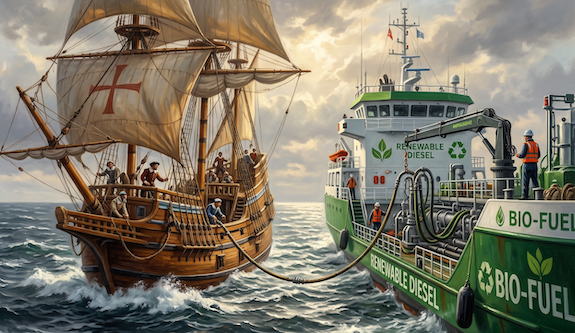
At its core, the Thanksgiving story isn’t about smooth sailing—it is about survival through unexpected alliance. When the Mayflower anchored off Cape Cod more than four centuries ago, the enduring lesson was that two groups with vastly different worldviews forged a moment of comity around a shared table because practical necessity demanded it.
In Washington today, energy and environmental policy usually remain frozen along familiar fault lines: rural agriculture versus coastal regulators, energy security versus decarbonization, market economics versus government mandates. Yet along America’s rivers and harbors, those divisions are dissolving into something far more durable than a temporary political truce—they are forming an economic closed loop. Picture grain and livestock from Iowa and Nebraska moving down the Mississippi River on barges pushed by towboats burning the very methane, renewable diesel, and ethanol generated by those same Midwestern fields.
Maritime waters are the literal jurisdictional boundary where domestic agricultural policy under the Clean Air Act collides with international shipping rules under the International Maritime Organization. Right now, a regulatory quirk at that border is keeping American fuel off American vessels.
Last month, Rep. Mariannette Miller-Meeks (R-Iowa) and six fellow Midwestern lawmakers sent a letter to Environmental Protection Agency Administrator Lee Zeldin urging a targeted fix to the Renewable Fuel Standard (RFS). Under current EPA rules, Category 3 marine engines—defined strictly by cylinder displacement at or above 30 liters per cylinder, rather than by where a vessel actually operates—are broadly excluded from generating RFS credits under an overly wide definition of “ocean-going vessels.” Because of that mechanical technicality, a harbor tug maneuvering barges in St. Louis or New York Harbor can be legally classified like a transoceanic container liner, disqualifying the renewable fuel in its tank from domestic credits.
The lawmakers’ proposal is straightforward: narrow the ocean-going definition in the next RFS rulemaking so fuel produced and consumed predominantly in U.S. domestic commerce—across tens of thousands of inland towboats, barges, ferries, dredges, and coastal workboats—qualifies for credits regardless of engine size, while leaving existing exclusions for marine residual and Emission Control Area-compliant fuels intact.
That single regulatory adjustment unlocks the financial mechanics needed to move clean marine fuels from pilot projects to commercial scale. Under the RFS, generating Renewable Identification Numbers (RINs) creates a tradable market credit that acts as a financial bridge, narrowing the price spread between cheap conventional bunker fuels and cleaner alternatives—whether drop-in renewable diesel, ethanol blends, or bio-LNG—without a single dollar of new federal spending or congressional appropriations.
As the American Biogas Council (ABC) noted in applauding the congressional letter, bio-LNG alone offers an immediate off-take pathway. Produced by capturing methane from farm manure, wastewater, and food waste, bio-LNG drops directly into existing LNG vessel and port infrastructure, putting millions of tons of organic waste to work while shielding operators from volatile diesel costs.
And while deep-sea international shipping remains locked in an economic standoff, America’s domestic fleet offers an immediate, sheltered market. As this week’s Digest Sustainable Marine intelligence underscores, global carriers have already committed more than $200 billion to over 1,350 dual-fuel vessels. Yet at the Geneva New Fuels conference last week, TFG Marine Executive Director Kenneth Dam warned that Trafigura’s marine fuel joint venture is deferring major alternative fuel investments until real demand materializes. With conventional very low sulfur fuel oil averaging $822 per metric ton in Singapore—compared to $997 for biodiesel and $1,325 for LNG—those dual-fuel ships simply continue burning fossil fuel oil, idling at the edge of the energy transition while the World Shipping Council pleads with IMO negotiators in London for binding global rules.
Meanwhile, America’s competitors are not waiting at the dock. Just this week, China’s Qingdao Port completed the country’s first international ship biomethane bunkering operation—fueling the vessel Decheng with biomethane derived from livestock manure and crop straw, the exact agricultural waste streams U.S. biogas producers are waiting to monetize. At the same time, Shanghai unveiled a blueprint to build a 1-million-metric-ton green fuel bunkering hub by 2028, Jilin province moved to accelerate green methanol adoption, and Hong Kong partnered with Beijing’s transport ministry to expand China’s Green Marine Fuel International Certification System—a bid not just to supply the world’s green marine fuels, but to write the global rulebook governing them. Across the Atlantic, the United Kingdom has already opened consultations on strict 2030 lifecycle emissions intensity limits.
America possesses the world’s deepest agricultural feedstock base and an immense domestic workboat fleet ready to modernize. Letting domestic vessels generate RINs satisfies every constituency at the policy table: Midwestern farmers gain resilient new demand, port communities breathe cleaner air, and the White House advances President Trump’s Executive Order 14269 and the Maritime Action Plan to restore American Maritime Dominance.
EPA Administrator Lee Zeldin does not need new legislation from Congress or a massive subsidy package to bring American crops and waste onto American waterways. By incorporating this Category 3 definition fix directly into the agency’s upcoming RFS rulemaking, the EPA can clear an outdated regulatory bottleneck, turn the heartland and the harbor into a unified supply chain, and ensure that the rules governing the next era of maritime energy are written in Washington rather than Beijing.
Category: Top Stories

