







Certainty Is the Mother of Investment: What Bioeconomy Leaders Are Telling Us Heading Into 2027
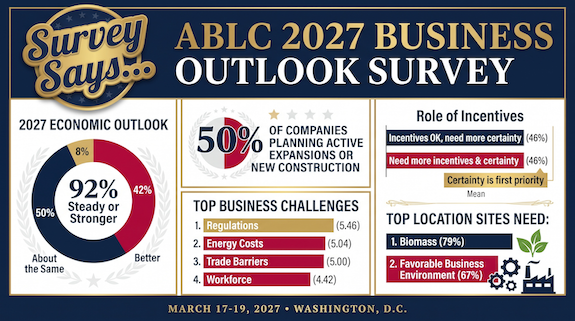
Ask bioeconomy executives what they expect from 2027, and you won’t hear hand-wringing about technological readiness or market potential. You’ll hear a remarkably consistent refrain: we are ready to build—if policy stops moving the goalposts and capital can find a clear path to close.
That is the central takeaway from the 2026 ABLC Business Outlook Survey, conducted ahead of ABLC 2027 (March 17–19 at the Mayflower Hotel in Washington, D.C.). Spanning technology developers, project sponsors, feedstock and supply-chain operators, and strategic advisors, the survey captures a sector caught between strong operational momentum and stubborn structural friction.
1. The Macro Mood: 92% Expect Steady or Stronger Conditions—And Half Are Building
Despite well-publicized headwinds across clean-tech capital markets over the past 24 months, sentiment on the ground remains disciplined and constructive:
-
50% of respondents expect overall economic conditions for the bioeconomy in 2027 to be about the same as in 2026.
-
42% expect conditions to be better.
-
Only 8% expect conditions to be worse.
That measured confidence is backed by real capital plans. When asked whether their companies are planning expansions or new construction in the next year, 50% of all respondents (12 of 24)—and 86% of those who gave a definitive yes/no answer—confirmed active build or expansion plans over the next 12 months.
The bioeconomy isn’t retreating into R&D mode. Companies are actively scoping steel in the ground. The question is what determines whether those projects reach Final Investment Decision (FID).
2. Policy & Incentives: Certainty Is the Non-Negotiable Prerequisite
If lawmakers and regulators want to unlock private capital in 2027, the survey points to a clear lever—and predictability matters just as much as generosity.
When asked about the role of incentives in advancing the bioeconomy:
-
46% said “Incentives are right, we need more certainty.”
-
46% said “We need more incentives and certainty.”
-
4% said “Incentives and certainty are about right.”
-
4% selected “Certainty is right, need more incentives.”
In total, 92% of respondents pointed directly to certainty as a core missing ingredient—and one write-in respondent named the exact pressure point on everyone’s mind:
“Some incentives are solid, some not, some need a clear future (looking at you 45Z). A broad carbon tax would be nice, but probably is not coming.”
3. The Regulatory Paradox: #1 Growth Challenge, Split Diagnosis
In our ranked assessment of the most significant challenges to continued business growth (scored 1 to 8, with 8 as most significant), federal and/or state regulations took the #1 spot overall (mean score 5.46, ranked in the top two challenges by 46% of respondents).
Yet when asked why regulation is a problem, the industry split across four distinct camps:
-
29% say there is too much regulation.
-
25% say there is too little regulation.
-
25% say regulation is about right.
-
21% offered custom write-in diagnostics—making clear that the real frustration isn’t simply regulatory volume, but regulatory design and inconsistency.
Across the write-ins, respondents flagged structural distortions across permitting, feedstocks, and end-use parity:
“Consistent, rational, and fixed regulation is needed; certainty is the mother of investment. And economics NEVER trumps the laws of nature.”
“Environmental, siting, and permitting makes new builds hard, while the lack of restrictions on fossil incumbents (and existing, permitted, and often grandfathered plants) makes competition challenging.”
“Existing regulations are no longer making technical sense. If I buy ethanol to blend in fuel, there is a RIN. If I buy that same ethanol to make acetic acid, that RIN disappears. That makes no sense. And dividing up routes based on feedstock may no longer be the best way to regulate the industry.”
“Regulations need to be feedstock and technology agnostic. Currently regulations favor e-fuels. Regs do not treat woody biomass equally with corn and other biomass feedstocks.”
Meanwhile, another respondent urged policymakers to apply proven fuel-blending mechanics to renewable gas and carbon-reformed hydrocarbons:
“We have E10 and talk about E15. Why not set a goal of natural gas at 5% SNG, then in 3 years 10%, and by 2040 or 2045 be at 50%—with credits given if NG is used with CO2 capture reformed to a hydrocarbon used to replace fossil feedstocks?”
The takeaway is unmistakable: developers navigating permitting delays and feedstock/chemical disparities feel penalized by poorly aligned rules, while producers waiting on durable LCFS, SAF, 45Z, or renewable gas mandates feel stalled by incomplete market-making policy. Both camps want the same thing: technology-neutral rules that stay put long enough to amortize a 15-year capital asset.
4. The Capital Bottleneck: Tight From Seed Stage to Project Finance
If policy certainty is the spark, capital access remains the choke point. When asked to evaluate the state of debt and equity capital for advancing the bioeconomy:
-
50% described capital as too expensive and too hard to find.
-
29% described capital as affordable, but too hard to find.
-
13% described capital as too expensive, but findable.
-
0% described capital as affordable and available.
Nearly four out of five (79%) respondents flagged capital availability as a primary barrier—whether priced high or low. And the write-ins reveal that the squeeze spans the entire funding lifecycle, from early-stage venture capital to commercial project development:
“Equity capital seems to be near impossible to find, especially at early stages (seed / pre-seed or development capital for commercial projects).”
“The VC industry is a broken business system for anything other than IT/AI, although the players in bio/pharma are still there. Outside of those two areas, there is no VC money that is reasonable. Government grants are no longer what they were either—far too short term in what they will fund.”
Another respondent boiled the commercial financing hurdle down to three words: “Need a market.” Until long-term offtake agreements and regulatory credit values carry bankable durability, both early-stage equity and commercial project debt will remain hard to unlock.
5. Beyond Policy: Power Costs, Trade Friction, and Workforce Rise to the Top
Looking across all eight ranked growth challenges, operational fundamentals—led by energy costs, trade uncertainty, and talent—clustered closely behind regulation:
Notably, energy consistency and affordability (#2), trade barriers (#3), and skilled workforce availability (#4) all outranked technology risk (#7) and site availability (#8). As biomanufacturing, e-fuels, and carbon capture facilities become more power-intensive—and as feedstock and equipment supply chains navigate tariff and cross-border uncertainty—baseload energy pricing, trade stability, and operator talent have moved to the front of the boardroom agenda.
6. The Site-Selection Playbook: Biomass, Ecosystem, Talent, and Support
Finally, we asked respondents two questions about geography: what attributes define the right place to build a project, and what weighs heaviest when deciding where to locate or grow operations.
On the check-all-that-apply wishlist for the ideal project location, feedstock security led the field:
-
Readily available supply of biomass — 79%
-
Favorable business environment — 67%
-
Skilled, productive workforce — 54%
-
Existing hub for bioprocessing — 50%
-
First renewable chemical tax credit — 33% (tied with Easy to get to)
-
Cutting-edge R&D — 29%
-
Biosciences leadership — 21%
And when forced to rank location considerations head-to-head (1–8), respondents placed existing relevant industry (mean 5.12), skilled workforce availability/pipeline (mean 5.04), and tax credits/state support (mean 4.96) in a tight top tier, followed by renewable energy availability (mean 4.67) and energy consistency/affordability (mean 4.42).
The message for states and regional economic development agencies is clear: state incentives and tax credits carry real weight (#3 overall), but they work best when paired with bankable biomass aggregation, existing industrial infrastructure, reliable clean power, and a trained operator pipeline.
What Happens Next: Bringing the Data to Washington
The findings from this year’s Business Outlook Survey go straight to the heart of the 17 interconnected summits at ABLC 2027, convening March 17–19, 2027, at the Mayflower Hotel in Washington, D.C.
-
Solving the Certainty & Parity Gap: The Policy Summit, The 45Z and IRA Credits Summit, The Renewable Chemicals & Biomaterials Summit, and The Farm Bill Programs Summit bring project developers face-to-face with policymakers and regulatory architects to address credit durability, feedstock neutrality, chemical/fuel parity, and permitting reform.
-
Unlocking Capital: The Finance & Investment Summit and The Hottest Projects Summit tackle capital stacking,early-stage and FOAK de-risking, and how developers are structuring bankable offtake agreements in a tight credit environment.
-
De-Risking Regional Deployment: The Regional Deployments Summit and Global Agriculture & Supply Chain Summit examine where biomass logistics, industrial hubs, and reliable energy are aligning to turn regional advantages into operating plants.
Category: Top Stories

