








Diaper Changeling: of ZymoChem, biobased plastics, and counting green molecules vs making them disappear
Every parent on earth has the exact same relationship with a used diaper: once it comes off the baby, you want it to GO AWAY. Immediately. Completely. Forever.
Instead, every minute around the world, more than 300,000 disposable diapers enter landfills, incinerators, or the environment. Nearly 40% of each diaper by mass is a petroleum-based superabsorbent polymer (Petro-SAP)—a cross-linked polyacrylate sponge built from fossil feedstocks that can persist for centuries, potentially for up to 500 years, and contribute to persistent microplastic pollution along the way.
The non-disappearing diaper doesn’t go away. It outlives empires.
And here is the catch if you are a parent—or a retail buyer, or a regulator—trying to buy your way out of that problem today: you really have to read the label. Because in the modern materials market, a diaper’s superabsorbent can be marketed as 100% biobased through mass-balance accounting and yet be “FAKE Bio!” in the physical product itself, measuring close to 0% renewable carbon.
100% fossil all the way, baby.
The changeling in the crib
In old European folklore, one of the great household terrors was the changeling. Fairies or trolls would slip into a nursery at night, spirit away the real child, and leave behind an enchanted counterfeit in the crib.
On the surface, the substitute looked the part. It wore the same swaddling clothes. Only when the household put it to a physical test—in old German tales, by boiling water in empty eggshells over the hearth until the startled imp gave itself away—did the illusion collapse.
Mass-balance accounting, properly used, is a respectable way to account for renewable feedstocks entering an industrial system. But when an allocated renewable credit is dressed up as physically renewable carbon in a finished product, the chemical industry has performed its own polite, spreadsheet-approved version of the changeling trick.
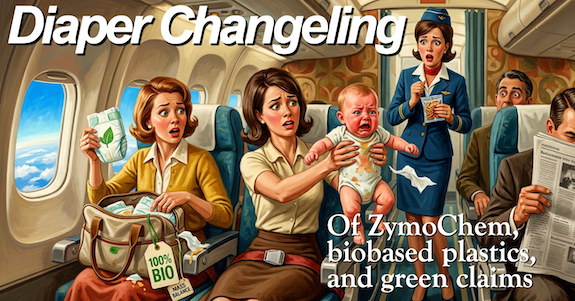
It works a bit like packing a diaper bag for a cross-country flight with your best friend, a planet-loving first-time mom. She has asked you to bring four biobased diapers. You check the label. It promises four. You pack four. And then—somewhere over Denver at 32,000 feet, right as the poop explosion hits—she discovers that the bag contains four diapers, all right, but not one of them contains the biobased polymer she thought she was getting.
Four on the label. Zero in the bag.
That is their counting problem. It is your crisis.
In defense of SAFsanity
Now, let’s give credit where credit is due before we throw the accountants overboard.
In aviation, demanding that every gallon of Sustainable Aviation Fuel be physically trucked, piped, and loaded into the wing of every specific aircraft whose passengers paid a green surcharge would be pure SAFsanity.
The upper atmosphere doesn’t care whether a ton of CO₂ was avoided over Frankfurt or Phoenix. Properly verified book-and-claim systems can connect buyers with eligible emissions reductions from SAF used elsewhere, letting capital flow to producers without requiring each buyer to take physical delivery. For fuels meant to be burned, fungibility is a feature, not a bug.
Even in upstream chemicals, mass balance has an industrial logic. Imagine feeding 10% renewable and 90% fossil raw materials into a giant integrated chemical manufacturing system, accumulating the renewable-content credits from 100 million diapers’ worth of superabsorbent production, and assigning those credits to 10 million premium “Green” diapers shipped to suburban label-readers while 90 million “Standard” diapers go to the Siberian tundra.
The accounting can legitimately document the renewable feedstock introduced into the system, subject to the rules governing the allocation. It can help finance early bio-feedstock integration without constructing duplicate chemical plants and pipelines overnight. Indeed, there’s nothing inherently wrong with that proposition.
Until you put the diaper in the crib to the eggshell test.
Because a diaper is not jet fuel. You don’t burn it at 35,000 feet where atmospheric mixing renders its precise location irrelevant. A diaper must perform against a baby’s skin, and its materials eventually confront a landfill, an incinerator, or perhaps a future composting system.
End-of-life physics is not fungible. You cannot use a mass-balance certificate to make fossil polyacrylate disappear.
The Real Thing, from San Leandro
That is why Tuesday’s major research release from San Leandro-based ZymoChem—coming just eleven days after the company captured the $1 million investment prize at the Startup World Cup Grand Finale in San Francisco—hits such a nerve across industrial biomanufacturing.
Back in May, in “The Diaper Change,” we looked at ZymoChem’s in-home consumer trials for its BAYSE Bio-SAP, and noted how adoption works in high-stakes household infrastructure.
Parents didn’t start with climate ideology. They started with functional trust: zero leaks, overnight dryness, and a product that did what diapers are supposed to do. Once the diaper proved itself, overall appeal rose from 76% to 92%, while purchase interest increased from 60% to 76% when parents learned that its superabsorbent was biobased and biodegradable.
The first obstacle had been performance. A diaper that doesn’t work isn’t improved by its environmental credentials, any more than a broken fire extinguisher is improved by its recycled packaging.
Now comes the second half of the equation: exposing the changeling and proving The Real Thing. And here the science becomes unusually satisfying. There are, in fact, two tests to be passed, and they answer two entirely different questions. Radiocarbon analysis tells us where the carbon came from. Biodegradation testing tells us where the carbon goes. One looks backward, into the history of the molecule. The other looks forward, into its fate. A polymer can pass the first and fail the second. Fossil-derived polymers can sometimes biodegrade, while plant-derived polymers can persist in the environment for decades.
Provenance is not destiny.
ZymoChem has now produced independently measured laboratory evidence addressing both questions, while maintaining the absorption performance that manufacturers and parents require. That is what makes this announcement different.
The eggshell test
In the hygiene aisle, ZymoChem points out, many products sold as “biobased” SAP rely on mass-balance bookkeeping rather than physical measurements of the polymer.
Run an ASTM D6866 radiocarbon test—the isotopic equivalent of boiling water in eggshells, separating recently living plant carbon containing carbon-14 from ancient, radiocarbon-dead fossil carbon—on a superabsorbent marketed as “50% biobased” through mass-balance allocation, and the polymer itself can measure close to 0% renewable carbon.
Chemically, it can remain the same cross-linked fossil-derived polyacrylate. The renewable allocation describes the manufacturing system, not necessarily the particular polymer in your hand.
100% fossil all the way, baby.
By contrast, an ISO/IEC 17025-accredited laboratory tested BAYSE directly and measured at least 98% physical biobased carbon in the polymer. Not allocated on a ledger. Physically present in the material. The distinction matters. A mass-balance certificate can establish the allocation of renewable feedstock. A radiocarbon test measures the carbon actually present. When the question is whether the renewable carbon has made it into the product, the radiocarbon test is the eggshell test: BAYSE passed.
Where the carbon goes
But renewable origin alone doesn’t make a polymer biodegradable.
BAYSE’s next accomplishment is considerably more interesting. Its chemistry is designed to provide the superabsorbency required in hygiene products while permitting microorganisms to break down the polymer when its working life is over. Under ISO 14855-1 controlled industrial composting conditions at 58°C, BAYSE reached 90% biodegradation in 60 days, roughly one-third of the maximum six-month test period. It then reached 100.0% (±3.9%) measured biodegradation in 76 days, based on the conversion of the polymer’s organic carbon to CO₂ by microorganisms.
In those laboratory conditions, the results indicate that no persistent polymer fraction remained to become microplastic pollution. That is an important result, particularly when compared with earlier plant-based hybrids such as starch-graft polyacrylates, where the starch may biodegrade while the synthetic acrylate backbone remains behind.
BAYSE’s accomplishment is not merely that its carbon comes from plants. It’s that the polymer has demonstrated both the performance needed while in use and the ability to biodegrade completely under a recognized controlled-composting test.
There is, of course, an important distinction between a polymer and an entire diaper. BAYSE is the superabsorbent component, not the films, adhesives, elastics, and other materials that make up the finished article. Nor does biodegradation at 58°C establish what happens at the same speed in a landfill, ordinary soil, or the natural environment. A diaper made with BAYSE is not automatically a fully compostable diaper. That will require suitable complementary materials, collection systems, and validated end-of-life pathways.
But the stubborn superabsorbent polymer, one of the principal obstacles to such a future, has now shown that it can disappear under controlled conditions.
That’s no small diaper change.
The regulators check the crib
And timing, in policy as in parenting, is everything.
On September 27, the European Union’s Empowering Consumers for the Green Transition Directive entered into application, strengthening restrictions on misleading environmental claims, vague sustainability assertions, and certain offset-based claims. The legislation does not prohibit mass balance as an accounting method, nor require every biobased claim to be supported by a radiocarbon test. But it raises the importance of explaining precisely what an environmental claim means and having evidence to substantiate it. For a hygiene brand seeking to distinguish physically biobased materials from renewably allocated materials, the difference is becoming commercially consequential.
Meanwhile, geopolitical shocks, including the 2026 disruption of shipping through the Strait of Hormuz, have reminded hygiene brands just how exposed propylene- and acrylic-acid-dependent supply chains can be to petroleum markets. ZymoChem’s renewable-feedstock approach offers an alternative to some of those dependencies, although commercial-scale economics and supply reliability still have to be demonstrated in the marketplace.
With additional financing recently closed, early-adopter hygiene customers committed, and commercial deliveries planned for the second half of 2027, ZymoChem isn’t merely proposing a paper substitute for the cradle. It has independently measured evidence for the origin and end-of-life behavior of a new material, alongside performance results that suggest the hygiene industry can actually use it.
Now comes the challenge of translating that technical achievement into millions of diapers, reliable supply chains, and eventually an end-of-life system that can take advantage of it.
The Real Thing
There will always be a vital place in the bioeconomy for smart accounting.
Where molecules are fungible, infrastructure is shared, and the objective is to finance a transition in the overall system, book-and-claim and mass balance can keep capital moving and prevent SAFsanity from stranding good projects in bad logistics.
But a claim about a system is not necessarily a claim about a product. And a claim about where a material came from is not necessarily a claim about what happens to it when we’re finished. When a product must perform in a nursery, survive the indignities of parenthood, and finally confront its fate in the environment, a spreadsheet can only tell part of the story.
Eventually, the molecule must answer for itself. Sooner or later, someone checks the crib—and what the world wants to find inside is The Real Thing.
Category: Top Stories

