








The Tyranny of Keyholes: Why the Bioeconomy Needs More Keys, Not More Pipelines
The morning after the election, half of Washington is celebrating, the other half is contemplating exile, and a refinery operator on the Gulf Coast is trying to obtain affordable, low-carbon hydrogen.
OPERATOR: I’ve got a farmer in Wisconsin capturing methane from manure. I’ve got a natural gas pipeline running past my refinery. I’ve got a reformer to make hydrogen and a geological formation right under my feet where I can store the carbon.
POLITICIAN: Excellent. So you’re bringing the farmer to Texas?
OPERATOR: No. I’m buying his renewable gas attributes and using the existing pipeline.
POLITICIAN: But how do you know you’re using his methane?
OPERATOR: How does a Tesla driver know which wind turbine supplied their electrons?
POLITICIAN: That’s different. Electricity has a grid.
OPERATOR: So does natural gas.
POLITICIAN: Let me put you through to somebody in Tax Policy.
Welcome to the tyranny of keyholes.
For two decades, the bioeconomy has struggled to squeeze new industrial possibilities through old regulatory openings. Too often, we’ve designed projects as though the feedstock, factory, customer, and carbon solution all had to occupy the same patch of ground—as though geography were an essential ingredient in chemistry.
Electricity escaped that trap long ago. The grid liberated generation from consumption. Renewable Energy Certificates (RECs) made it possible to account for renewable generation separately from the physical journey of individual electrons, even as the industry continues to debate the quality and consequences of different accounting methods.
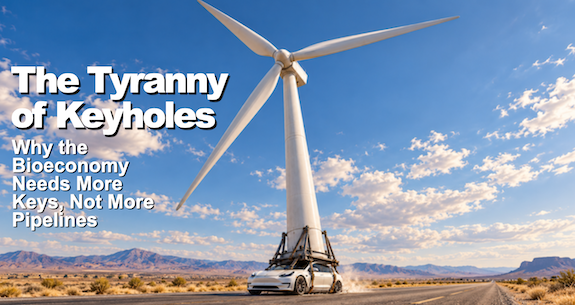
Imagine the electric vehicle revolution if every Tesla needed its own dedicated, extension-cord-connected wind turbine. You’d need a rather large garage. And a very small Tesla. Yet that is effectively the logistical burden we’ve repeatedly imposed on biological carbon: bring everything together, then wonder why the economics don’t work.
The next great advance in industrial decarbonization may not require a new molecule, a new catalyst, or an exotic reactor. It may simply require a better set of keys.
The Cellulosic Crucible: When Geography Fought Chemistry
The bioeconomy should know better, because it has already lived through the consequences of trying to concentrate an entire agricultural supply chain around a single industrial facility.
Following the Energy Independence and Security Act of 2007, with its ambitious 16-billion-gallon cellulosic biofuel target for 2022, capital flowed into technologies designed to turn agricultural residues, wood, and other lignocellulosic materials into transportation fuels. The vision was compelling. America’s farms and forests could supply the raw materials for a new generation of biorefineries. Agricultural waste would become valuable fuel. Rural economies would prosper. But the factories needed enormous quantities of material that was bulky, inconsistent, seasonally available, difficult to transport, and surprisingly reluctant to cooperate with industrial machinery.
Corn stover, wheat straw, and bagasse are wonderful things in a field. They are rather less wonderful when they bridge inside a hopper, jam a conveyor, wear out equipment, or resist the chemistry intended to break them apart.
Pioneer facilities developed by Abengoa, DuPont, POET-DSM, Beta Renewables, Clariant, and others demonstrated both impressive technical achievements and the unforgiving realities of commercial scale-up. Only Iogen and Versalis made it through, only Iogen had multiple licenses operating at scale.
Some failed commercially. Others were idled, repurposed, or struggled to achieve anticipated production levels. The explanations varied: mechanical handling, feedstock quality, conversion yields, operating costs, financing, competition, and unstable policy support. The lesson wasn’t that cellulosic chemistry was impossible, or that every commercial plant failed for the same reason.
A brilliant conversion technology cannot repeal the economics of moving and processing difficult raw materials.
And the physical burden was multiplied by geography. A large facility required a sufficiently concentrated supply of agricultural material within an economically tolerable collection radius. Scale the factory too far, and the feedstock bill could overwhelm the efficiencies of scale.
The central dilemma was merciless: the factory wanted concentration; the biology was distributed. But what if we could do some of the biological work close to the source, convert heterogeneous waste into a standardized energy carrier, and then move that energy through infrastructure already built?
The Great Escape: When Biology Found the Gas Grid
Renewable Natural Gas offered one answer. Anaerobic digestion and landfill gas recovery made it possible to capture methane from biological waste streams. After upgrading, the resulting biomethane could meet pipeline specifications and enter existing natural gas networks.
Suddenly, the product was no longer a bale of straw or a truckload of manure. It was methane. A standardized gaseous commodity, capable of moving through an enormous existing industrial network.
RNG did not eliminate the practical difficulties of digesters, gathering systems, upgrading facilities, or methane leakage. Nor did it make solid biomass processing obsolete. But it demonstrated something important: distributed biological resources could serve customers far beyond the farms and landfills where they originated. Better still, environmental attribute systems made it possible to contract for eligible renewable gas production and assign its verified environmental characteristics to another gas user, subject to the applicable market’s rules. The physical gas could follow the network. The contractual environmental claim could follow a documented chain of custody.
This was the bioeconomy’s equivalent of discovering the electrical grid.
RNG initially found substantial markets in compressed natural gas transportation fleets, where renewable fuel incentives supported its economics. Those markets remain important, but they need not define the outer limits of renewable methane’s industrial usefulness.
The question is what comes next. What if we used the gas network not merely to supply renewable vehicle fuel, but to deliver renewable carbon attributes to the largest existing consumers of industrial hydrogen? What if we stopped moving hydrogen across the country, and started making it exactly where it’s needed?
The Hydrogen Catch-22: The Customer Is Here, the Clean Energy Is Somewhere Else
Industrial hydrogen has a geography problem.
Petroleum refineries need it for hydrotreating and other operations. Ammonia producers need it for fertilizer. Chemical manufacturers need it as an essential feedstock. These established applications account for the overwhelming majority of dedicated hydrogen demand. They aren’t speculative markets waiting for a hydrogen economy to materialize. The problem is supplying them with cleaner hydrogen at an acceptable delivered cost.
Electrolytic hydrogen can be attractive where abundant low-carbon electricity is available at competitive prices. But new production facilities can face expensive power supply requirements, transmission constraints, grid interconnection delays, and capital-intensive equipment.
Conventional natural gas reforming with carbon capture offers another route, but carbon capture carries costs, and upstream methane emissions can materially weaken the lifecycle result.
And hydrogen itself is a notoriously inconvenient traveler. Its low volumetric energy density means transporting substantial quantities of gaseous hydrogen requires compression, specialized equipment, and potentially dedicated pipelines. Liquefaction introduces additional equipment and substantial energy requirements.
The hydrogen may be clean when it leaves the factory. That doesn’t mean it will be cheap when it arrives at the customer’s gate. Meanwhile, CO₂ capture projects can face the opposite problem: a useful industrial facility may be far from suitable geological storage, requiring expensive new CO₂ transportation infrastructure.
We can find ourselves attempting to solve three transportation problems at once: moving the feedstock to the hydrogen factory, moving hydrogen to the customer, and moving carbon dioxide to the storage reservoir.
We’re asking the wrong question. Instead of asking where to build the clean hydrogen factory and how to transport its output, why not start with the customer and ask how to bring the necessary energy and carbon attributes to that location? The natural gas grid makes that question particularly interesting.
Native Separation: Put the Hydrogen Factory Where It Belongs
Consider a refinery or ammonia plant located above, or sufficiently close to, suitable geological storage formations. It already needs hydrogen. It already has industrial infrastructure. It may already have access to natural gas transmission networks. And the technology for converting methane into hydrogen is hardly experimental.
Steam methane reforming (SMR) and autothermal reforming (ATR) are established industrial pathways. In simplified overall form, the chemistry can be represented as:
CH₄ + 2H₂O → CO₂ + 4H₂
In a conventional reforming process, methane and steam are converted through intermediate reactions into hydrogen-rich gas containing carbon dioxide and other constituents. The hydrogen is then purified, often using pressure swing adsorption or other separation equipment.
Crucially, substantial quantities of CO₂ arise in relatively concentrated process streams. Capturing carbon dioxide from these streams can be less energy-intensive than extracting dilute CO₂ from a power-plant smokestack. That doesn’t mean the carbon capture is free. SMR also creates furnace emissions, and high overall capture rates require additional equipment, energy, and capital. ATR configurations can offer advantages when high capture rates are a priority.
But the process gives engineers an attractive starting point: industrial hydrogen production and concentrated carbon separation can be designed together rather than treated as unrelated operations.
Now substitute eligible waste-derived RNG attributes for the conventional fossil natural gas supply, using an approved accounting system. The physical gas is withdrawn from the network at the industrial facility. Hydrogen is manufactured adjacent to its customer. Captured CO₂ is compressed, transported a short distance, and injected into a properly characterized, permitted geological formation.
The biological feedstock does not have to come from the same county, or even the same state. The farmer can remain in Wisconsin, the refinery in Texas, and the carbon can remain underground. Three industrial functions, optimized for the geography that actually matters.
The Three Freedoms of the New Bioeconomy
The economic elegance lies in allowing different parts of the value chain to find their own best locations.
First, produce renewable methane where biological resources are abundant.
Dairy farms, swine operations, landfills, and other suitable waste sources have different economics, methane-capture opportunities, and environmental baselines. Those differences matter. The best place to produce RNG is not necessarily the best place to consume industrial hydrogen.
Second, make hydrogen where demand already exists.
An existing industrial customer can potentially absorb substantial hydrogen volumes without requiring a distant distribution network, dedicated high-pressure trailers, or speculative new end-use infrastructure. A short pipe across the fence is generally preferable to a hydrogen highway across three states.
Third, store carbon where geology makes storage practical.
Not every refinery sits above an appropriate reservoir. Geological capacity, injectivity, containment, pore-space rights, monitoring, and Class VI permitting remain essential. But where suitable formations are available, co-locating hydrogen production and sequestration can eliminate a major transportation obstacle.
The architecture doesn’t abolish geography. It allows us to stop treating every geographical connection as equally necessary.
Let the gas move through existing infrastructure. Let the environmental attributes move through verified accounting. Let hydrogen and captured CO₂ travel the shortest practical distances.
This is the crucial distinction between physical integration and economic integration. We don’t need every participant in the value chain to be neighbors. We need the value chain to be connected, verifiable, and commercially viable.
The Mathematics of Negative Carbon
Renewable methane also introduces an intriguing possibility: hydrogen whose modeled lifecycle carbon intensity falls below zero. Certain manure-based RNG pathways can earn deeply negative lifecycle carbon intensity values under applicable accounting methodologies. That result arises largely from the modeled avoidance of methane emissions that would otherwise occur under the specified waste-management baseline.
Methane is a potent greenhouse gas, so capturing it before release can generate substantial calculated climate benefits. But here’s where careful accounting matters. The negative carbon intensity associated with an RNG feedstock is not automatically the carbon intensity of the hydrogen subsequently produced from it.
A credible hydrogen lifecycle assessment must include feedstock production, the counterfactual fate of the methane, upgrading, leakage, transportation, reforming energy, carbon capture efficiency, storage performance, and the treatment of environmental attributes.
Nor are avoided methane emissions identical to permanent atmospheric carbon removal.
Avoiding a methane release prevents a modeled source of warming. Permanently storing eligible biogenic CO₂ can constitute carbon removal under an appropriate accounting framework. Both may contribute to the climate performance of the system, but they represent distinct environmental effects.
What matters is that they are properly measured, attributed, and counted only once. Under favorable, verified conditions, their combination creates the possibility of exceptionally low—and potentially substantially negative—lifecycle hydrogen emissions. Not every RNG source will achieve that result. Not every storage project will qualify. And no amount of attractive accounting can excuse uncontrolled methane leakage.
But the opportunity is significant. Instead of simply reducing the emissions associated with making hydrogen, we may be able to pair industrial hydrogen production with methane-emission avoidance and permanent biogenic carbon storage. The same hydrogen molecule. A potentially very different climate outcome.
The Key We Need: From Accounting Permission to Bankable Reality
Why isn’t this scaling overnight? Because recognizing an elegant solution in principle is not the same as making it work in practice. The Treasury Department’s January 2025 final Section 45V rules already acknowledged that renewable natural gas can support clean hydrogen production and established a framework for qualifying gas book-and-claim systems.
That was an important recognition.
Washington did not declare that a refinery must personally meet the cow whose methane it is purchasing. But recognition came with conditions. Eligible systems must demonstrate appropriate registration, attribute tracking, ownership, retirement, lifecycle accounting, and safeguards against double counting.
Under the rules, qualifying RNG book-and-claim systems may be used beginning in 2027, but only after the Treasury Secretary determines that a system satisfies the relevant requirements. These safeguards are not bureaucratic ornaments. They are what make the keys trustworthy. The question is whether the resulting system will be practical enough, consistent enough, and timely enough to support actual investment decisions.
And the clock is running.
Legislation enacted in 2025 shortened the Section 45V construction-start deadline. Under current law, qualifying clean hydrogen facilities must begin construction before January 1, 2028. That makes 2027 an especially consequential year: the anticipated opening of the qualifying gas attribute framework coincides with the approach of the federal credit’s construction deadline.
For developers, uncertainty over qualification can be just as consequential as uncertainty over chemistry. A lender cannot finance an attractive theoretical carbon intensity score. It needs confidence that environmental attributes can be acquired, verified, retired, and recognized under the rules applicable to the project.
Nor does access to an attribute automatically create entitlement to every available incentive. Federal credits, state low-carbon fuel programs, and carbon sequestration incentives have different eligibility requirements and restrictions. Industrial hydrogen is not automatically eligible for transportation-fuel credits, and environmental benefits cannot simply be sold or claimed repeatedly.
The key must fit the lock.
The other critical constraint is geology. The United States has made progress in delegating Class VI carbon storage permitting authority to qualified states, including Texas, which obtained primacy in December 2025. That can improve coordination and regulatory administration. It does not eliminate the need to demonstrate safe storage, obtain permits, and meet rigorous monitoring requirements. The attractive project is therefore not a fantasy in which everything becomes easy. It is a configuration in which unnecessary sources of friction are removed so that developers can focus on the difficult tasks that actually matter.
More Keys, Fewer Keyholes
The election is over. The politicians will return to Washington to celebrate, negotiate, legislate, and discover that the voters have once again presented them with a collection of mutually incompatible instructions.
Industrial chemistry will take no notice.
Hydrogen will still be needed at refineries, fertilizer plants, and chemical facilities. Methane will still arise from biological waste. The natural gas network will still connect distant parts of the American economy. And suitable geological formations will still offer opportunities to isolate captured carbon, subject to rigorous assessment and permitting. We do not need to solve every infrastructure problem with another infrastructure megaproject. Sometimes the most important innovation is the connection we no longer need to build.
For bioenergy, that means abandoning the assumption that everything valuable must happen in one place.
For regulators, it means recognizing that a trustworthy environmental accounting system can connect activities across geographical distances without pretending that physical molecules carry individual passports. For industry, it means designing projects around the locations where economic and environmental value can actually be created.
There will be hard questions. There should be hard questions. Methane leakage matters. Counterfactual emissions matter. Attribute ownership matters. Carbon storage integrity matters. But hard questions are reasons to build rigorous measurement systems, not reasons to insist that every farm, factory, and customer share the same zip code.
The electrical industry has spent more than a century creating the network that allows power to be produced in one place and consumed somewhere else. The bioeconomy has a remarkable opportunity to use an existing gas network to accomplish something similar. And hydrogen is only the beginning. The larger opportunity is to liberate distributed biological resources from the geographical constraints that have so often undermined their commercial promise.
The bioeconomy doesn’t need another keyhole. It needs reliable keys—and permission to turn them.
Category: Top Stories

