








Heard on the Floor at ABLC Next: The Bleach Makers, the Plastic Breakers, the Biomass Wranglers, and Other Signs That the Bioeconomy Has Gone Completely Practical
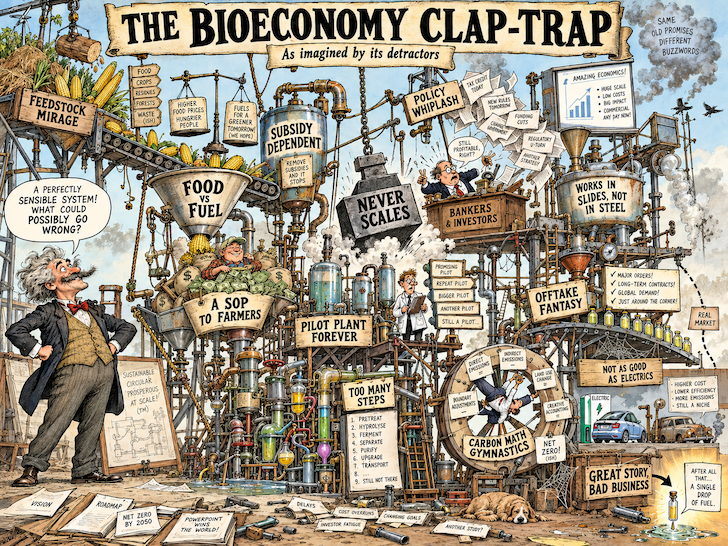
Act I — The Magnificent Bioeconomy Clap-Trap
If you could gather the bioeconomy’s most devoted critics, professional skeptics, and occasional internet trolls in a room and ask them to draw a picture of the industry, the result might look suspiciously like a Rube Goldberg machine. And what a magnificent contraption they would draw!
Food versus fuel! Subsidies forever! A sop to farmers! Carbon calculations requiring an advanced degree in creative accounting! Technologies that never scale! Pilot plants that breed other pilot plants! And somewhere, inevitably, an electric vehicle waiting to demonstrate that the entire enterprise was unnecessary in the first place. Rube Goldberg himself might have been overwhelmed by the ingenuity of it all.
Every criticism lovingly connected to the next by pulleys, pipes, policy levers, and increasingly improbable financial assumptions. Insert corn at one end, billions in subsidies at the other, and eventually a tiny drop of renewable fuel might emerge—provided nobody pulled the wrong lever. It is a splendid picture of the bioeconomy.
*At least, the bioeconomy as its detractors prefer to imagine it.
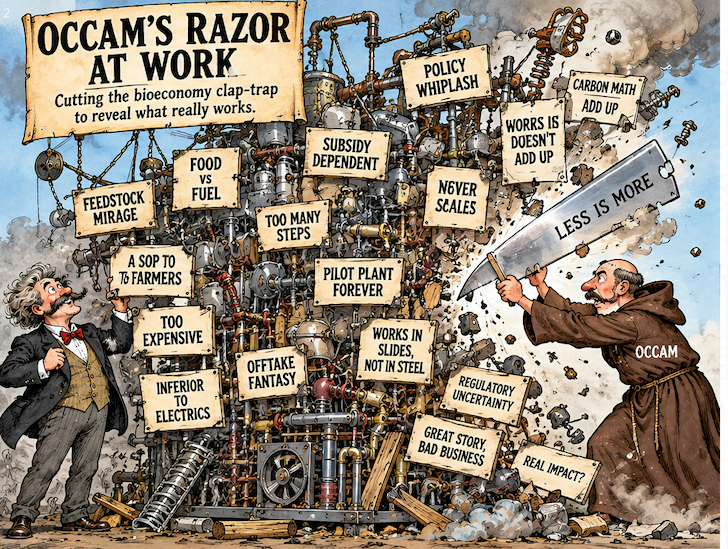
Act II — Enter William of Ockham
Then, at ABLC Next in San Francisco, William of Ockham appeared to have entered the building. The medieval philosopher brought his celebrated razor, and the industry’s innovators seemed eager to borrow it. Sixty-eight chemical processing steps? ReSource Chemical proposed twenty. Can’t feed irregular biomass into a pressurized reactor? Jenike & Johanson attacked the feeder. Can’t afford to build a recycling plant and then go looking for customers? Rhea’s Factory proposed building inside a customer’s facility. Can’t make the original truck-fuel market work? Oberon Fuels found another market in aerosol propellants.
And so it went.
Not every complication was imaginary. Not every proposed solution is yet proven at commercial scale. But the engineers were no longer merely explaining why the machinery was complicated. They were taking it apart.
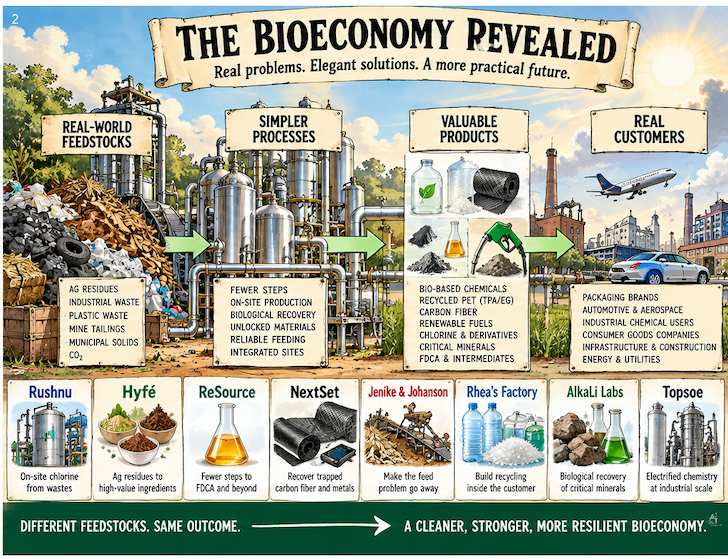
Act III — The Beautiful Machine
And what emerged from beneath the clap-trap?
Rushnu was making a case for producing essential chemicals from waste, closer to the point of consumption. Hyfé was turning variable agricultural residues into consistent, valuable ingredients. NextSet Materials was developing ways to recover valuable carbon fiber and metals trapped in difficult-to-recycle composites. Topsoe was replacing the fired section of a reformer with electricity. Aemetis was finding new value in energy efficiency, renewable gas, and carbon management.
The common denominator was not some miraculous new feedstock, a single favored molecule, or the latest government incentive. It was the removal of unnecessary difficulty. Fewer steps. Better machinery. Existing infrastructure. Real customers. More value from the same resources.
Of course, Occam’s razor does not guarantee commercial success. Neither do beautiful process diagrams. There are still permits to secure, facilities to build, customers to qualify, and lenders to persuade.
But a striking change was visible at ABLC Next. The dreamers had not abandoned their dreams. They had begun making them practical.
Category: Top Stories

