








The Hound of the Sopertonvilles
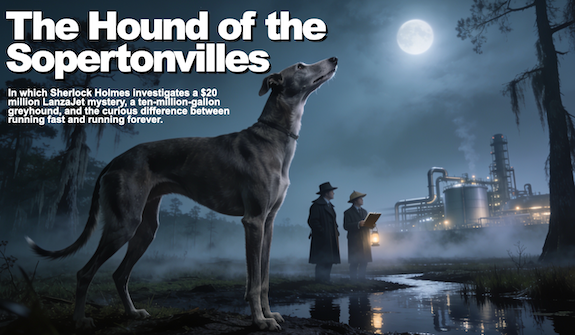
In which Sherlock Holmes investigates a $20 million mystery, a ten-million-gallon greyhound, and the curious difference between running fast and running forever.
It’s a foggy night in the Upper Coastal Plain near Soperton, Georgia, the air hangs low over forested wetlands, dark-water creeks and river swamps. Tiger Creek and Cypress Creek wander through the country in boggy, waterlogged patterns, beneath bald cypress and tupelo gum. The ground gives underfoot. The trees seem to lean in. And somewhere in the distance, from beyond the black water and the pine edge, a hound is baying.
“Do you hear it, Holmes?”
“I do, Watson.”
“It has rather the sound of the Baskervilles about it.”
Holmes, who had been examining a sheaf of industrial press releases by lantern light, did not immediately look up.
“Then let us hope,” he said at last, “that the creature is less supernatural than financial.”
For this is not, in fact, the moor. It is Georgia. And the hound in question is not a hell-beast but a greyhound—an exceedingly fast and expensive one—known in certain circles as Freedom Pines Fuels.
The pedigree is first-rate. The backers are numerous and eminent. The ambition is immense. The task: to convert ethanol into sustainable aviation fuel at commercial scale and thereby help prove that the world may one day fly on something other than fossil kerosene and used cooking oil.
But as in all good mysteries, the most interesting fact is not what has happened. It is what has not yet quite happened.
Freedom Pines, LanzaJet’s alcohol-to-jet facility in Soperton, has already shown that it can run. It has produced fuel that meets specification. It has demonstrated that the chemistry works. What it has not yet publicly demonstrated is that it can keep running—long enough, steadily enough, efficiently enough—to settle into the ordinary routines of commercial life.
And now comes the twist worthy of Baker Street: rather than backing away from the uncertainty, the owners have leaned in. New capital is arriving. Vinod Khosla is stepping in as an investor. LanzaTech is increasing its ownership. Jennifer Holmgren, a veteran of first-of-a-kind industrial struggles and no stranger to stubborn technologies, is taking a more direct hand in the effort.
To a casual observer, this is merely another clean-tech financing round. To Holmes, it is the curious incident of the committed owner.
“Watson,” he said, finally laying down the papers, “the notable thing is not that a plant should require more money. Plants of this sort are often immoderate in their appetites. The notable thing is that the people nearest to the animal have decided it is worth feeding.”
“And what do they believe?” asked Watson.
“That,” said Holmes, “is the question.”
There are, broadly speaking, three races in the life of a first-of-a-kind industrial plant.
The first is the sprint of invention. Can the chemistry work at meaningful scale? Can the equipment be made to perform? Can the product come out the other end in a form the customer can actually use? That race is often dramatic, expensive and uncertain, but it at least offers a clear finish line. The fuel is either on-spec or it is not.
The second race is the harder one: continuous operation. Can the plant keep going? Can it run not merely in campaigns, trials or bursts of promise, but day after day, week after week, through maintenance cycles, feedstock variations, startup annoyances, shutdown annoyances, weather, wear, operator learning curves, and the hundred small insults by which industry tests every claim ever made for it? Can it behave not like a heroic demonstration, but like a factory?
The third race is commerce itself. Can the thing make money? Not merely gallons, not merely headlines, not merely hope, but a viable business capable of surviving without an endless appeal to virtue or subsidies or investor patience.
Clean technology, and especially sustainable aviation fuel, has never lacked for sprinters. The sector is full of dramatic dashes: first flights, first gallons, first ribbon cuttings, first celebrity endorsements, first photographs of smiling executives in hard hats. What it has lacked, time and again, are creatures built for the longer life that follows.
Which is why the greyhound metaphor turns out to be more apt than it first appears.
A racing greyhound already knows how to run. No one has to teach it speed. What comes later is another matter. A retired greyhound entering family life must make a different transition. It must exchange the thrilling burst for the durable routine. It must discover how to live not for seconds, but for years.
This, one suspects, is where Freedom Pines now finds itself.
The plant has shown the burst. The question is whether it can settle into the sofa.
One should be careful here. Outsiders do not possess the operating data to convict or acquit. The public does not know the exact throughput, utilization rate, production cost, or length of successful continuous campaigns. It is entirely possible that the remaining gap is narrower than skeptics assume—or wider than optimists admit. But the nature of the mystery has become clearer. The unresolved issue is no longer whether alcohol-to-jet fuel can be made. It can. The unresolved issue is whether this particular commercial facility can make it continuously enough, and economically enough, to justify the confidence of those now doubling down.
Here the identity of the believers matters.
Vinod Khosla has not made a career of financing technologies he regards as permanently dependent on sentiment. Jennifer Holmgren and the LanzaTech circle have not made a habit of walking away from difficult industrial problems merely because the road turns ugly. If they are increasing ownership, contributing capital and reasserting control, it is because they believe not merely in the abstract beauty of sustainable aviation fuel, but in the practical possibility that this plant—and the broader alcohol-to-jet platform—can be made to behave like a business.
That does not make them right. It does, however, make the story more interesting.
For what they are really saying is this: the animal is not finished. It has more in it. The first race was not the only race.
That matters well beyond one facility in Georgia. For nearly two decades, sustainable aviation fuel has lived with a stubborn imbalance. HEFA, built largely on fats, oils and greases, has been the only commercial route of real consequence. Useful, yes. Important, yes. Sufficient, no. If aviation is serious about decarbonizing at global scale, it will need more than one path and more than one feedstock pool. Alcohol-to-jet matters because it widens the field. It opens the possibility of producing fuel from abundant ethanol sources and, eventually, from wastes, residues and industrial carbon routed through ethanol intermediates. It is not merely another plant. It is a claim about what the future menu of aviation fuel could look like.
Which brings us back to the hound in the swamp.
Holmes rose, crossed to the window, and listened again to the faraway cry.
“What do you make of it?” Watson asked.
“It is a splendid sound,” Holmes replied. “Strong lungs. Fine breeding. Plenty of spirit.”
“But can it win?”
“My dear Watson, you persist in asking the wrong question.”
“And what is the right one?”
Holmes turned.
“Not whether it can run. We know that. The question is whether it can live.”
It is a magnificent distinction, and one the advanced bioeconomy would do well to remember. The world has seen enough sprinting. Enough one-off triumphs, enough peak moments, enough heroic narratives ending just before the dull but essential business of repetition begins. The real industrial test is not the glorious burst. It is ordinary reliability.
That phrase sounds unimpressive until one remembers how few first-of-a-kind plants ever truly earn it.
Ordinary reliability means that the extraordinary has become routine. That the operators know what to expect. That the feedstock arrives. That the equipment behaves. That the process recovers from its bad days. That customers can make plans around your existence. That investors cease speaking in the future tense. That the facility becomes not a science project, nor a symbol, nor a brave experiment, but a thing with habits.
That is the long-haul life awaiting every successful sprinter.
So perhaps the story at LanzaJet is not best told as a rescue at all. A rescue implies a broken creature dragged from the track. This seems, rather, to be a transition story: a champion sprinter being prepared for family life.
The investors are not asking Freedom Pines to run faster. They are asking it to stay.
And that may be the most demanding race in the whole clean-fuels saga.
“Then the case remains unsolved?” said Watson.
“On the contrary,” said Holmes, reaching for his hat. “We know precisely what evidence is still required.”
“And what is that?”
Holmes opened the door to the fog.
“Let the hound run,” he said. “Then let us see if it comes home every night.”
From the Casebook: The Baker Street Irregulars Intervene
In which Dr. Watson’s literary masterpiece is assaulted by three urchins, a chemical flowsheet, and an alarming quantity of ethanol.
221B Baker Street, London.
Dr. Watson had just finished reading aloud The Hound of the Sopertonvilles, his latest literary triumph. Holmes sat by the fire, fingertips together, regarding his companion with the expression of a man who had just been subjected to an unusually long sermon.
“Well?” demanded Watson.
“Atmospheric, Watson. Positively atmospheric. The fog, the black-water creeks, the cypress trees. You have given Georgia all the terrors of Dartmoor.”
“Thank you, Holmes.”
“Unfortunately, you have omitted most of the evidence.”
Watson bristled.
“Evidence? My dear Holmes, I have given you a magnificent mystery!”
“Precisely. And now perhaps we might investigate it.”
There came a tremendous clatter upon the stairs, followed by the unmistakable sound of Mrs. Hudson threatening to summon the constabulary.
“Ah,” said Holmes. “The Irregulars.”
The door flew open. Wiggins entered, followed by two disreputable-looking boys, one clutching a rolled-up chemical diagram and the other carrying a silver hip flask.
“Evenin’, guv’nor,” said Wiggins. “We’ve brought the goods.”
“And your associates?”
“Cartwright, sir. He’s our scientific bloke. And this here’s Simpson. Financial investigations.”
“Financial investigations?” said Watson.
“Mostly looking for loose change,” said Wiggins.
Simpson took a discreet pull from his flask.
“What’s in that?” demanded Watson.
“Ethanol, guv.”
“Ethanol?”
“For me, Dad, Chief!”
“Simpson!” snapped Cartwright. “That’s industrial feedstock! You don’t know what impurities are in it!”
Simpson examined the flask with sudden concern.
“Blimey. Could’ve mentioned that before I nicked it.”
Holmes extended his hand.
“The flask, Simpson. We shall examine its contents later.”
“Waste not, want not, sir.”
“Quite. Though preferably without poisoning the investigators.”
Exhibit One: The Anatomy of the Hound
Cartwright unrolled his drawing across Watson’s manuscript.
“Oi! Mind the prose!” cried Watson.
“Right, guv. Here’s how the animal works. Start with ethanol. Dehydrate it into ethylene. Oligomerize the little molecules into longer chains. Hydrogenate them. Fractionate the lot. Bob’s your uncle—aviation fuel and renewable diesel.”
“Bob is most certainly not my uncle,” said Watson.
“Figure of speech, sir.”
“An important one,” said Holmes. “Continue.”
“Here’s the clever bit,” Cartwright said. “The ethanol can come from corn, sugarcane, or suitable waste-derived sources. LanzaTech can even make ethanol from industrial waste gases. So the animal’s not tied to one particular dinner.”
“Unlike HEFA,” added Wiggins, “which leans heavily on fats, oils and greases.”
“That’s right. More sorts of grub for the hound.”
“And the resulting fuel?” Holmes asked.
“Approved synthetic blending component, sir. ASTM D7566. Up to fifty percent in the finished jet fuel blend.”
Watson buried his face in his hands.
“An entire paragraph of beautiful prose, and you have replaced it with a specification number.”
“Got to have the right papers if you’re flying, Doc,” said Simpson.
Exhibit Two: The Three Races
Wiggins produced three battered racing tickets.
“Right, guv’nor. Three races. First one’s the sprint. Can the hound make proper jet fuel? It did, in 2025. On specification.”
“Splendid,” said Watson.
“Second one’s the long haul. Can it keep making fuel, day in and day out, without the whole works stopping for a cuppa?”
“And can it?” asked Holmes.
Wiggins shrugged.
“That’s the rub, guv. We ain’t got the public numbers. No proper sustained throughput figures, no uptime record, no utilization.”
“Then we must not claim to know,” said Holmes.
“Third race,” continued Wiggins. “Can it earn its keep? Sell the fuel, cover the costs, pay its bills?”
“Every family must balance its accounts,” said Watson.
“Especially with a greyhound eating ten million gallons a year,” said Simpson.
“Producing,” corrected Cartwright.
“Same difference when you’re paying for it.”
“Not remotely,” said Holmes.
Exhibit Three: The Twenty-Million-Dollar Kennel
Simpson stepped forward, suddenly looking rather more businesslike.
“Now here’s where it gets tasty. At least twenty million dollars coming in. LanzaTech upping its stake, Vinod Khosla joining the investment, board members pitching in.”
“And the management?” Holmes asked.
“Jennifer Holmgren, sir. Taking the interim chief executive job and staying chair of the board.”
“Quite a collection of believers,” observed Watson.
“There’s more names than you can shake a stick at,” Simpson continued. “Airbus, airlines, Shell, Mitsui, Microsoft, Breakthrough Energy, government support and the rest.”
“Are they all contributing to this particular financing?” Holmes asked.
“Nah, guv. Some are earlier backers or supporters.”
“Then keep them separate,” Holmes instructed. “A man’s presence at the racetrack does not establish that he purchased a ticket in the latest race.”
Watson nodded approvingly.
“At last. A distinction worthy of literature.”
Exhibit Four: The Missing Evidence
“Now,” said Holmes, “what remains to be discovered?”
“Monthly production!” cried Wiggins.
“Continuous operating hours!” shouted Cartwright.
“Capacity utilization!”
“Unit production costs!”
“Cash flow!”
“Enough!” cried Watson. “You have mugged my beautiful manuscript in broad daylight!”
“Evening, actually,” said Simpson.
“And filled its pockets with numbers!”
“Not enough numbers, Doc,” said Wiggins. “That’s the whole trouble.”
Holmes smiled.
“An admirable summary.”
Watson stood, deeply affronted.
“Have none of you the slightest appreciation for atmosphere? Suspense? Character? The great literary tradition?”
“Love a good yarn, Doc,” said Simpson. “But you can’t run a refinery on atmosphere.”
“Particularly,” observed Cartwright, “if the atmosphere contains excessive moisture.”
Watson made a strangled noise.
Holmes raised his hand.
“Gentlemen, a compromise. Watson’s narrative shall remain untouched. The chemistry, the operating tests and the financial evidence shall enter the Casebook.”
“And what of the missing figures?” asked Wiggins.
“We shall identify them as missing. An investigator must distinguish an unanswered question from an unfavorable answer.”
Watson sank gratefully into his chair.
“Then my prose is spared?”
“For the present,” said Holmes.
“And the hound?”
Holmes looked toward the window.
“The hound has demonstrated that it can sprint. Its owners have decided to prepare it for a longer life. Whether it can settle into the daily routine remains the question.”
Simpson retrieved his flask from the mantelpiece.
“Speaking of settling in, guv, any chance of a spot of proper brandy?”
“Mrs. Hudson!” called Holmes. “Some tea for the gentlemen.”
“Tea?” said Simpson.
“Without ethanol,” added Cartwright.
“Cor blimey,” said Simpson. “This detective business ain’t half thirsty.”
The Irregulars departed, leaving a mass of papers, three muddy footprints and a deeply offended Dr. Watson.
Holmes returned to his chair.
“An excellent investigation,” he remarked.
Watson glared.
“My dear Holmes, next time I shall write about a perfectly ordinary murder.”
“An excellent idea, Watson. Far fewer production metrics.”
And somewhere beyond the dark waters of Tiger Creek, the hound bayed once more.
Category: Top Stories

